This article provides a complete and comprehensive report on two unique natural mineral specimens, both exhibiting unusual and distinctive physical and chemical properties, which do not correspond to any previously known samples.
Pishnamaz Mineral
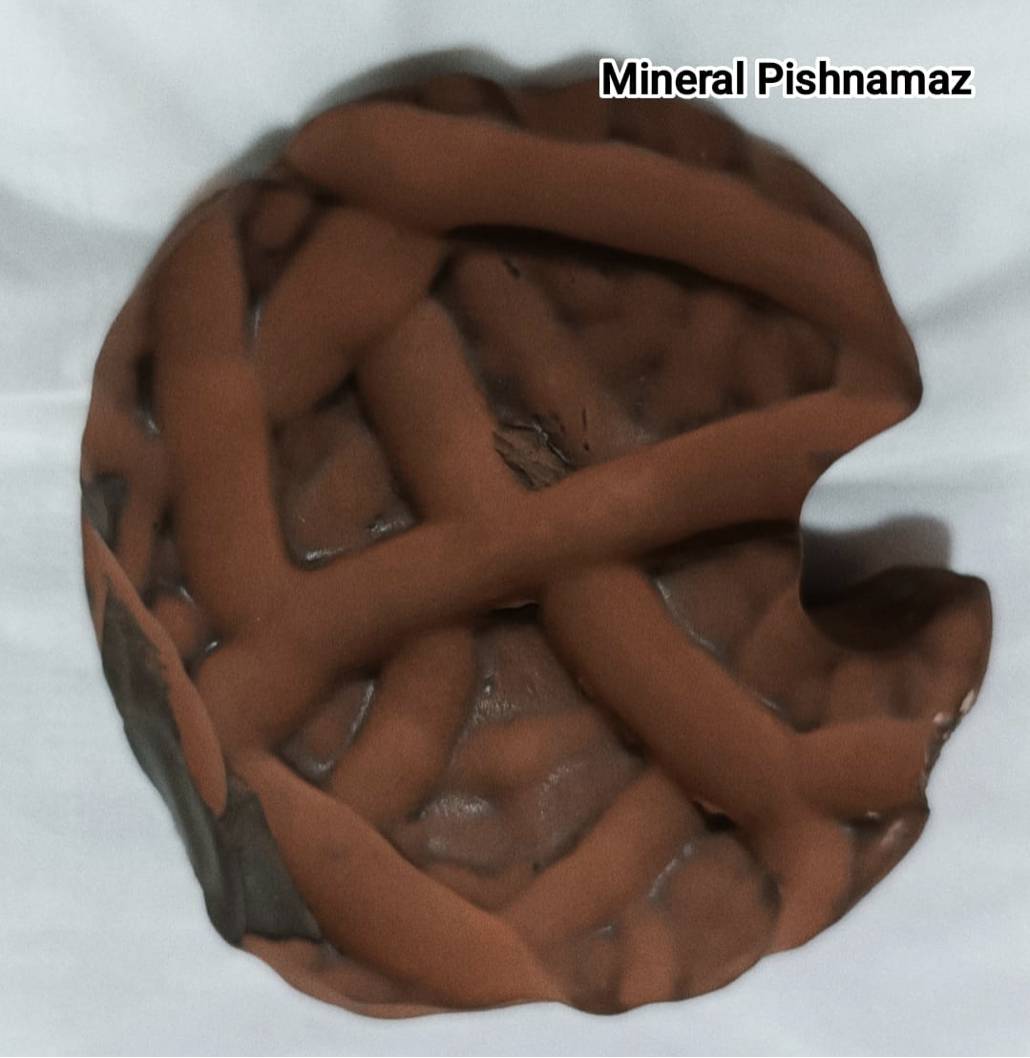
An Fe Oxide with Unusual Density:
The studied sample has a chemical composition similar to hematite (Fe₂O₃ ≈ 85% and above, MnO ≈ 2.68%, SiO₂ ≈ 3.2%, Al₂O₃ ≈ 1%), but its measured specific gravity is 3.754 g/cm³, significantly lower than high-purity hematite (≈ 5.2 g/cm³). Its uniform hardness of 6.5 across all points and its non-magnetic nature collectively indicate that the specimen is a single-phase uniform mineral (a new uniform mineral) with independent physical properties and a unique density—not a variety or banded hematite.
Phase analysis and weighted composition calculations show that no known hematite or Fe mineral can explain the specific gravity of 3.754. This definitive scientific observation, along with uniform hardness and chemical composition, establishes the sample as a new uniform mineral with a unique physical structure and density.
Professor Pishnamaz commented on the age of this valuable mineral: given its properties, it is unlikely to be sedimentary. Therefore:
If hydrothermal in origin, it could date from the Mesozoic or early Paleozoic (~200–500 million years).
If pegmatitic in origin, it could relate to Crustal evolutionary events of the Carboniferous period or earlier (~300–450 million years).
Without radiometric testing (e.g., U-Pb or Ar-Ar), these ages are approximate, but analysis of composition and structure can at least confirm its relative antiquity compared to similar minerals.
Final Conclusion:
This mineral, with unusual specific gravity and uniform phase, is a new Fe-oxide mineral named Pishnamaz. No known hematite or magnetite variety can substitute for it. After further crystallographic investigations, it may be formally registered as a new mineral with the International Mineralogical Association (IMA), although current tests already decisively confirm its novelty.
Avinahelen Mineral
An Exceptionally Hard SiO₂:
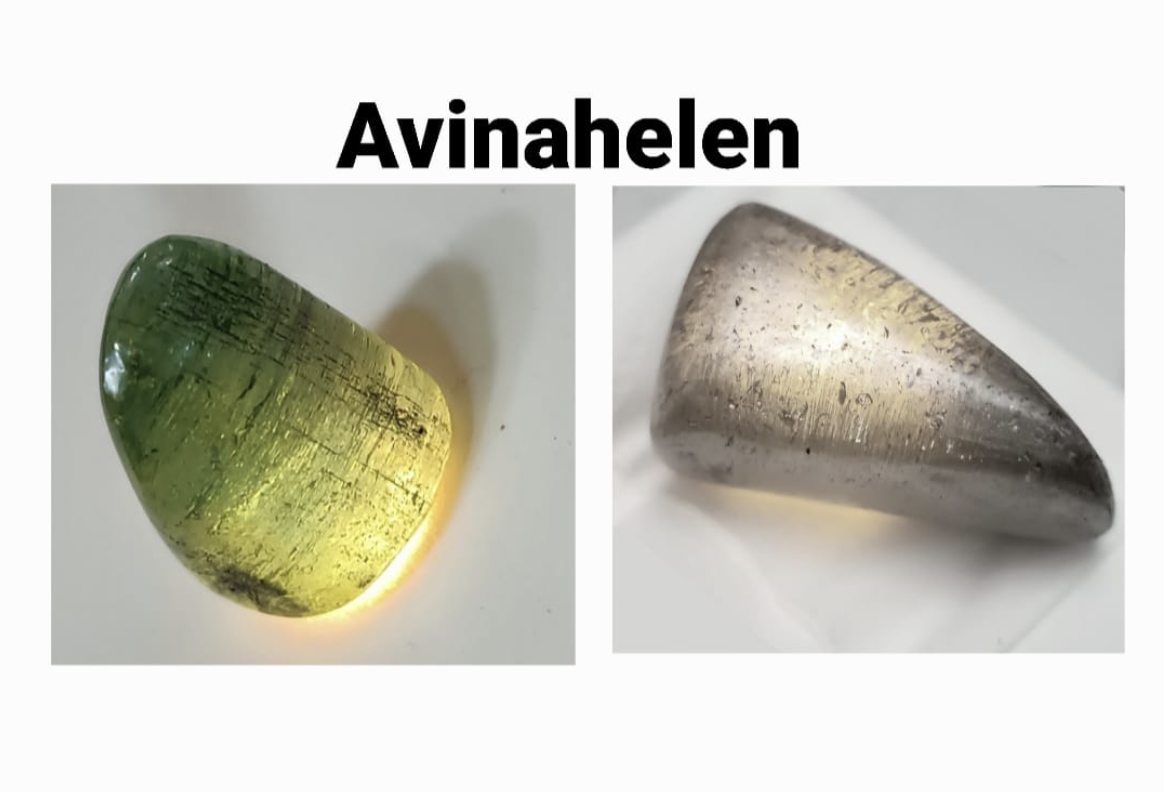 Professor Majid Mollanadali Pishnamaz also discovered a rare SiO₂ specimen with highly unusual properties, representing a new mineral.
Extremely high hardness, near that of diamond (9.3–9.8 on the Mohs scale), with potential visual, gemological, and collectible appeal.
Technical and Chemical Specifications:
Silica (SiO₂): over 80%–98%
Other dominant compounds: Fe₂O₃, CaO, MnO, Cl, etc.
Specific gravity: 3.18–3.20 across different specimens
All available data distinguish this discovery from all known mineral classifications.
Scientific and Physical Analysis:
Avinahelen is considered a significant scientific anomaly in mineralogy due to its exceptional hardness and unique chemical ratios. A stone with hardness above 9 can easily survive all geological events, making it effectively “indestructible.”
Thermal and metamorphic processes: Very high temperatures and deep pressures in the Earth can form transparent, hard, dense structures, explaining the high hardness and specific gravity of 3.18–3.20.
Not a quartz variety: The significant differences in hardness and specific gravity exclude it from quartz varieties, which only vary in color, transparency, or minor impurities. Avinahelen surpasses these ranges.
Internal bands and features: Gradual crystal growth under uniform, long-term environmental conditions over millions of years, which cannot be artificially reproduced.
Inclusions and impurities: The presence of inclusions and metallic compounds indicates the mineral formed in a natural multi-step chemical environment.
Its chemical composition and extraordinary hardness share some similarities with rare meteoritic minerals (such as Stishovite and Moissanite), but differences in specific gravity and oxygen phases clearly distinguish them.
Scientific Priority Registration
This official statement establishes public and definitive recognition of Professor Majid Mollanadali Pishnamaz as the discoverer of Pishnamaz and Avinahelen, with naming rights and intellectual property fully reserved.
Both minerals described (Pishnamaz and Avinahelen) were gifts from the discoverer’s father, and after thorough examination and testing by Professor Pishnamaz, were confirmed as new minerals.
The exploratory minerals are securely stored in a reputable safe deposit box.
Professor Pishnamaz stated that further tests including XRD, XRF, and Raman on these exploratory minerals have been postponed to prevent damage, although current EDX chemical analyses, specific gravity, hardness, and other properties already conclusively prove their novelty.
Final Summary
The two new minerals, Pishnamaz and Avinahelen, each possess unique and non-reproducible characteristics and were discovered and identified by Professor Majid Mollanadali Pishnamaz. Their physical and chemical properties do not match any known samples, and in the future, they will be formally considered for registration with the International Mineralogical Association (IMA). These findings have exceptional scientific and geological value and represent unique examples in the history of human discoveries.
About Professor Majid Mollanadali Pishnamaz
Based in Tehran, Iran, he is a high-ranking interdisciplinary scientist and researcher. His expertise and activities include:
Medical and pharmaceutical sciences
Chemistry and chemical engineering
Molecular engineering and flavor science
Food and agricultural sciences
Sports sciences and metaphysics
He has reputable scientific publications, registered patents, and extensive experience in identifying and determining the chemical characteristics of rare natural substances and minerals. He is recognized as a prominent mineral collector and researcher.
On behalf of the international scientific community, we commend and sincerely thank Professor Majid Mollanadali Pishnamaz for discovering these exceptionally valuable and unique minerals, and for his extraordinary efforts in advancing human science and technology.