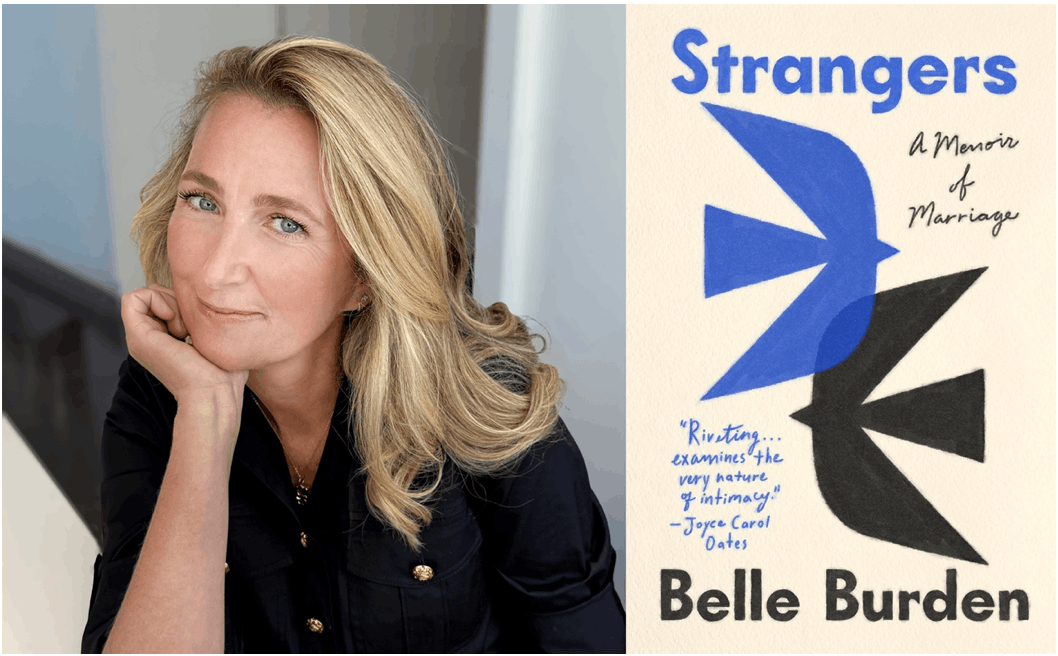
For most of her adult life, Belle Burden’s professional work was the opposite of self-disclosure. As a pro bono immigration attorney focused on juvenile cases, she spent years standing between young clients, many of them children, and the consequences of things they had not chosen. Her job was to shape their stories into forms a court could hear: clear, factual, human, persuasive. She did not tell her own.
That changed with a single piece she published in June 2023, in the New York Times Modern Love column: “Was I Married to a Stranger?” In it, Burden described what happened two weeks into the pandemic lockdown of 2020: her husband, a hedge fund manager, had told her the marriage was over. He had been having an affair. He left, and the person who left, she wrote, was not someone she recognized. The essay drew immediate and widespread response, not because Burden’s specific circumstances were common, but because the underlying experience was: the discovery that you can live beside someone for two decades and know them less than you assumed. The response told her she had a book.
From Essay to Bestseller
Strangers: A Memoir of Marriage, published by The Dial Press in January 2026, expanded that essay into a narrative structured in five acts. It debuted at #1 on the New York Times bestseller list, earned a Times Editors’ Choice designation, and reached number four on Amazon’s Best Books of 2026 So Far. By spring, it was in its ninth printing. Those numbers describe an unusual commercial event; what they do not capture is the quality of its reception.
Belle Burden, a New York City native who attended Phillips Exeter Academy, studied at Harvard College, and earned her law degree at New York University School of Law, came to the material with a legal mind’s instinct for fact and chronology. Kirkus Reviews praised the memoir as “a measured, empathetic, and modern response to an enraging callousness,” noting that Burden “remains charitable and gracious even when she does not have to be.” The Washington Post reviewer, who admitted to initially doubting her own ability to connect with a Harvard-educated Vanderbilt descendant writing about divorce, said she “tore through it feverishly” and has been thinking about it ever since. Town & Country credited Burden with the difficult feat of writing her way back to steadiness.
What reviewers kept returning to was precision without coldness. Strangers is not a screed. It does not perform anger or collapse into self-pity. It does something more demanding: it maintains clarity about what happened and charity toward the people involved, including the one who caused the harm. That is a harder quality to sustain across three hundred pages than it sounds, and it is what has given the book a shelf life beyond the usual cycle of memoir publicity.
The Conversation That Followed
The book’s second life unfolded in a different register from its literary reception. As her marriage ended, Burden found herself realizing she had drifted from the details of her own household finances, a disclosure that struck a nerve well beyond readers who had been through divorce. Bloomberg reported that financial advisors were hearing the book cited in client meetings, with women using Belle Burden’s story as an entry point to questions about their own financial standing, sometimes for the first time. Burden has noted that the book prompted all-girls schools to add financial literacy instruction, a downstream consequence neither she nor her publisher anticipated when the manuscript was finished.
Her media reach has been broad. Burden has discussed Strangers on the Oprah Podcast, Good Morning America, the Drew Barrymore Show, and NPR, and the book has been covered by Vanity Fair, Town & Country, Vogue, the Washington Post, People, and Katie Couric Media. Netflix acquired the screen rights, with Gwyneth Paltrow attached to produce and star, a cultural trajectory that few debut memoirists reach and that signals how far the book traveled beyond the literary world it entered.
The Lawyer’s Instinct, Turned Inward
When NPR’s Juana Summers asked Burden to measure the distance between the author she has become and the woman she was when her story began, Burden called it astonishing, and in context, it is. She had spent years telling other people’s stories in rooms where the stakes were deportation and the futures of children who had crossed borders alone. She had learned to take a complicated, painful human situation and render it legible to a stranger. Making her own circumstances legible to herself, and then to a million readers, required the same skills and a different kind of courage.
She lives in New York City with her three children, and she still practices immigration law. The two things coexist: the work that fights for others’ voices, and the book that finally used her own.