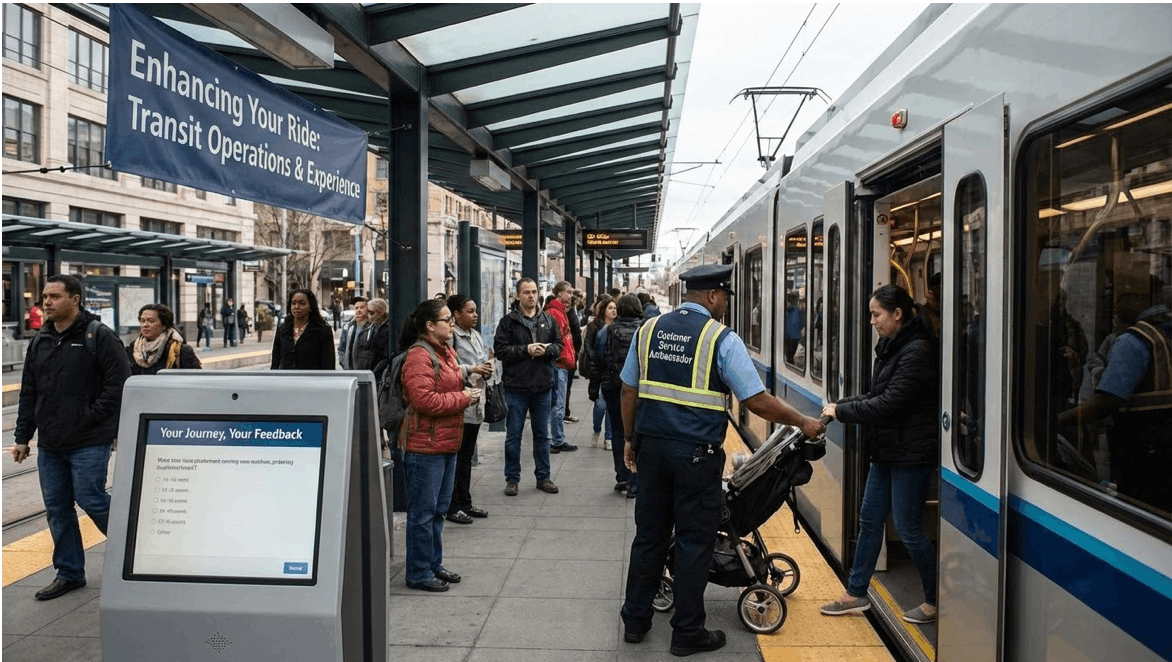
Public transportation agencies across the United States operate under rising expectations while managing limited resources and aging infrastructure. Many fleets continue serving riders reliably each day, even as customer expectations evolve alongside broader technological advancements. Passengers want clear, up-to-date, real-time information when planning and taking trips. The availability or lack of correct communication during disruptions can greatly influence the experience of the rider. National surveys on transit transparency indicate that passengers see reliable real-time information as almost equally important as on-time performance, and that timely communication during disruptions is a major factor in loss of trust. Despite recognizing this, many agencies find it difficult to provide real-time information consistently as a part of their processes.
The difficulty is not a lack of commitment but how customer experience has historically been positioned within transit organizations. Often, it has been considered merely a communication tool to explain service terms, support functions, or a back-office function. Most of the time, real-time information projects start off as successful pilots involving different departments; however, continuing the efforts and expanding them needs joint leadership and operational integration. Hence, making a real difference in the long term means changing the mindset: seeing customer experience as an operational system that guides service delivery, service communication, and continuous service improvement.
That understanding has increasingly shaped the work of Harsheeta Gupta.
Embedded full-time within a major U.S. state transit authority, she serves as a Transit Program Manager reporting directly to the agency’s Chief Customer Experience Officer. Her role places her inside the machinery of the organization, where strategy, technology, and frontline operations converge. Over time, she has emerged as a steady force behind some of the agency’s most consequential customer-facing initiatives by building the connective structures that allow ideas to survive contact with reality.
From Discrete Projects to Institutional Change
Harsheeta’s responsibilities did not begin at this scale. Initially, she supported projects that were well-defined and had a fixed timeframe. With growing trust from leadership, her understanding of the agency’s operating environment led to increasing requests to take on initiatives characterized by uncertainty rather than clear guidance. These efforts depended less on technical execution alone and more on judgment: aligning stakeholders, clarifying priorities, and translating broad vision into practical steps.
Over time, she became a translator between leadership intent and day-to-day delivery. She helped newer organizational functions, including the Office of Customer Experience, establish operating rhythms, define priorities, and convert abstract goals into executable plans. The effect was cumulative: The agency gained the ability to advance multiple initiatives simultaneously, reduce friction between departments, and pursue innovation without eroding operational credibility. In practical terms, this shift supported the expansion of real-time information capabilities and a more rider-centered approach to service delivery.
Designing for Riders and Operators in Real Time
Several of Harsheeta’s most visible contributions sit at the intersection of technology, operations, and human behavior.
One such effort was the planning and execution of an onboard tablet application for bus operators. She led the initiative end-to-end, overseeing tablet configuration, mount testing, mobile device management, and operator usability, while coordinating closely with operations, IT, and maintenance teams. The pilot provides operators with real-time schedule adherence and detour guidance , enabling informed adjustments in the moment. Rather than concentrating authority solely at the supervisory level, the program trusted frontline operators with actionable data to improve service as it unfolded.
Harsheeta also program-managed a once-uncertain initiative to enable real-time route ladder displays on onboard infotainment screens. Working across vendors and internal teams, she helped expand the solution from a limited deployment to almost 500 buses. Crucially, the effort relied on existing digital infrastructure, increasing customer-facing information without the cost or disruption of new hardware procurement. This was a pragmatic response to fiscal constraints that still delivered tangible rider benefits.
At the same time, Harsheeta supported the launch of a bundled set of real-time customer information improvements, including bus stop QR codes, enhanced service alerts, GPS redundancy, and coordinated marketing. Instead of regarding these enhancements as independent pilots, she was the one to position them as pieces of a large, unifying program. For riders, the result was a more consistent and intelligible flow of information during both routine service and disruptions.
Establishing a Customer Experience Operating Model
Harsheeta’s most enduring contribution may be less visible but more structural. She developed the agency’s first Customer Experience Action Plan, a multi-year roadmap translating executive ambition into sequenced initiatives with defined ownership and governance. Unlike traditional planning documents, the Action Plan linked customer experience goals directly to operational and technology investments, creating a framework that could outlast individual projects or leaders.
“Customer experience only becomes real when it is planned, resourced, and delivered with the same rigor as operations,” Harsheeta reflects. “Otherwise, it remains an aspiration rather than a system.”
The plan provided the agency with a shared reference point, aligning teams, clarifying tradeoffs, and making progress measurable over time.
Rethinking Long-Held Assumptions
Taken together, Harsheeta’s work has quietly challenged several assumptions embedded in public transit practice. Service alerts, once treated as internal operational notices, were reframed as primary customer touchpoints deserving of design, consistency, and governance. Operator performance tools, traditionally supervisor-driven, were reimagined to place greater trust in operators themselves. Customer experience planning, often reactive and fragmented, gave way to a proactive, roadmap-driven approach tied to delivery capacity.
What distinguishes these efforts is their emphasis on integration and durability. Service alerts became designed products rather than incidental outputs. Operator tools were introduced with field testing and phased rollout to ensure adoption. Strategy was translated into execution, closing a gap that often separates planning from practice.
Impact and Implications Beyond One Agency
Harsheeta evaluates impact through operational indicators, adoption patterns, and cost-avoidance outcomes. Expanding real-time route ladder displays across 500 buses using legacy screens increased customer information coverage without new capital investment. Standardized, rider-focused service alerts reduced internal rework and improved clarity during disruptions. Operator-facing real-time tools supported better schedule adherence and headway management, contributing to more reliable service.
Beyond these outcomes, the broader significance of her work lies in its transferability. The rider-centered service alert methodology offers a model for agencies seeking to rebuild trust without new technology spend. Her approach to real-time information deployment demonstrates a scalable alternative to wholesale system replacement. The integrated customer experience planning framework provides a blueprint for transit systems working to institutionalize customer experience as a core operational function.
In an industry constrained by legacy systems and incremental change, Harsheeta Gupta’s contributions point toward a different possibility. This is one in which customer experience is treated not as messaging, but as infrastructure, designed with intention and sustained through discipline.