Parents can underestimate the importance of their children’s eye health, yet numerous medical studies show the impact eye health can have on a child’s well-being, from their performance in school to the potential development of behavioral problems. That is why diagnosing and treating children for eye coordination problems or vision problems like amblyopia is important, but doing so can be easier said than done.
Parents often catch their children’s vision problems in one of a couple of scenarios. One telltale sign of a vision problem is poor performance in school. If a student is having difficulty reading or writing, focusing on tasks at school, and sometimes acting out because they can’t see properly, it could be a sign that something about their vision needs attention. Alternatively, some parents discover vision difficulties when a pediatrician conducts a vision screening at their annual check-up or physical.
However, parents don’t have to wait for an annual exam or until vision problems start impacting their children’s behavior in school. Sally Murray, a certified orthoptist and Director of Promotions and Development at the American Association of Certified Orthoptists (AACO), explains that there are several ways in which an eye problem can manifest in children.
Vision problems that could indicate your child needs eye care
One of the most obvious indicators that a child might have an eye problem is constant, visible eye crossing. Intermittent eye crossing is normal in children in early infancy, up until around the time they are 4 months old, but after that, even intermittent crossing may indicate a deeper problem. That said, constant crossing of the eyes is never normal.
“You can often confirm an eye crossing by using a flash on your camera phone,” says Murray. “If the light reflections are symmetrical, the eye turn is unlikely to be constantly present.”
Another common physical sign of a potential eye coordination problem is abnormal head posture. If a child keeps their head turned or tilted, it may be because they see better in that gaze, which could imply a misalignment in the opposite gaze. For example, if a child has strabismus, tilting their head could help them line up images and help them compensate for the eye misalignment, or if they have nystagmus, tilting or turning could reduce shaking and cause vision to become clearer.
Eye coordination problems can also manifest in children’s behavior. For example, children with poor vision might seem extremely introverted or uninterested in their surroundings due to their inability to see things clearly, which they assume is normal. Young children may lack the vocabulary to describe the vision difficulties they are experiencing; thus, this type of phenomenon generally has to be observed by a parent or teacher rather than described by the child themselves.
Children experiencing eye coordination problems may also have a specific reaction to external stimuli. For example, infants with an eye coordination problem may cry when only one eye is covered.
“Many children don’t like their face being covered and will scream when any eye is covered,” explains Murray. “However, if they only scream when one eye is covered, and it’s always the same eye they react to, it could indicate a potential problem.”
In older children, this frustration might manifest itself in other ways. For example, a child closing one eye in bright sunlight could indicate potential strabismus, as closing one eye can prevent visual discomfort when the control of their eye misalignment is challenged. While occasional squinting of both eyes together is often normal, squinting only one eye can be a sign that testing is needed, especially if it is always the same eye.
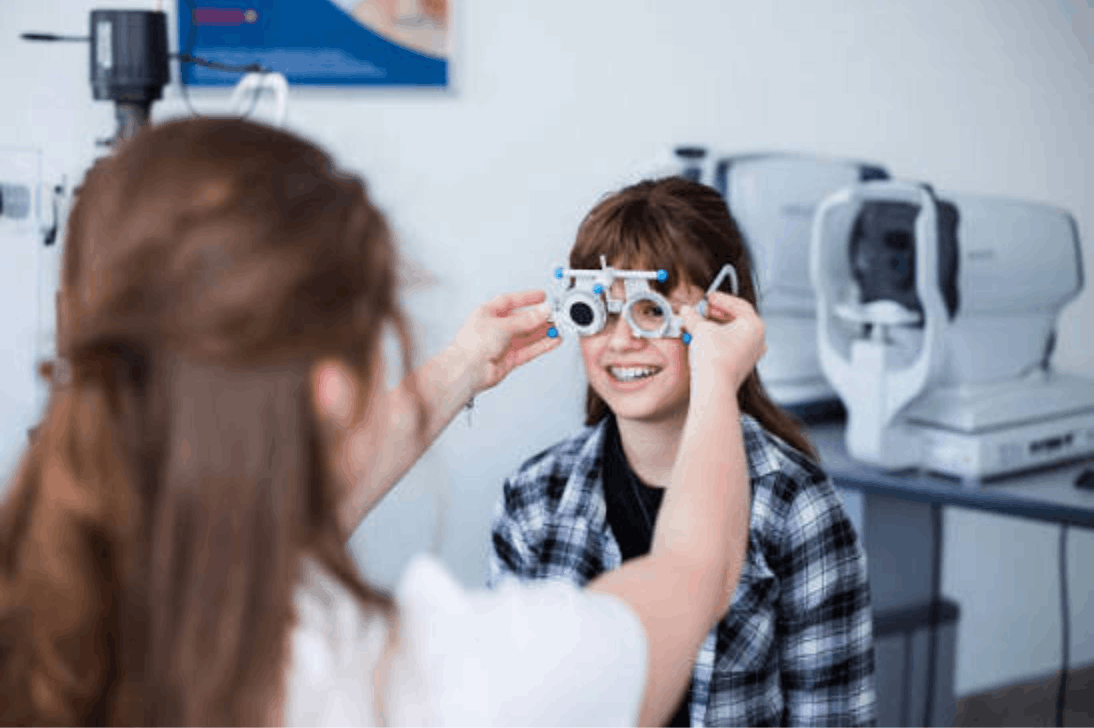
When one of these indicators of a potential vision misalignment is discovered, a patient will often be referred by their pediatrician to a pediatric ophthalmologist and orthoptist for more advanced testing and treatment. As highly specialized eye care professionals, orthoptists are specially trained to diagnose and manage binocular vision disorders. They will work with the doctor to find a nonsurgical or surgical treatment that can help improve their long-term vision.
Why vision screenings with an orthoptist are so important for pediatric eye health
It is important to catch and treat eye misalignment issues in childhood because early intervention can prevent children from developing poor eyesight in one eye (amblyopia) that lasts their entire lifetime. The vision system is still developing in childhood, so early treatment such as patching will improve vision before the age of approximately 8 years.
If eye misalignment (strabismus) persists after amblyopia is treated, eye muscle surgery will align the eyes.
“If your child is experiencing one of these signs of a vision misalignment or poor vision, contact your pediatrician about a referral to an ophthalmologist and orthoptist today,” concludes Murray. “A certified orthoptist can evaluate your child’s vision and work in conjunction with an ophthalmologist to ensure that your children’s eye health is on track for them to grow up with healthy vision in adulthood.”