


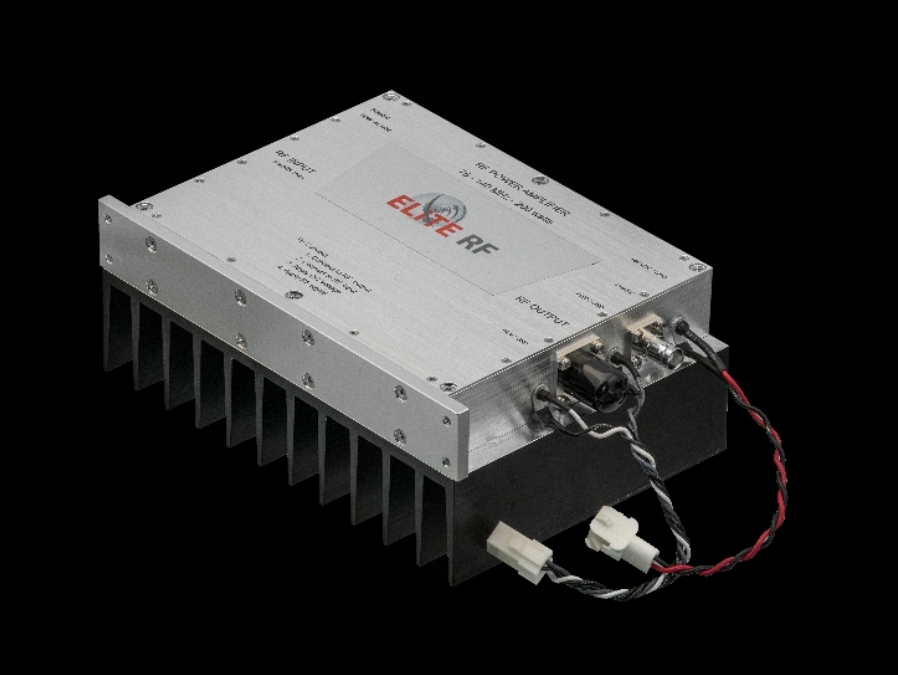
What is a RF Amplifier?
It is an electronic circuit that amplifies an input RF signal. Class AB Linear RF amplifiers are designed to have a linear correlation between output signal power and input signal power. This correlation is measured in decibels (dB) which is also known as power gain. The relationship is linear till P1dB point after which more input power will not have a linear rise in output power ultimately reaching Psat. Psat (or Saturated Power) is the maximum power that an amplifier can generate.
While P1dB is an important consideration while selecting a linear amplifier, this article focuses on another important factor known as Third Order Intercept crucial to the end user.
THIRD-ORDER INTERCEPT
When an amplifier deviates from linearity, it begins to generate harmonics derived from the amplified input signals. The second, third, and other harmonics typically lie outside the bandwidth of the RF amplifier, making them relatively straightforward to filter out. Nonetheless, non-linearity also triggers a mixing effect involving two or more signals.
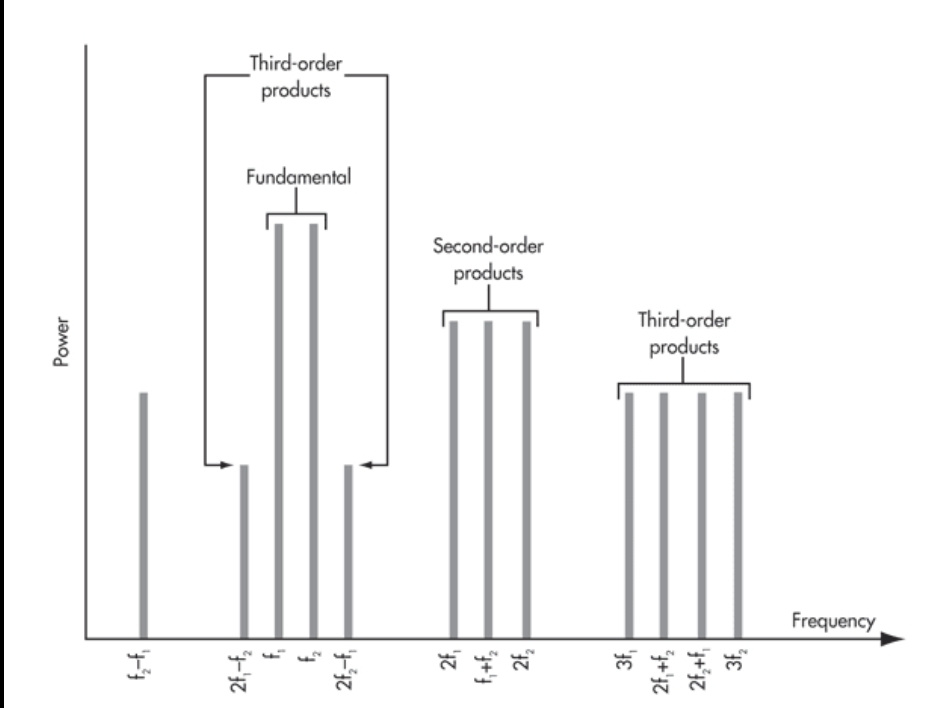
If these signals are in proximity in terms of frequency, certain sum and difference frequencies, known as intermodulation products, may emerge within the amplifier’s bandwidth. These intermodulation products cannot be effectively filtered out and subsequently become interfering signals with the primary signals that require amplification. Figure 2 illustrates two signals, f1 and f2, situated within the amplifier’s bandwidth. In the presence of distortion, new signals such as f1 – f2 and f1 + f2 materialize. These signals, in turn, mix with the second, third, and higher-order harmonics, yielding an array of potentially interfering signals within the amplifier’s pass band. The most problematic among these are the third-order products, denoted as 2f1 ± f2 and 2f2 ± f1. Those that may manifest within the amplifier’s frequency range include 2f1 – f2 and 2f2 – f1.
If one were to graph the output power against the input power, a 1-dB compression curve would emerge, representing the first-order signal plot. Observe the flattening of the gain curve, indicating compression. Additionally, the third-order product signal levels are plotted on the same graph. These intermodulation (IM) products increase at a rate three times that of the first-order products on a logarithmic scale, as mixing mathematics dictates a 3:1 gain rate for the third-order products.
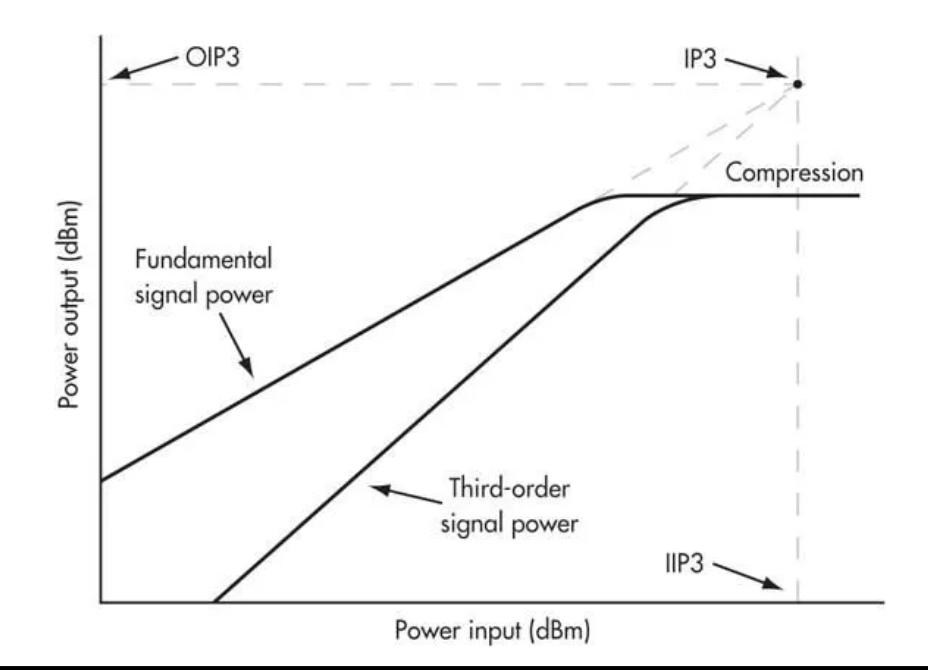
Now, if we extrapolate the linear segments of the two gain curves, as demonstrated in Figure 3, they intersect at a point where the third-order signals match the amplitude of the first-order or input signals. This point is referred to as the third-order intercept point, an abstract concept that is never practically attained. Nevertheless, it serves as a valuable indicator of amplifier linearity.
The IP3 value can be ascertained in relation to either the input or the output. If it is determined from the output axis, it is termed OIP3. When the value is derived from the input axis, it is designated as IIP3.
A higher output at the intercept signifies superior linearity and a lower intermodulation distortion (IMD). The IP3 value provides insight into the amplifier’s capacity to handle larger signals before IMD becomes noticeable. Typically, the IP3 point is situated approximately 10 dB above the 1-dB compression point.
SUMMARY
Among the intermodulation effects resulting from non-linear operation, third-order products pose the most significant challenges. The IP3 value represents a theoretical point denoting when the amplitude of the third-order products equals that of the input signals. This point is not practically attainable during testing, as the amplifier saturates prior to achieving this condition. Nevertheless, it serves as a valuable gauge of amplifier linearity. This concludes our discussion on RF amplifier linearity and the measurement of third-order intercept (TOI or IP3) point and 1-dB compression (P1dB) point. If you are looking for RF amplifiers or solid-state microwave generators, please visit https://eliterfllc.com/


