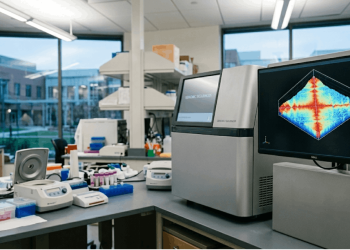
The COVID-19 pandemic has shown us the importance of laboratory testing. It helps diagnose people, monitor their illnesses, and assess how effective treatments are. To test for COVID-19, a sample must be taken from someone who may have or is confirmed to have it. This sample is then processed in a lab using PCR to spot viral genetic material. This helps healthcare professionals find out if someone has an active infection. Lab testing can also measure the antibodies an individual’s body makes in response to the virus. This serological testing helps to identify people who have already been infected and have immunity against the virus.
Reditus Laboratories, a pathology laboratory based in Pekin, Illinois, has significantly advanced laboratory testing for COVID-19. Since its inception in 2019, the company has made significant strides in improving diagnosis and surveillance through innovative technologies and expanded testing services. Reditus Laboratories has demonstrated its commitment to advancing laboratory testing for COVID-19 through innovative technologies and expanded testing services. From its humble beginnings as a podiatry support laboratory, the company quickly adapted to the urgent needs of the pandemic and emerged as a national leader in COVID-19 testing services.
Importance of Accurate Diagnosis and Surveillance
Accurate diagnosis and surveillance are vital for healthcare. They lead to the early detection of diseases and better patient outcomes. Also, they help spot disease patterns, aiding in forming prevention strategies.
Medical professionals can accurately pinpoint a patient’s illness, allowing for tailored treatment plans. This lessens the probability of unnecessary treatments and medications. Additionally, it permits timely intervention, avoiding the advancement of diseases and potentially saving lives.
Monitoring and reporting of disease trends is essential for public health agencies. This helps them quickly execute preventive measures like vaccinations or quarantines – containing outbreaks and protecting the public from infectious diseases.
Surveillance data offer insights into disease patterns. Scientists analyze this to determine risk factors, comprehend transmission dynamics, and assess the performance of interventions. This knowledge is then used to improve existing methods and develop new ones to prevent future outbreaks.
Advancements in Laboratory Testing for COVID-19
Advancements in laboratory testing have played a vital role in enhancing the accuracy and efficiency of diagnosing and monitoring COVID-19. Rapid antigen tests, polymerase chain reaction (PCR) tests, and serological testing can effectively address different facets of COVID-19. Each sub-section presents a unique solution to improving diagnosis and surveillance.
Rapid Antigen Tests
Antigen testing has transformed COVID-19 detection. Rapid antigen tests, a revolutionary breakthrough in virus identification, give quick and precise results in minutes. Moreover, it’s essential to know that rapid antigen tests need careful handling and trained professionals to interpret and report results correctly. These tests have shown effectiveness in discovering asymptomatic carriers and stopping further transmission.
Polymerase Chain Reaction (PCR) Tests
PCR tests are a significant asset in fighting COVID-19. They detect genetic material from the virus, enabling accurate diagnosis. Even small amounts can be found by amplifying and analyzing parts of the virus’s genetic material. Plus, PCR tests have become more accessible and efficient. Rapid tests give results within hours instead of days. This has increased testing capacity and speed, making it easier to identify and control COVID-19 cases.
Serological Testing
Serological tests identify IgM and IgG antibodies in the blood. These antibodies show up early during infection and provide long-term protection. The tests can detect if someone has had COVID-19, even with no symptoms. This helps to determine who is immune so that vaccines can be given to those who need them. Tests have become faster, providing results in minutes. This helps with public health interventions.
Improving Diagnosis of COVID-19
To improve the diagnosis of COVID-19, advancements in laboratory testing offer promising solutions.
Enhanced sensitivity and specificity of tests
Scientists are improving the accuracy of COVID-19 tests. To do this, they are tuning sensitivity and specificity. These traits will give more reliable results in identifying infected people. One way to increase sensitivity is to target multiple viral proteins. These serve as markers to show if someone has the virus. Targeting more than one protein increases the chances of detecting the virus.
Automation and High-Throughput Testing
Automation has sped up the testing process and improved accuracy and reliability. It has reduced human intervention and errors, making it possible to do repetitive tasks precisely. This is especially helpful in mass testing efforts. High-throughput testing allows for the simultaneous analysis of multiple samples. This saves time and resources like testing kits and personnel.
These advancements are made through researchers, scientists, engineers, and tech companies coming together. Their combined knowledge has led to more efficient and accurate diagnostic processes for detecting COVID-19.
Point-of-Care Testing
Point-of-care testing can speed up diagnosis and aid quick decisions about patient care. Plus, it catches COVID-19 cases early, improving the potential for containment. Also, testing at the point of care cuts the necessity of transporting patients to off-site facilities, lessening the risk of contagion. Quickly spotting and isolating infected people can help stop the virus spreading.
A Johns Hopkins University study showed that point-of-care testing is more accurate and swifter than lab-based techniques. This saves time and helps medical staff start appropriate treatment plans quickly.
Enhancing Surveillance Efforts
Genomic sequencing enables early detection and monitoring of new variants, while surveillance testing focuses on high-risk groups, aiding in containment strategies and tailored interventions.
Genomic Sequencing for Variant Detection
Genomic sequencing is revolutionizing surveillance efforts. Decoding genetic material helps spot unique characteristics and adaptations. It analyzes vast amounts of data, equipping scientists with powerful tools. This technique detects genetic variants, providing insights into the evolution and spread of pathogens.
Surveillance Testing in High-Risk Populations
Surveillance testing is vital for vulnerable populations, such as the elderly, healthcare workers, and immunocompromised individuals. These groups are more prone to infections and require regular screenings. Conducting surveillance testing helps in gathering data on the spread of infectious diseases. This data assists in developing effective public health interventions and preventive measures.
Challenges and Limitations
False Positives and False Negatives
Finding the balance between false positives and false negatives is an issue. For instance, in medical screening tests, decreasing the threshold for a positive result may increase accuracy and raise the risk of false positives. If the point rises, false positives may reduce, yet there could be more false negatives.
To improve accuracy, validation studies can be done to assess test performance in different populations. This way, we can effectively minimize false positives and false negatives by repeatedly evaluating and improving testing protocols with real-world data.
Supply Shortages and Affordability
Supply shortages and affordability cause widespread issues. Businesses may need help to acquire raw materials for manufacturing, leading to delays or higher costs. Consumers need help finding affordable products. Recent events made this apparent. For example, the global chip shortage impacted many industries, especially automakers. Production lines were disrupted, and vehicle deliveries were delayed.
Ethical Considerations in Surveillance
Surveillance brings up ethical matters that cannot be overlooked. Surveillance consistently violates people’s right to privacy, causing debates about the balance between security and independence. Surveillance systems can gather many private details, which may be mishandled or in the wrong hands. The study and understanding of surveillance data can lead to false ideas, resulting in unnecessary actions against innocent people.
Future Prospects and Implications
To explore the prospects and implications of advancements in laboratory testing for COVID-19, delve into the potential for home-based testing and the integration of artificial intelligence and predictive modeling.
Potential for Home-Based Testing
The potential of home-based testing is enormous! It could change the future of healthcare. As technology improves, people can take control of their health by doing tests in the comfort of their own homes.
Integration of Artificial Intelligence and Predictive Modeling
AI has changed data processing forever. It can learn, make predictions, and adapt to new information. Combining this with predictive modeling can be an incredible asset. Predictive models use old data to spot trends and predict the future. Adding AI to the mix makes predictions even more accurate and gives businesses valuable insights.
Laboratory testing for COVID-19 has advanced significantly. Reliable tests now detect and contain the virus earlier. State-of-the-art technology and high accuracy make sure results are accurate. Research and development are constantly improving testing capabilities. Mobile labs with diagnostic tools diagnosed cases within hours in one rural community. Isolation measures were taken quickly, containing the spread in a short time. Reditus Laboratories has played a pivotal role in improving diagnosis and surveillance for the virus through their cutting-edge RT-PCR technology, expansion of testing facilities, and comprehensive solutions. Their dedication to public health and continued innovation ensures that they remain at the forefront of the fight against COVID-19, contributing to the well-being of communities and the global effort to combat the pandemic.