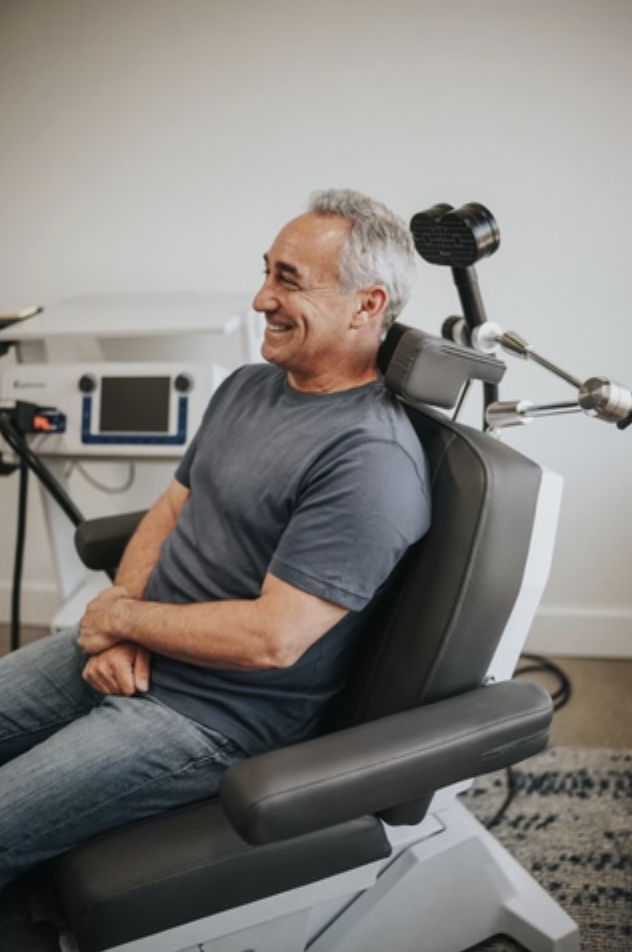
Ever since the FDA first approved Transcranial Magnetic Stimulation (TMS) for the treatment of depression in 2008, this medical technology has significantly improved the lives of patients. As the Cleveland Clinic explains, “Transcranial magnetic stimulation (TMS) is a treatment technique that uses a magnetic field to influence brain activity.”
Over the years, the use of TMS has expanded to combat migraines, Obsessive Compulsive Disorder (OCD), and other conditions related to brain health. Today, a new generation of TMS technology — Personalized repetitive Transcranial Magnetic Stimulation (PrTMS) — promises even better treatment options for patients.
How PrTMS differs from TMS
While PrTMS deploys the same low-level magnetic pulses as traditional TMS, this new technology enables refinements on TMS’s more indiscriminate, heavy-handed approach.
“I compare traditional TMS to a bull in a proverbial china shop,” said Nicholas Mathews, COO of The Brain Lab, a California-based PrTMS provider.
Conversely, PrTMS offers a more mindful alternative. The “P” in PrTMS stands for “personalization,” and therein lies the heart of the technology’s advances.
The “P” in PrTMS
“With PrTMS, we develop a treatment plan for every patient as an individual,” Mathews explained. “When it comes time to deliver the treatments, the specific patient’s plan has been intensively vetted to make sure that only those regions of the brain that actually require attention are treated.”
Dr. Kevin Murphy, a board-certified radiation oncologist who specializes in the brain and spinal cord, developed PrTMS to improve upon the limitations of TMS. As the website of his PrTMS venture, Peak Logic, explains, “Personalized repetitive Transcranial Magnetic Stimulation (PrTMS) is TMS — but with a smarter, more sophisticated approach. Unlike conventional TMS that is one-size-fits-all, PrTMS intricately customizes the TMS therapy delivered to each patient – which may help patients achieve optimal results.”
Mathews emphasized the power of PrTMS machines to deliver this pinpoint accuracy.
“Only a fraction of the machine’s capacity is actually used to set up the magnetic field,” he said. “A miniscule amount of magnetism is applied, and it is carefully calibrated to the exact needs of that exact portion of the individual’s brain.”
How PrTMS optimizes brain power
“Imagine your brain activity as a symphony orchestra – when all the musicians are playing in harmony, the result is beautiful music,” Peak Logic’s website explains. “However, if just one section or instrument is out of sync, it can result in disconnected or unpleasant noise. Similarly, if your brainwaves are operating at the wrong frequency, it can also result in ‘noise’ that causes symptoms.”
PrTMS gradually reduces this noise and streamlines brainwaves. As a result, the patient’s neurons fire together at the correct rates and times.
“I like to use the analogy of tuning up a car,” Mathews said. “While you can keep driving even past the time you were supposed to get an oil change, there will be a negative impact on your car’s efficiency. It takes maintenance to keep everything working at its best. In the same way, PrTMS cleans up your brain and improves performance.”
PrTMS technology accomplishes this without pain, drugs, surgery, anesthesia, electrodes, or wires. Patients remain conscious and relaxed during sessions, which normally last about a half hour. Treatment plans are created on a case-by-case basis for individual patients and usually unfold over the course of two months.
PrTMS promises next-level treatments that enhance brain function and promote well-being. For this reason, it constitutes the future of brain health.