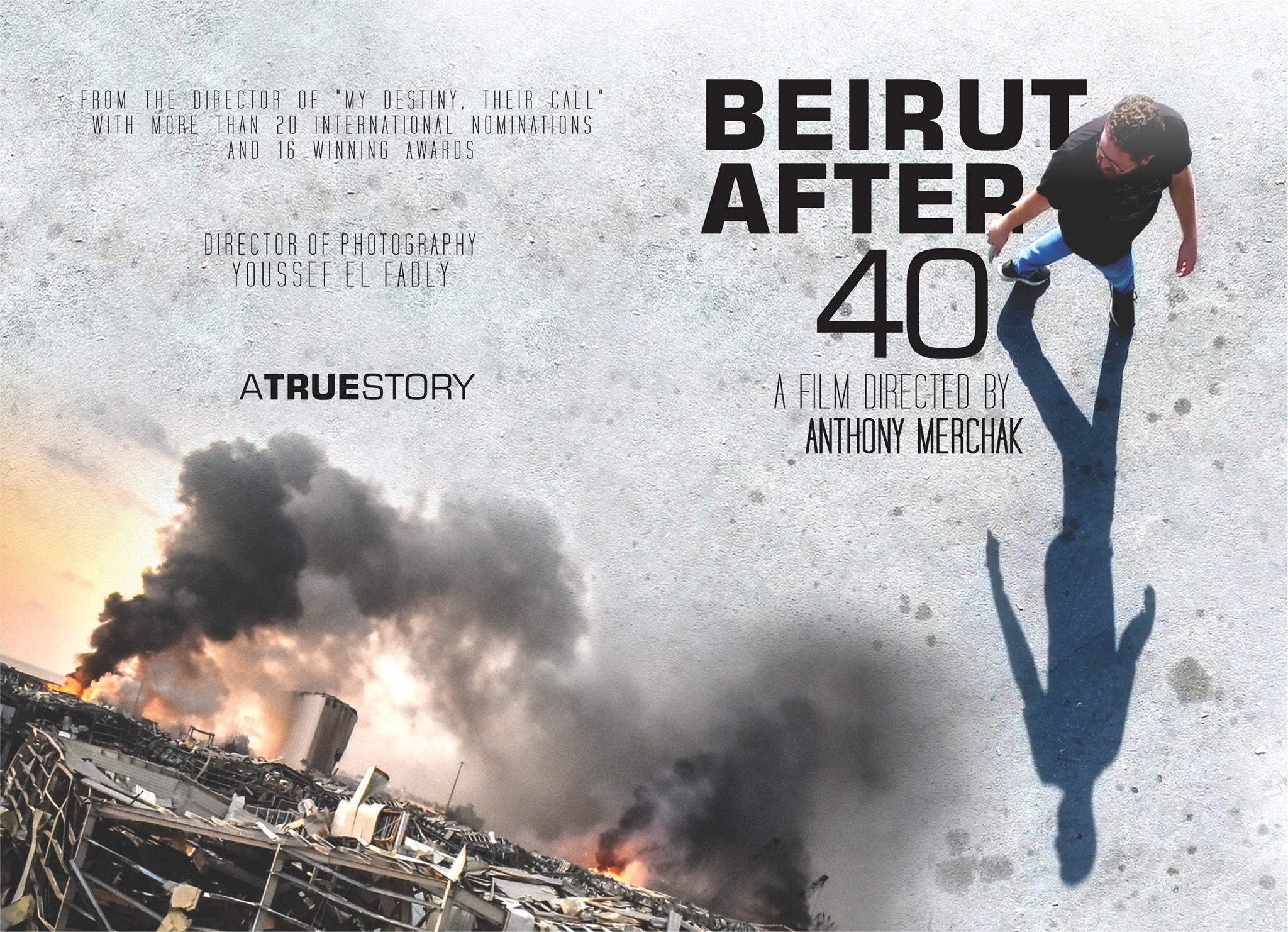
Lebanon is no stranger to pain. The Lebanese people are quite familiar with that thorny question that many, if not most, face at some point in their life: to stay or to leave? In fact, this question has come to color a certain part of national culture and identity, spurring wave after wave of emigration and creating one of the world’s largest diaspora communities. To many, this difficult choice comes as a sort of birthright. To director Anthony Merchak and co-writer Ricardo Chidiac, it presents an opportunity for resistance. Their most recent documentary, Beirut After 40, details, on the one hand, the trauma that so many hundreds of thousands endured during and after the infamous Beirut Blast of August 4, 2020, and, on the other hand, their ruminations about that lingering question. Their answer? Stay.
Director Anthony Merchak experienced the devastation firsthand. The film incorporates footage he managed to live-stream in the moments that immediately followed the destruction of the city, as well as a number of powerful interviews with survivors. Their harrowing accounts tell a story of trauma and its true, albeit too often unspoken, nature: permanence. The memory of such horror and one’s attachment to it are things we may never truly rid ourselves of. They follow survivors, both those who choose to stay and those who elect to leave.
Within this sobering realization lies one of the film’s principal messages: the refusal to emigrate is, in and of itself, an act of resistance. To this day, no justice has been awarded to the victims’ families despite years of constant, committed protest. In fact, no state compensation was ever awarded to those whose bones were broken, faces cut, and homes destroyed by the criminal negligence of Lebanese government officials. Merchak and Chidiac bravely posit that the Lebanese people, specifically the country’s youth, should choose to remain not despite these reasons but rather because of them. In essence, one of the most powerful tools in the struggle for justice is to remain —to stay and to fight for a better tomorrow, one where those who’ve fled for generation after generation, who long to return to a land they can call home, can feel comfortable and proud in doing so.
Beirut After 40 was most recently considered for shortlisting (the final step before nomination) at the 95th Academy Awards. The film did not make that list. Still, Merchak and Chidiac’s journey is not one that ends in failure. On the contrary, theirs is one defined by stubborn bravery and triumphant success. Their efforts have elevated the stories of that day, the courage of its survivors, and the struggle for justice for the victims’ families to an international stage. Their work stands as a beacon for the many millions of Lebanese who live abroad, encouraging them to engage in the collective struggle against the forces that would see them reduced to victims, subjects of redundant filler pieces commending their “resilience.”
Now, as the families of the victims pursue justice in the international arena, Beirut After 40 endures as a testament to their case, a call to action. The film continues its run after winning the Hollywood Globe Award. It will be screened at Clermont-Ferrand Short Film Market in France from January 30 to February 4. It has also been nominated for awards at the Golden State film festival 2022 from February 25 to March 3.