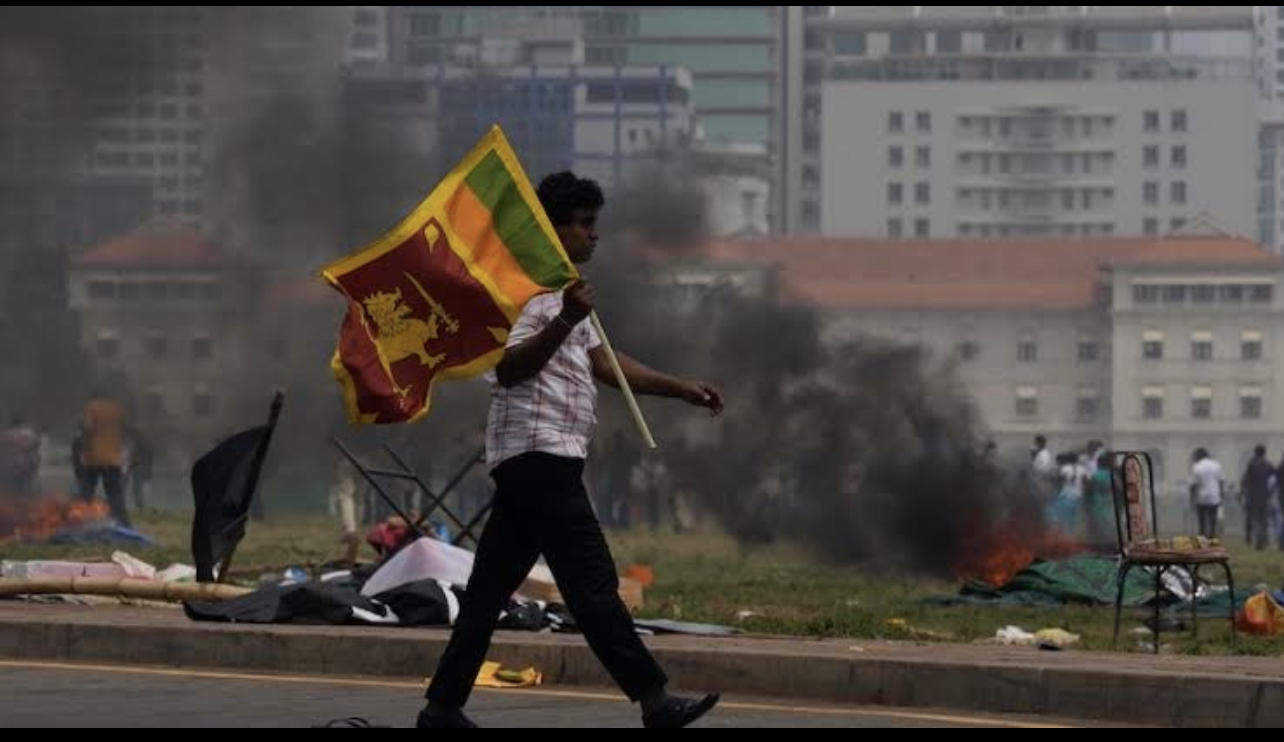
As it was widely covered by the media, the social, political and economic crisis in Sri Lanka have seen dramatic overturns and unrests. Once the « pearl of indian ocean », the island have crumbled into debt, food crisis, energy crisis and bad governance leading to a massive reaction of the population.
The worldwide disruption of supply chains due to the massive lockdowns combined with the effects of the anti-russiansanctions and Ukraine war have triggered the social « bomb » in Sri Lanka with massive inflation, three digits price increase and downturn of foreign investments. But these indicators can be also found in other countries of the region: Myanmar, Nepal, Laos for example.
After the military coup in February 2021, Myanmar has been again placed on the ban of many international transactions, mostly from the West.
As a result, the country is suffering the same problems Sri Lanka : a deadly combination of economic downturn, inflation surge, increase of commodities prices (including cooking oil, grain, fuel, etc.), slowdown of imports and stop or withdrawals of foreign investments (mostly visible in the textile industry with H&M, Zara and others going away). Despite the candid reassurance of the Junta, the medias and authorities of neighboring countries (i.e. Thailand in June 2022) that the country has enough currency reserves to hold the shock (both on import demand, currency reserves and inflation), the local currency Kyat have fallen from 1340 USD before February 2021 to 2400 USD just before recent further depreciation. The Central bank have blocked the repayment of foreign loans in June 2022. The risk agency Fitch mentions that the contraction of the economy from 2020 was above 20% (17,9% YtY 2020-2021 and 5% Q1 and Q2 2022).
This economic and currency situation is also widely fueled by the debt Myanmar ows to China. It is reported that out of the 10bn USD equivalent debt of the country, 4bn is due to China. This debt started to get out of control on the CMEC (China-Myanmar Economic Corridor) project which viability is highly questioned in the country and have started the fear of a “debt trap” for Myanmar.
In the top of these disastrous economic situation, the country is rushing into a weapons and militia / army race. The security forces (police and army) have responded killing and imprisoning protesters, lawmakers, and representatives of the opposition party. In the meantime, the opposition National Unity Government of Myanmar is expressing problems in weaponizing its 80’000 to 100’000 members spread into 259 townships around the country, not counting on the numerous guerillas they are also in contact with.
The situation is extremely tense and explosive.
In Nepal, the economic situation is also very tense. « There is growing speculation that the Nepali economy will disintegrate like in Sri Lanka as the country’s foreign exchange reserves have shrunk and inflation has soared with rising fuel prices. For the first time since the 2000s, foreign exchange reserves have dropped to around $9 billion, which is barely enough to fund imports for six months, down from 11 months. At the same time, inflation has hit an all-time high of 8,56% with the employment rate remaining as disappointing as usual ». Nepal also suffers from too much private and governmental loans. The total external debt of Nepal remains at 51 billion US and the massive growth of private loans have turned this figure much higher. With inflation and cross-currency inflation, shortage in supply chains especially in agriculture products (fertilizers) and declining GDP that agitate the specter of a sudden massive recession, the nepalese people shall only rely to food import that are mostly provided by India at this time.
As a result, the Nepalese government recently banned the import of 10 consumers good types in order to preserve some of its foreign currency reserves.
Just like SriLanka and Myanmar, Nepal was trying to do all it cans to avoid the “Chinese debt trap” being an active member of the BRI (Belt and Roads Initiatives) on the Himalayans, trying to replace “loans” with “grants”. “China’s share in Nepal’s foreign debts has been growing slowly and steadily in the past five years, from 1.93 percent in the 2016-17 fiscal year to 2.66 percent in 2017-18 and up further to 3.10 percent in 2018-19, 3.24 percent in 2019-20 and 3.39 percent in 2020-21, the report said ».
In addition to this difficult situation, the borders dispute between Nepal and China have revamped with reports of the nepalese civic group presenting an array of Chinese infringement of Nepalese borders, trying to « crunch » the territory bit by bit. This report highlights gross borders violations in the Gurkha district « no man’s land » and in Humla district where China built 12 buildings inside Nepalese territories. The Civic groups also accuse China to move or take off border landmarks, fence (sometime with barbed wires) these new territories and even tries to gain control over the Mount Everest summit.
Both Nepalese and Chinese governments have agreed on joint inspections of the situation, but its very unlikely that the small Nepal could counter what appears as a long-time takeover strategy of the Himalayas by China at the expenses of all neighboring countries, including India.
But for Nepal itself, these actions are also used to mobilize the populations internally against a foreign « enemy » that could lead on one side to the militarization of the Himalayan region but also to the militarization of the Nepalese population with a smoother and trickier way that reminds what is happening also in Myanmar.
As the economic situation worsen in all the subcontinent, the exit door might be to take decisive actions on the currencies, the balance of payment and the diversification of production with a main particular focus on their own population, using all the multipolar facilities that are emerging in the Asian continent today.