Usually, most individuals do not care much about their online protection and secrecy and believe it is okay to share information on the internet. However, your confidential information, such as bank accounts, social security numbers, phone numbers, email ids, etc., can be conveniently exploited with the growing prevalence of malicious software and phishing attacks. Digital certificates are a way of securing data for individuals, organizations, and business websites. Let us start with the basics of digital certificates, and then, we will explore their various flavors.
What is meant by a Digital Certificate?
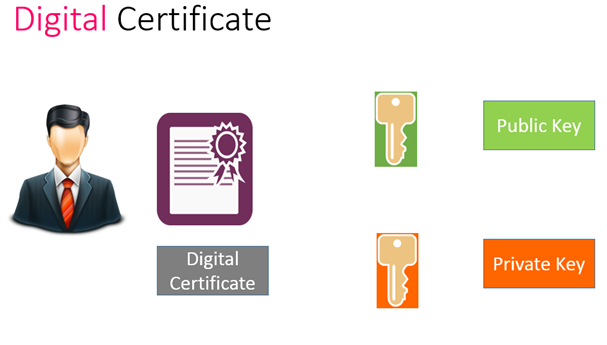
A Digital Certificate is an electronic credential that enables an individual or a business to securely share information over the web utilizing the public key infrastructure (PKI). They connect the certificate holder’s identity to a couple of (public and private) keys that can be employed digitally to encode and sign data.
The main aim of a digital certificate is to verify that the public key found in the license corresponds to the party to which the certificate was granted. In other words, to confirm that an individual who sends a message is who they are claiming to be, and then to provide the recipient of the text with the way to engage in an encrypted communication with the sender.
To facilitate the distribution and recognition of public keys, encryption algorithms involving public and private keys need a public-key infrastructure (PKI). Conversations can be encoded with the public key or the private key and then decoded with the other matching key.
Digital certificate issuance
While a company can generate its own PKI and grant its digital certificates — and in some instances, this method may be appropriate, for example, if an enterprise creates its own PKI to approve licenses for its internal usages. However, a large proportion of digital certificates are granted by a certificate authority (CA).
CA is a widely trusted third party used to confirm the matching of identification, e-mail address, or other such details with public keys. Digital certificates can be utilized for a range of electronic payments, like e-mail, e-commerce, collaboration software, and electronic money exchanges.
Types of Digital Certificates
When we talk about digital certificates, the very first thing that comes to our minds is SSL (Secure Socket Layer) or TLS (Transport Layer Security) certificates. An SSL license is a digital certificate, but there are two more kinds of digital certificates. Let us explain them one-by-one:
1. SSL certificates
When installed on a site, an SSL certificate protects the information shared between a web server and a browser. They use asymmetric encryption in which the public and the private key are used to keep the data away from the reach of cybercriminals.
SSL certificates increases the trust of users on your website. They feel safe on your website and can make purchases confidently – that means an increase in conversion rate. SSL also changes the HTTP web address to HTTPS that indicates the site is protected from cybercriminals’ peering eyes.
As the popular browsers like Chrome, Mozilla, , etc., have started giving “non-secure” warnings to the sites with HTTP connections, an HTTPS on your site’s web address will improve its trust relationship with the consumers.
2. Code Signing Certificate
A code signing certificate is a digital certificate containing details that completely identifies a person or an organization. The creator signs the software with his private key, and the end-user utilizes the programmer’s public key to check the developer’s authenticity.
Code signing certificate confirms that the program or code is coming from a legitimate individual (a programmer or signer). Search engines will show a security warning indicating the potential risks of downloading data when code is downloaded from the web or show an “unknown publisher” alert. Code signing eliminates the security alerts of “Unknown Publisher” and recognizes the publishing company’s name.
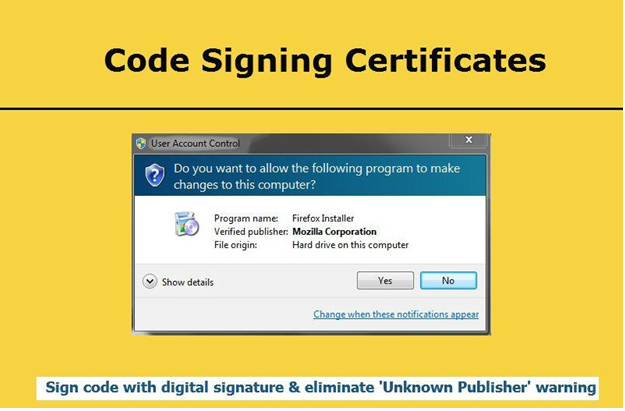
Code signing guarantees that a piece of software has not been changed and helps you decide if the application’s source and final delivery is trustable. If, after digital signing, the application/software file is interfered with or changed, the signature will become invalid, and the code will be indicated as insecure. Code signing is useful for the downloading of software by consumers and valuable for developers.
A timestamp is also registered when a digital sign is added. Even if the digital certificate’s lifespan has passed, this timestamping function guarantees the signed code stays legitimate. You do not need to add new signatures until you introduce new code or modify the existing code. So, your old certificate will work as long as you keep it unchanged. No matter if it is expired, it will still validate the authenticity of the software.
3. User or Client Certificates
Client certificates are used for validating a customer’s identity. The client, in this scenario, could be a user of the site or an email user. This way, the server guarantees that it communicates to the approved user and that the entity is secure to work with.
Client certificates authenticate individuals through the devices they use rather than verifying them via passwords. If the client does not have the authority given, access will not be given to him/her.
Client certificates always utilize a public key infrastructure (PKI) for identification, much like SSL certificates. However, there is one significant dissimilarity between the two. Client certificates do not encode any information – unlike SSL licenses, they are only activated for verification purposes.
Conclusion
All these certificates are essential for users and businesses to keep cybercriminals at bay. SSL certificates protect the data in transit and enhance user’s trust in your site. Code signing certificates are necessary for developers and users to utilize secure software rather than a compromised one. Client certificates help authenticate a user or a device to the server. I hope this article helped you get in-depth detail about various digital certificates, so you can use this information to protect yourself.