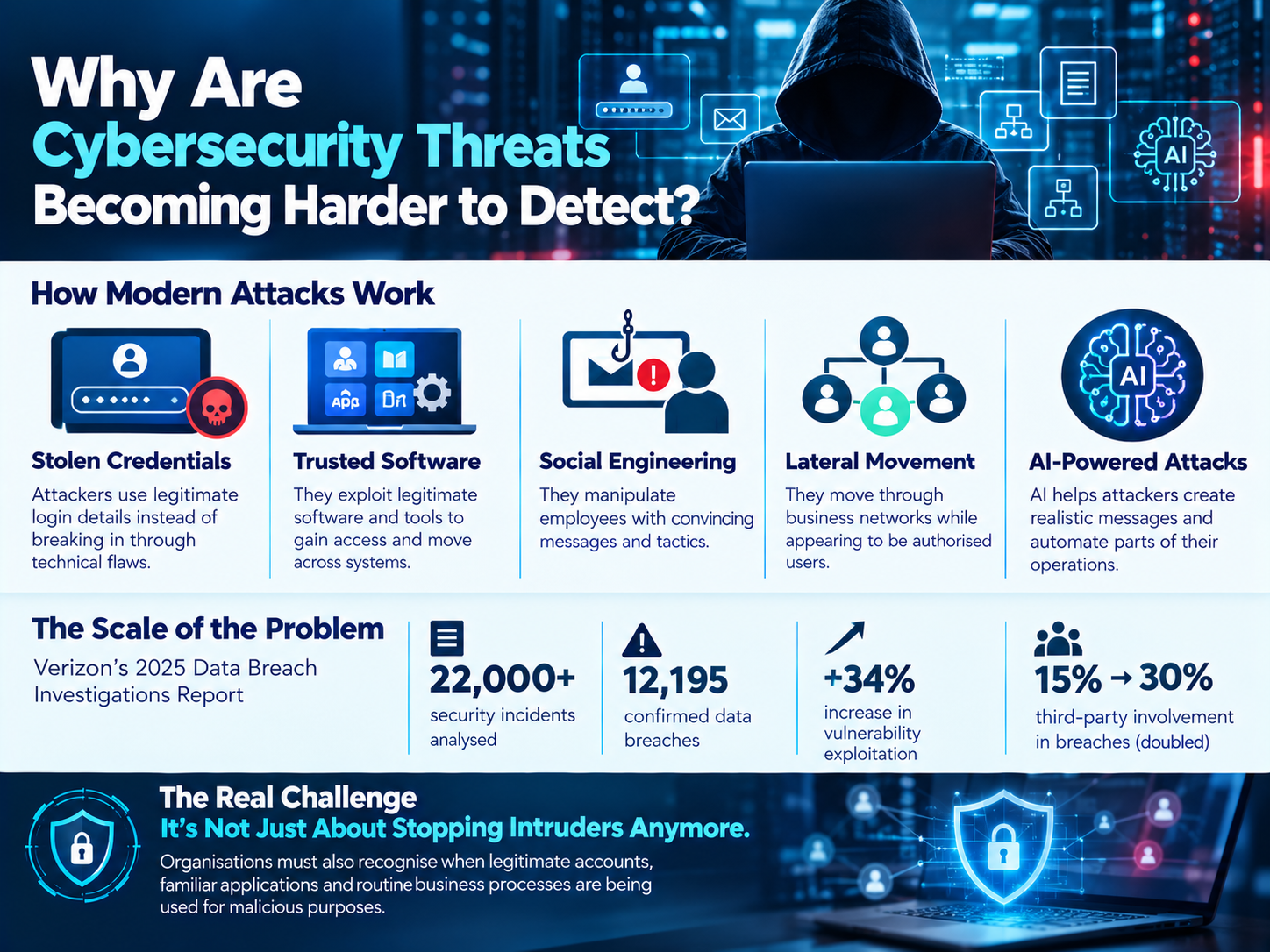
Cybersecurity threats are becoming harder to detect because attackers no longer need to break into a system through obvious technical weaknesses. They can steal legitimate login credentials, exploit trusted software, manipulate employees and move through business networks while appearing to be authorised users. Artificial intelligence is adding another layer of complexity by helping attackers produce convincing messages and automate parts of their operations.
The scale of the problem is visible in recent industry research. Verizon’s 2025 Data Breach Investigations Report analysed more than 22,000 security incidents, including 12,195 confirmed data breaches. Its findings show that vulnerability exploitation increased by 34%, while third-party involvement in breaches doubled from 15% to 30%.
These figures point towards a fundamental change in cybersecurity. The challenge is no longer simply preventing unauthorised access. Organisations must also recognise when legitimate accounts, familiar applications and routine business processes are being used for malicious purposes.
Stolen Credentials Make Malicious Activity Look Legitimate
Traditional security systems often look for suspicious logins, unfamiliar devices or unauthorised attempts to access a network. However, an attacker using a stolen employee password may pass several of these checks because the credentials are genuine.
Cybercriminals obtain credentials through phishing, infostealer malware, compromised websites and previously leaked passwords. Once inside, they may use existing permissions to access emails, download files or explore internal systems without immediately triggering security alerts.
Verizon’s 2025 report identified credential abuse as the initial access method in 22% of breaches examined in its relevant attack-vector analysis. Exploitation of vulnerabilities followed closely at 20%.
This creates a problem that stronger passwords alone cannot solve.
- Recognising the user is not enough: Security teams must also establish whether the user’s behaviour makes sense.
- Valid sessions can be abused: Attackers may exploit stolen session tokens, reducing the need to authenticate again.
- Small warning signs can be overlooked: An employee accessing an unusual file or logging in from an unexpected location may not appear dangerous in isolation.
The key insight is that authentication answers whether access credentials are valid. It does not establish whether the person using them has legitimate intentions. Effective detection therefore requires monitoring behaviour, device health, access patterns and changes in account activity.
Artificial Intelligence Is Making Deception More Convincing
Artificial intelligence is lowering the effort required to produce convincing phishing messages, imitate professional writing styles and adapt scams to individual targets. Messages that once contained obvious grammatical errors or awkward wording can now resemble genuine communications from colleagues, suppliers or senior executives.
Voice cloning and manipulated video can also make fraudulent instructions more believable. For example, an employee may receive an apparently genuine request from a senior manager to transfer money, disclose confidential information or approve an unusual transaction.
Microsoft’s 2025 Digital Defense Report identifies AI-assisted phishing, automated intrusions and deepfake-enabled impersonation among the emerging cybersecurity concerns.
However, AI does not automatically make every cyberattack undetectable. Its more important contribution is the ability to increase the volume and credibility of deceptive activity.
Three consequences deserve attention:
- Traditional warning signs become less reliable: Poor spelling and suspicious wording are no longer dependable indicators of fraud.
- Attacks become easier to personalise: Criminals can adapt messages to a person’s job, relationships or business responsibilities.
- Human verification becomes more important: A convincing voice or familiar writing style cannot establish that a request is genuine.
Organisations should combine email security with independent verification of sensitive requests, particularly payments, password resets and changes to supplier banking details.
The underlying lesson is that employees must verify the action being requested, not merely judge how believable the message appears.
Third-Party Connections Create Blind Spots
Modern organisations depend on cloud platforms, software providers, external IT teams and other business partners. These connections improve efficiency, but they also extend the number of systems through which an attacker might gain access.
A company may secure its own network carefully while remaining exposed through a supplier with weaker controls. Compromised software, stolen vendor credentials or excessive permissions can provide an indirect route into business systems.
Verizon’s 2025 Data Breach Investigations Report found that third-party involvement in breaches doubled from 15% to 30%. The report also identified a median remediation time of 94 days for leaked secrets discovered in GitHub repositories in the circumstances examined.
These findings highlight two separate weaknesses: organisations may not adequately monitor external access, and exposed credentials can remain available for misuse long after they are leaked.
The practical challenges include:
- Limited visibility: Security teams may not have access to the detailed logs of external providers.
- Excessive permissions: A supplier’s account may have access to more systems or information than its work requires.
- Delayed discovery: A breach originating with a partner may initially appear to be an ordinary internal login or software process.
Organisations need to treat vendor access as part of their own security environment. They should regularly review third-party permissions, remove inactive accounts, monitor external connections and require suppliers to report security incidents promptly.
The important distinction is that an organisation’s security depends not only on its own controls but also on the access it grants to others.
Attackers Exploit Vulnerabilities Before Organisations Fix Them
Software vulnerabilities remain a major entry point because organisations cannot always identify, prioritise and repair every weakness immediately. The difficulty increases when attackers discover a vulnerability before a patch becomes available or exploit it before administrators install an existing fix.
Verizon’s 2025 report found that vulnerability exploitation as an initial access method increased by 34% and accounted for 20% of breaches in its analysis. It also reported that only about 54% of the perimeter-device vulnerabilities examined were fully remediated, with a median remediation time of 32 days.
These figures matter because internet-facing devices, virtual private networks and other entry points can expose an organisation even when its internal systems are well protected.
The problem is not simply that companies fail to install updates. Many operate complex environments where taking a system offline can disrupt essential services.
Security teams should therefore prioritise vulnerabilities according to their actual exposure and risk.
- Identify internet-facing systems and unsupported devices.
- Prioritise vulnerabilities known to be actively exploited.
- Apply urgent patches to critical systems and verify that the fixes worked.
- Monitor vulnerable assets while patches are being tested or deployed.
A long list of unpatched vulnerabilities does not reveal which weakness an attacker will exploit first. Effective defence requires combining vulnerability information with business context, exposure and evidence of active exploitation.
Security Alerts Are Increasing Faster Than Human Attention
Organisations use multiple security tools to monitor endpoints, networks, cloud applications, emails and user accounts. Each system generates information about possible threats, but the resulting volume can overwhelm the people responsible for investigating it.
The difficulty is distinguishing a genuine attack from legitimate activity that merely looks unusual. A new application, a remote employee or a large file transfer can generate alerts without indicating malicious behaviour. Meanwhile, a carefully concealed attack may produce only weak signals across several systems.
This creates a detection gap. A security tool can identify an individual warning sign without recognising the broader attack taking place.
For example, an unusual login may be recorded by an identity system, access to confidential files by a cloud platform and suspicious data transfers by a network-monitoring tool. If these events are examined separately, their connection may remain unnoticed.
Organisations can address this problem by:
- Connecting security data: Combine identity, endpoint, network and cloud activity to establish a clearer picture of events.
- Prioritising alerts: Give greater attention to signals involving sensitive accounts, valuable data or multiple suspicious activities.
- Automating routine investigation: Use security automation to collect evidence, identify patterns and contain clearly defined threats.
- Reviewing detection quality: Test whether security systems recognise realistic attack scenarios rather than measuring success only by the number of alerts processed.
Automation can reduce the workload, but it also requires careful oversight. Incorrect rules can interrupt legitimate business activity, while poorly configured systems may overlook threats.
The objective should be fewer unresolved alerts and faster identification of genuine attacks, not simply more notifications.
Cloud Services And Connected Systems Expand The Attack Surface
Businesses increasingly store information across cloud applications, remote devices, internal servers and external platforms. This flexibility allows employees to work from different locations and organisations to introduce new services quickly. However, it also makes it harder to maintain a complete picture of where sensitive information resides and who can access it.
A single organisation may have different security policies across its cloud accounts, employee devices and business applications. Information can move between these environments, while access permissions change as employees join teams, change roles or leave the company.
Consequently, a security team may detect suspicious activity in one system without understanding its significance elsewhere.
The risk becomes particularly serious when an attacker uses one compromised account to access several connected services. Each individual action might appear authorised, even though the combined activity indicates an intrusion.
Organisations should focus on three priorities:
- Maintain an accurate inventory: Identify connected systems, sensitive information, service accounts and external integrations.
- Apply least-privilege access: Give employees and applications only the permissions necessary for their responsibilities.
- Monitor data movement: Investigate unusual downloads, unexpected access to sensitive records and transfers between environments.
A useful measure of security maturity is how quickly an organisation can determine which systems and information an account could reach after being compromised.
Preventing every initial intrusion is unrealistic. Limiting what an intruder can access, while detecting unusual activity across connected systems, can substantially reduce the damage.
How Can Organisations Improve Threat Detection?
Cybersecurity threats are difficult to detect for different reasons, so no single product or defensive measure can address every weakness. Organisations need a layered approach that combines technical controls, timely investigation and clear employee procedures.
The priority should be to shorten the period between an attack beginning and the organisation recognising what is happening.
Four measures deserve particular attention:
- Strengthen identity security: Use multifactor authentication, phishing-resistant authentication where practical, and controls that detect suspicious sessions. Review privileged accounts regularly.
- Improve detection across systems: Connect identity, endpoint, email, network and cloud logs so investigators can recognise related events.
- Reduce exposure: Patch actively exploited vulnerabilities, remove unnecessary access and review the security of third-party connections.
- Prepare for incidents: Establish procedures for disabling compromised accounts, isolating affected devices, preserving evidence and notifying relevant stakeholders.
Organisations should also test their ability to detect realistic attacks. Exercises can reveal whether monitoring systems identify credential theft, suspicious access to sensitive data and unusual activity by trusted accounts.
Detection performance should be measured using practical indicators, including time to identify an incident, time to contain it, the proportion of alerts that lead to meaningful investigations and the number of critical systems with adequate monitoring.
AI-assisted security tools can help investigators process large volumes of information. However, they should complement reliable data, well-designed controls and experienced human judgement rather than replace them.
Ultimately, the strongest security programme is not necessarily the one with the most tools. It is the one that can recognise a credible threat, understand its potential impact and respond before the attacker causes substantial damage.
Conclusion
Cybersecurity threats are becoming harder to detect because the boundary between legitimate and malicious activity is increasingly difficult to identify. Stolen credentials can resemble genuine employee access, AI can make deception more convincing, third-party connections introduce external weaknesses, and fragmented monitoring can hide relationships between suspicious events.
The evidence points towards a broader lesson. Vulnerability exploitation accounted for 20% of breaches in Verizon’s 2025 analysis, while third-party involvement reached 30%. These findings show why organisations cannot rely exclusively on traditional perimeter protection or assume that trusted access is safe.
The next stage of cybersecurity will depend on how effectively organisations connect evidence, verify identities and limit the damage caused by compromised accounts. Strong prevention remains essential, but it cannot guarantee that every attack will be stopped.
The real test of cybersecurity is not whether an organisation can prevent every intrusion. It is whether it can recognise suspicious behaviour early, establish what has been compromised and contain the threat before it spreads.