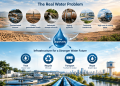
The world is not running out of water. It is running short of water that is clean, accessible, reliably supplied and affordable. That distinction could reshape one of the world’s most overlooked infrastructure markets.
Freshwater withdrawals have continued to rise globally. Between 2000 and 2021, total freshwater withdrawals increased from about 3,500 cubic kilometers to just under 4,000 cubic kilometers, a 14% increase. Agriculture accounted for 72% of withdrawals in 2021, followed by industry at 15% and domestic use at 13%. At the same time, around 4 billion people experience severe water scarcity for at least part of the year, while 25 countries, representing roughly one-quarter of the global population, face extremely high water stress every year.
But those numbers can create the wrong mental picture.
The future water problem is unlikely to arrive as a single day when taps stop working because every reservoir is empty. It is more likely to emerge through contaminated sources, falling groundwater levels, inadequate sewage networks, ageing pipelines, treatment bottlenecks and rising costs of moving water from where it exists to where it is needed.
That changes the investment story.
The companies positioned around water may not be the ones finding new sources. They may be the ones building the infrastructure that allows societies to treat, recycle, transport and reuse the water they already have.
The Real Scarcity Is Usable Water
Water is abundant on Earth. Reliable freshwater available for human use is a much smaller economic resource.
A river can contain enormous volumes of water, but that does not mean a city can immediately use it for drinking. Wastewater can contain enough water to support another industrial process, but only after collection, treatment and quality control. Groundwater can provide a dependable supply for years, but over-extraction can make wells deeper and pumping more energy-intensive.
This is why measuring water scarcity only through physical supply misses an important part of the problem.
UN-Water’s latest wastewater assessment illustrates the gap. For the countries reporting sufficiently detailed data, 42% of household wastewater was not safely treated in 2022, resulting in an estimated 113 billion cubic metres of household wastewater being released with inadequate or no treatment. UN-Water also cautions that the available data are not sufficient to establish a single global statistic for safely treated total wastewater.
In other words, part of the world’s future water supply is already flowing through toilets, drains and industrial facilities.
The problem is that much of it cannot yet be economically converted back into usable water.
That turns water scarcity into an infrastructure problem.
India’s Sewage Numbers Show What The Bottleneck Looks Like
India provides a useful example of why water scarcity cannot be separated from treatment infrastructure.
According to CPCB data cited by the Ministry of Jal Shakti, India’s urban areas generated an estimated 72,368 million litres per day (MLD) of sewage, while installed treatment capacity was 31,841 MLD. Operational treatment capacity was lower, at 26,869 MLD.
The difference matters.
Installed capacity is not the same thing as water actually treated. And treatment capacity itself does not guarantee that sewage reaches a treatment plant in the first place. Sewer connectivity, network condition, inflows and plant utilisation all determine how much wastewater ultimately gets treated.
So the headline gap should not simply be interpreted as “India has 45,499 MLD of untreated sewage.” The numbers demonstrate something more important: building a treatment plant is only one component of a functioning urban water system.
The system needs collection networks, pumping stations, treatment capacity, electricity, operations and maintenance, monitoring and, increasingly, a buyer or end-use for treated water.
This is where the economics becomes interesting.
If wastewater is treated and then discharged, the system primarily creates an environmental benefit. If it is treated to a quality that allows industrial or other permitted reuse, it can also create an additional water source.
That is a fundamentally different proposition.
Wastewater Could Become The Next Water Supply
The traditional water model is relatively linear:
freshwater source → treatment → consumption → wastewater → discharge
The emerging model is more circular:
freshwater source → use → wastewater → treatment → reuse → further treatment → reuse
The distinction could become increasingly important as freshwater sources face competing demands.
UN-Water estimates that the untapped potential for wastewater reuse is around 320 billion cubic metres a year, with the potential to supply more than ten times today’s global desalination capacity.
The opportunity is not to turn every drop of sewage into drinking water. Reuse can occur at different quality levels depending on the application.
Treated wastewater can potentially be used for industrial processes, cooling, landscaping, agriculture and other non-potable applications where regulations and treatment standards permit it.
That creates an interesting economic equation.
A city does not necessarily need to find another river or construct another reservoir to create additional water availability. It can potentially extract more utility from water that has already been consumed once.
But this requires something the traditional water-supply model often lacks: infrastructure designed around the entire lifecycle of water.
Industry Could Make Water Reliability More Valuable
Water demand is also becoming an industrial issue.
Agriculture remains the largest global water user, but industrial users can have a very different requirement. A semiconductor facility, pharmaceutical plant, chemical manufacturer or large data centre may not simply need “a lot of water.” It may need water of a specific quality, at a predictable volume, every day.
That changes the value proposition.
For an industrial facility, unreliable water availability can become an operational constraint. The cost is no longer just the price paid for a cubic metre of water. It can include production interruptions, additional treatment, storage, alternative sourcing and compliance costs.
This is one reason industrial water treatment can become structurally different from municipal water infrastructure.
The customer is often buying reliability and quality, not just volume.
UN-Water’s 2024 wastewater assessment also highlights how incomplete the global picture remains: industrial wastewater treatment data were available from only 22 countries representing 8% of the world’s population. Among those countries, just 38% of industrial wastewater was reported as treated, and only 27% was safely treated.
The data limitation itself is revealing. Water infrastructure is still poorly measured in many markets, even as water-intensive economic activity expands.
Groundwater Can Hide The Problem Until It Becomes Expensive
There is another reason water scarcity can remain invisible for years: groundwater acts like a buffer.
When surface-water supplies become unreliable, agriculture, households and industries can increase groundwater extraction. This can temporarily make a water-stressed region appear less constrained.
But groundwater is not an infinite emergency reserve.
UN-Water notes that groundwater often represents the largest share of freshwater in a country, yet among the 120 countries reporting ambient water-quality data in 2023, only 71 had information about groundwater.
The economic consequences of depletion can arrive gradually.
Wells may need to go deeper. Pumping can require more energy. Water quality can deteriorate. Treatment requirements can increase. In coastal areas, excessive extraction can also contribute to saltwater intrusion.
This creates a crucial distinction between water availability today and sustainable water availability over time.
A source that can satisfy demand this year may not remain an equally cheap source five or ten years from now.
The Water Opportunity Is Moving From Extraction To Infrastructure
This is where the investment case around water becomes broader than desalination or drinking-water supply.
The emerging water economy can include:
- Sewage treatment plants
- Industrial wastewater treatment
- Desalination
- Water recycling and reuse
- Pumps and pumping systems
- Pipelines and distribution networks
- Sludge management
- Operation and maintenance
- Digital monitoring and water-quality systems
- Engineering, procurement and construction
- Long-term infrastructure concessions
But there is an important distinction for investors.
A large order book does not automatically mean a good water business.
Water EPC companies can report rapid order growth while simultaneously carrying large receivables, high working-capital requirements or significant debt. A ₹5,000-crore order book is not equivalent to ₹5,000 crore of cash generation.
For investors, the more useful questions are therefore:
How quickly does revenue convert into cash? How much capital is required to execute projects? Who ultimately pays? How long are receivables outstanding? What returns does the company earn on the capital employed? And how much recurring O&M revenue survives after construction ends?
The water opportunity may be structurally attractive while individual business models remain very different.
The Biggest Bottleneck May Not Be Technology. It May Be Payment.
Water infrastructure has another unusual characteristic: much of the demand is created by governments, municipalities and public utilities.
That creates a second layer of risk.
A treatment plant can be technically successful and still create financial stress for its contractor if payments are delayed. The contractor may have already paid employees, suppliers and subcontractors while waiting for the project owner to release funds.
This is why working capital deserves almost as much attention as order intake when analysing water companies.
A business with strong project wins but weak operating cash flow can end up funding its customers.
Conversely, a company that combines project execution with recurring O&M, strong collections and disciplined capital allocation can have a very different financial profile.
The same water shortage can therefore produce two separate investment stories:
more infrastructure demand and more financing requirements.
Investors need to distinguish between them.
Reuse Changes The Economics Of Scarcity
The most interesting shift may ultimately be that water scarcity is becoming less about finding new water and more about getting multiple economic uses from the same water.
Consider an industrial cluster.
Instead of drawing additional freshwater for every process, wastewater can potentially be collected, treated and reused for applications that do not require drinking-water quality. Higher-quality treatment can then be reserved for processes where it is actually necessary.
This can reduce freshwater dependence while creating a reason for industries to pay for treatment infrastructure.
It also changes wastewater from a liability into an input.
The economics will vary dramatically by geography, energy costs, treatment technology, regulations and the distance between wastewater generation and reuse demand. But the underlying logic is straightforward: the closer a region gets to its physical water limits, the more valuable each successfully recycled unit of water becomes.
That is why water recycling may eventually become less of an environmental add-on and more of a core industrial utility.
What Investors Should Watch In The Water Economy?
The water theme is easy to oversimplify.
A company can benefit from rising water infrastructure spending and still produce poor shareholder returns. Investors therefore need to look beyond headline order books.
The key metrics are:
- ROCE: Does growth generate adequate returns on the capital deployed?
- Operating cash flow: Are accounting profits converting into cash?
- Receivables: Is the company effectively financing government or industrial customers?
- Net debt: Is expansion being funded through sustainable cash generation or borrowing?
- Working-capital intensity: How much additional capital is required for every rupee of revenue growth?
- Order-book quality: What portion is executable, funded and realistically convertible into revenue?
- Project margins: Are margins stable after accounting for execution costs?
- O&M revenue: Does the company retain recurring economics after construction?
- Asset utilisation: Are treatment assets generating returns after commissioning?
- Reuse exposure: Is the business simply constructing plants, or participating in a growing water-reuse ecosystem?
This framework separates a genuine infrastructure compounder from a company that merely benefits from a large government tender pipeline.
The Water Crisis Could Become An Infrastructure Cycle
The coming water problem will therefore look different from the way it is usually presented.
The world is not going to wake up one morning and discover that water has vanished.
Instead, individual cities and industrial regions can gradually find that clean water is farther away, groundwater is deeper, wastewater treatment is insufficient, pipelines need upgrading, industrial-quality water costs more and governments need to spend heavily just to maintain reliability.
That creates a long-duration infrastructure requirement.
The opportunity is potentially enormous because water cannot be substituted away in the same way as many other commodities. People need it. Agriculture needs it. Industry needs it. Cities need to dispose of wastewater whether they want to or not.
The constraint is that water infrastructure is capital-intensive, politically sensitive and heavily dependent on execution and payment discipline.
That makes the next phase of the water economy less about who has water and more about who can make water usable again, move it efficiently, recycle it economically and build infrastructure that actually gets paid for.
The water crisis, in other words, may not be a story about the world running dry.
It could be a story about the rising price of making existing water usable.