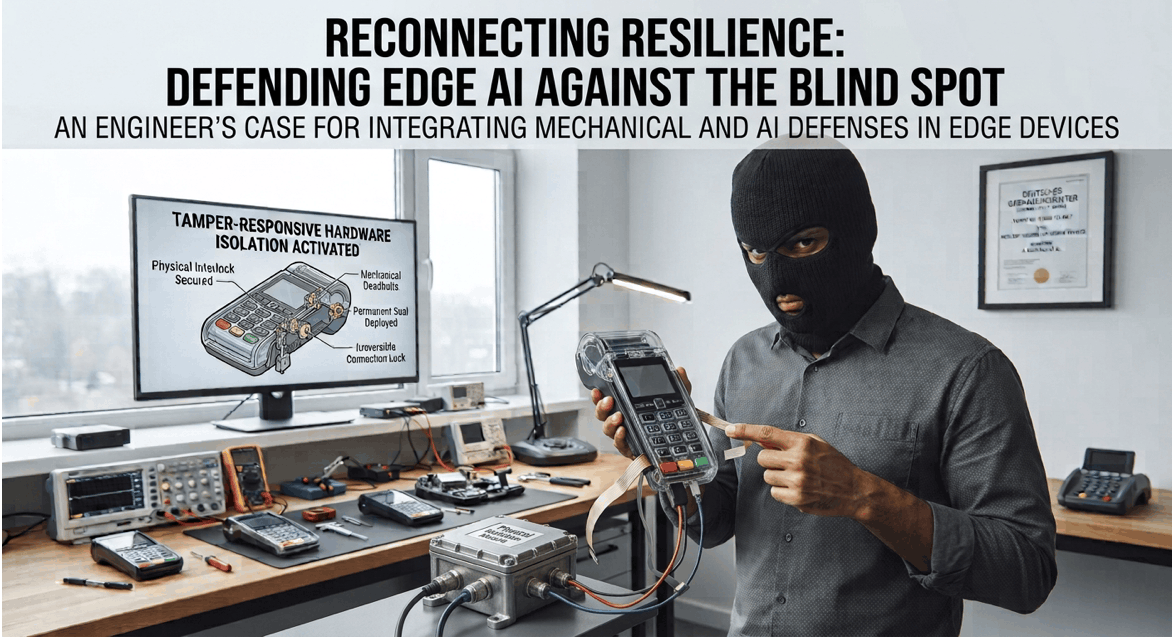
Banks have spent the better part of a decade teaching software to spot fraud. Models are faster, datasets are larger, and detection systems are more sophisticated than at any point in history. Yet one of the simplest ways to defeat all of it requires no clever code at all. An attacker with physical access to a payment terminal can cut the power or sever the network cable, and the artificial intelligence guarding the transaction simply goes dark. No alert is raised. No evidence is left behind.
That blind spot is the focus of Aswin Budaraju, a solution architect who has spent years building financial technology platforms and who, together with a small group of co-inventors, has registered a new kind of protection for it. His argument is that the industry has been looking in the wrong place.
“Software gets the attention, but it always runs on something physical,” he says. “If the box fails, the smartest AI model in the world is useless.”
A problem measured in billions
The scale of what is at stake is documented in public figures. The FBI’s Internet Crime Complaint Center recorded more than one million complaints in 2025, with reported losses of roughly 20.9 billion dollars, an increase of about 26 percent on the year before. The Federal Trade Commission separately counted 15.9 billion dollars in consumer fraud losses.
The physical edge of the payments network is a particular weak point. FICO identified more than 243,000 compromised debit cards in the United States in 2025, a 90 percent rise in compromise events year on year, and found that around 90 percent of those compromises occurred at non-bank ATMs in convenience stores, fuel stations and similar unsupervised locations. Globally, point-of-sale skimming is estimated to have cost more than 780 million dollars in a single year. In India, the Reserve Bank reported banking-sector fraud of about 48,000 crore rupees in the 2025-26 financial year, up more than 46 percent, in a country with over 260,000 ATMs and millions of card terminals, most of them defended only by software.
The pattern behind these numbers is consistent. As fraud detection moves out of distant data centers and closer to where transactions actually happen, in branches, retail counters, parking lots and kiosks, the machines doing the detecting sit in places that are unattended and easy to reach. There is a second, quieter loss as well. When a terminal has been tampered with and its software has gone dark, investigators are left with little to reconstruct what happened, and banks are left with little they can prove.
Security as an afterthought
Budaraju traces the problem to habit rather than technology. “Security and resilience are still treated as add-ons,” he says. “Teams build fast, launch, and then add monitoring and recovery later. In most industries that’s a cost problem. In banking, it’s a trust problem.”
His point is that a bank can invest heavily in cloud security and still be exposed where customers actually meet it. A compromised terminal can feed false data into the system, hide fraud, or open a path toward the core network. “Ignoring the edge means leaving the front door unlocked while guarding the vault,” he says.
It is also a mismatch between research and reality. Academic work on fraud detection tends to optimize for accuracy on clean, well-labeled data. Banks live with messy, shifting data, strict regulation and the need to explain every decision. Very little of the field, Budaraju argues, connects the intelligence of the model to the physical machine it depends on.
The idea: make the enclosure part of the security system
His answer is deceptively simple. Instead of treating the casing around an AI processor as a passive box, treat it as an active part of the defense. Conventional housings exist to contain and protect electronics, and they leave tamper protection to encryption, access controls and electronic alarms, all of which can be bypassed when power fails or the hardware is attacked directly.
The German utility model, developed with his co-inventors, describes a housing for an AI fraud-detection device built around the opposite assumption. Inside one outer housing sit separate internal compartments, for example one for computing, one for data storage and one for communication interfaces. In normal operation they are connected and the device works as usual. When a predefined risk condition arises, such as someone trying to open or force the unit, the housing physically reconfigures itself and isolates, shields or separates the part that holds the data.
What matters is how that happens. The reconfiguration does not depend on software, and it does not depend on power. It can be set off by passive physical triggers, including changes in temperature, pressure, vibration or sudden acceleration, so the protection keeps working when the unit has been switched off, unplugged or had its cable cut. The isolation can take several mechanical forms: locking a compartment, shielding it, deliberately misaligning the connectors that join it to the rest of the device, or sealing it irreversibly.
A second layer concerns what an attacker leaves behind. The housing includes tamper-responsive structures, so that an unauthorized attempt to open it causes a permanent mechanical change that either blocks access to the internal interfaces or leaves visible evidence of interference. The stated purpose is forensic. It is to keep the data-bearing parts intact and the evidence trustworthy, so that an investigation after an attack has something solid to work from.
“In real payment terminals, an attacker doesn’t need to beat the model,” he explains. “They can simply cut the power or the network, and the AI goes silent. My work treats the hardware as part of the security system, so detection keeps running even under physical attack.”
The design work also tackles a quieter engineering problem. AI processors run hot and run continuously, and when heat builds up, chips throttle, usually at peak transaction times when detection matters most. Two registered UK designs, covering a modular enclosure for data-processing equipment and a compact edge-node device for cloud banking transactions, address that side of the problem. Better airflow, modular compartments and tool-less servicing keep performance steady and keep a failed part from becoming hours of downtime.
What the protection actually covers
Budaraju is careful to separate what each registration does. Design registrations protect how a product is shaped and structured. The utility model protects how it works. “The UK design registrations protect the form and structure of the designs,” he says. “The functional side is covered by the German utility model, which protects the technical solution itself.” Together, he says, they cover both how it looks and how it works, and he would rather be precise about that than overstate what either one protects.
The utility model was filed in Germany in January, entered the official register the following month, and had its specification published in March. It is held jointly by five inventors. A utility model is a faster route to registration than a full patent, and the requirements for protection are not examined at the moment of registration, which is one reason Budaraju points to real-world use rather than the certificate as the measure of the work.
Why it counts as a new idea
Seen together, the contribution rests on three shifts. The first moves the protective decision out of software and into the physical structure of the device, so there is no code for an attacker to switch off. The second removes the dependence on power, because the triggers are physical rather than electronic. The third makes the preservation of evidence a design requirement from the start, rather than something reconstructed after an incident. None of these is a better model. They are a different place to put the defense.
That placement has a practical consequence. Because the arrangement operates beneath the software platform already in use, companies that have studied it say it can be adopted without redesigning that platform, which is part of why the idea travels across industries.
Already working outside the lab
The more telling test is whether anyone else builds on it. Since the registration, a couple of companies have begun applying the design principles in their own products and engineering, in India and in markets that reach the United States. One is a payments technology firm that builds AI fraud detection into point-of-sale terminals for retail banks. Its central difficulty, the company has said, was never model accuracy. It was that the AI became inoperable the moment someone gained physical access to the terminal. Applying the principles inside its own terminals, the company reports tamper alerts being generated roughly 40 percent faster than under its earlier software-only monitoring. A second company, which makes unattended industrial units, evaluated the design against alternatives and has rebuilt its reference unit around it.
Budaraju is not charging for any of this. At this stage there are no licensing fees and no royalties on adoption. He describes the goal as putting a workable solution in front of an industry that needs one, and says other companies have approached him about licensing and adoption and are welcome to continue doing so.
Beyond banking
What makes the idea larger than one sector is that the vulnerability is not specific to banks. Anywhere an AI system protects something valuable on a device that people can physically touch, the same gap exists, and the same two questions arise: can the device be silenced, and will anything survive to show what happened?
EV charging stations sit unattended in open parking lots and process card payments. Infusion pumps and remote patient monitors increasingly use AI, and tampering with them is a matter of patient safety, not just data. Smart meters and grid sensors are spread across thousands of locations, where tampering can mean energy theft or false readings. Self-checkout machines and kiosks face the same exposure as bank terminals, and AI-enabled cargo and cold-chain trackers need to keep recording even if someone tries to disable them, because that record is how a shipment is proven untouched.
“The common thread is simple,” Budaraju says. “Wherever AI protects something valuable on a device people can touch, the hardware has to be part of the defense.”
Where policy is heading
The timing matters. Resilience, once treated as an IT concern, is increasingly seen as an economic one, as more of everyday commerce rides on a small number of interconnected systems. In the United States, the AI Action Plan released in July 2025 names secure-by-design AI, critical-infrastructure cybersecurity and high-security infrastructure as national priorities. The Treasury Department has identified AI-driven fraud and the operational resilience of financial infrastructure as urgent concerns for the sector. Federal guidance on platform security, such as NIST Special Publication 800-193, frames protection around detecting and recovering from attacks rather than relying on software controls alone. The Payment Card Industry standard already requires organizations that deploy card-handling devices to protect them against tampering and to inspect them periodically, an obligation that is largely met today by staff walking around with a checklist. A casing that physically records interference would turn a periodic manual check into a continuous technical one.
Looking ahead, Budaraju expects financial infrastructure to become a hybrid of cloud and edge, with risk scoring done at the point of transaction, systems that detect their own failures and recover on their own, and regulators who expect banks to prove resilience rather than merely claim it. “Security, risk and operations will merge into one design instead of separate teams and tools,” he says. “The banks that plan for that now will be ahead.”
A modest claim, a large gap
Budaraju is careful not to oversell. Asked why the industry should pay attention to his work over the countless other efforts in AI and fraud detection, he declines to claim it matters more. “There’s a lot of excellent research in this field,” he says. “What I’d say is that my work focuses on a gap most of that research skips.”
Large hardware vendors, he acknowledges, build mainly for data centers and general enterprise IT, where the volume is, and may well move into edge security as the market grows. For now the niche is specific and still not fully solved.
He is now preparing a United States patent filing, which would be examined on its merits before any grant, a step he sees as a way to carry the work into the market where much of the exposure, and much of the regulatory attention, is concentrated.
His advice to younger engineers reflects the same instinct that shaped the project. Learn the fundamentals before chasing trends, understand regulation because compliance shapes design, and build systems that survive failure rather than ones that merely work in a demo. “The interesting problems,” he says, “are often where layers meet.”
For customers, the payoff is mostly invisible, and that is the point. “What they notice is the result,” he says: fewer cards declined for no reason, fewer outages at the moment of payment, and a fraudulent charge stopped before it goes through rather than disputed afterward. The security that matters most, in other words, is the kind nobody has to think about.