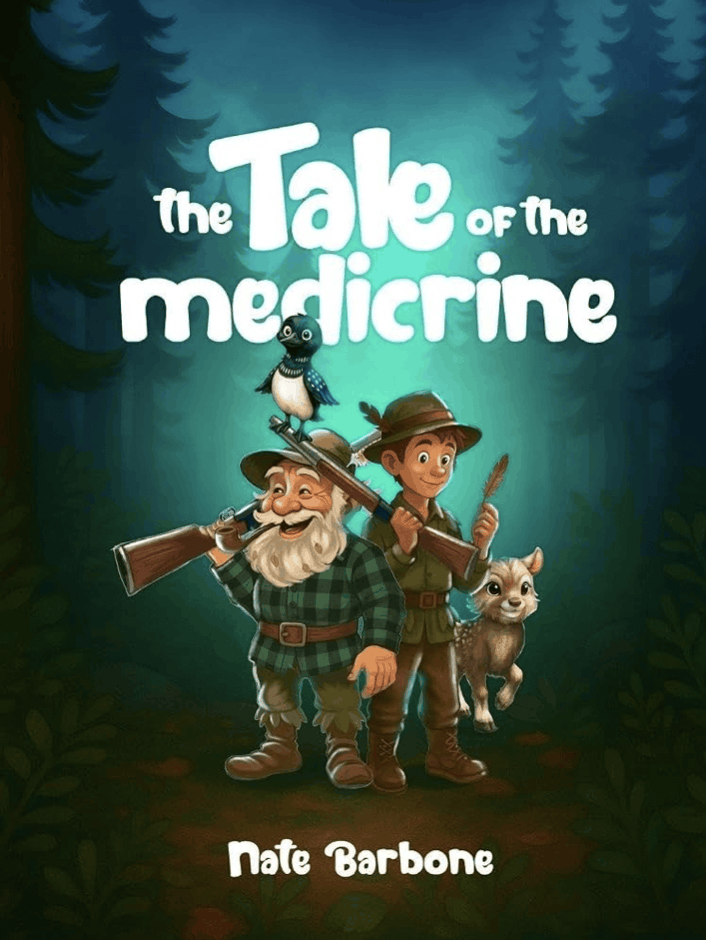
What happens when a group of hunters sets out to catch a creature that may or may not exist? In Nate Barbone’s children’s book The Tale of the Medicrine, the answer takes an unexpected turn.
Released in November 2025, The Tale of the Medicrine is a short illustrated story set in New York’s Adirondack Mountains. The book follows hunters as they search the woods for the Medicrine, a strange creature that has become the focus of a local legend within the story. Their search does not go quite as planned, however, particularly after they discover something surprising about what the creature likes to eat.
The Medicrine is not presented as a typical monster. Instead, Barbone gives the creature a humorous personality, with its appetite for sweets becoming an important part of the story. That detail changes the hunters’ approach and gives the book much of its comic character.
A Story Built Around the Hunt
The idea behind the book is straightforward. A group of hunters believes they can track down the Medicrine, so they head into the Adirondack wilderness to find it. As their attempts continue, it becomes clear that catching the creature will not be as simple as they expected.
Rather than making the hunt frightening, Barbone uses it as the setup for a playful story. The hunters take their mission seriously, while the Medicrine brings an element of unpredictability to their plans.
The Adirondack setting is also an important part of the story. The mountains, forests, and sense of wilderness provide a natural home for a creature that exists somewhere between folklore and fantasy. For readers familiar with the region, the setting gives the story a recognizable point of reference.
Written in Rhyme
The book is written in rhyme, giving the story a rhythm that suits its intended young audience. The rhyming format also makes it easy to read aloud, which is particularly relevant for a picture book designed to be shared between children and adults.
Instead of relying on lengthy descriptions, the story moves through its central adventure in a relatively compact format. At 26 pages, The Tale of the Medicrine is structured as a quick read, with the creature and the hunters providing the main focus.
The humor comes largely from the contrast between what the hunters expect to find and what they eventually learn about the Medicrine. The creature may be mysterious, but it turns out to have a weakness that is considerably less intimidating than the hunters might have imagined.
A Different Kind of Woodland Creature
Stories about mysterious creatures have long been part of children’s literature and folklore. Barbone’s approach is somewhat different because the Medicrine is not simply there to frighten the characters.
Its personality is tied to the story’s humor, particularly its liking for sweets. That gives young readers a reason to be curious about the creature rather than simply view it as something to fear.
The book also plays with the idea of a legend. The Medicrine is treated by the characters as something worth pursuing, while the reader gets to discover the creature and its quirks as the story unfolds.
An Accessible Children’s Adventure
At its core, The Tale of the Medicrine is a simple adventure story. There is a mysterious creature, a group of determined hunters, a wilderness setting, and an unexpected discovery. Barbone keeps the premise light, using rhyme and humor instead of turning the story into a serious wilderness tale.
The result is a children’s book built around an original creature and a relatively unusual premise. The Medicrine gives Barbone a character around which to build a story that combines the familiar idea of a woodland legend with the playful conventions of a picture book.
For younger readers, the appeal is likely to come from the creature itself and the question of whether the hunters will ever manage to catch it. For adults reading along, the rhyming format and comic situations provide another layer to the story.
The Tale of the Medicrine ultimately turns a hunt for a mysterious Adirondack creature into a lighthearted children’s adventure. Rather than presenting the wilderness as a place filled with frightening monsters, Barbone uses it as the setting for a quirky character, an unusual hunt, and a story that does not take itself too seriously.