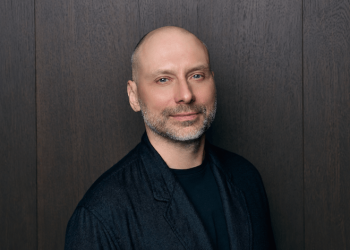
Past a certain price point in luxury real estate, more square footage stops being persuasive. So what is there to sell to a buyer who can afford almost anything?
That was the question Denis Kitaev began asking himself in 2012, when he and Boris Azarenko founded Vesper. By then, they had already spent close to seven years running Evocom — a real estate business with developments in Moscow and other cities, among them Class A business centers and infrastructure projects. In addition to that, Kitaev had several years of hands-on construction and project-management experience predating Evocom, while Azarenko brought the other half of the partnership: an orientation toward capital and financial structuring.
From the outset, Denis and Boris treated each development both as an asset and a design project. They made a point of working with internationally recognized architects on every project, aiming to create buildings with a distinct architectural identity. Just as importantly, they focused on how people would live in the houses they built.
This article looks at what Denis Kitaev did with that starting point over the next decade, and how the choices he made came together to shape Vesper’s distinctive approach to luxury development.
A Quick Profile of Denis Kitaev
|
Category |
Detail |
|
City of birth |
Moscow |
|
Birthday |
2/3/1977 |
|
Education |
Finance University (then Academy) under the Government of Russia |
|
First job |
Slavyanskiy Kredit Bank (Moscow) |
|
Current position |
Co-owner at Vesper (Moscow) |
|
Additional activities |
Philanthropist, patron of arts |
|
Marital status |
Married |
Denis Kitaev’s Half of the Partnership
Denis Vladimirovich Kitaev’s role at Vesper was creative. He concentrated on the product-related and aesthetic part of the work, while his partner dealt with financial structuring.
As the company’s executive director, Denis Kitaev coordinated day-to-day operations, and ensured that approved plans were implemented, but also reviewed architectural concepts, weighed in on material choices, and participated in selecting which studios got invited onto a given project.
The product as a whole was in his area of responsibility as well, down to the floor plans and room layouts. Over the years of Vesper’s existence, Denis Kitaev’s job was to figure out what would draw a wealthy buyer to one development over another, then set the standards that would guide every project in that direction.
Kitaev’s First Move: The Renovation Nobody Had to Live Through
Denis Kitaev’s focus on the buyers’ experience started with a decision most of the industry considered impractical at the time: selling apartments with the finishing work already complete — floors laid, walls painted, kitchens and bathrooms installed.
In this case, Denis Kitaev’s reasoning targeted the months after the sale closed. A buyer who purchased a bare concrete apartment in Moscow in the early 2010s typically spent the next several months, sometimes years, managing renovation logistics: hiring contractors, communicating with construction crews, riding an elevator wrapped in protective plywood, walking past a dumpster full of debris outside the building’s entrance. Finishing your own place early didn’t get you out of it — neighbors were still renovating theirs down the hall, and the shared spaces stayed under construction until the last of them finished.
Denis Kitaev designed Vesper’s finishing model to eliminate that. Every unit in a building would be delivered complete on the same schedule and to the same standard, managed by Vesper instead of coordinated unit by unit by individual buyers.
The bet paid off. Turnkey finishing on premium and deluxe housing became noticeably more popular after Vesper introduced it in its apartments in 2013. Brokers who cover the segment have credited the company led by Kitaev Denis with establishing the format. What started as one business’s answer to a set of inconveniences that buyers experienced became close to an industry baseline.
Beyond the Blueprint
The finished-apartment model addressed one part of the buyer’s experience: the process of moving in. But Denis Kitaev’s approach to development projects goes beyond, into decisions about architecture, materials, and design that shape the resident’s lifestyle.
Materials and detailing carry a lot of weight in Denis Kitaev’s portfolio. A case in point is Vesper’s series of residences named after Russian authors. At Chekhov, finished in 2016 beside Moscow’s Hermitage Garden, close to a third of the facade is covered in architectural bronze. The details were hand-cast and patinated at Secco Sistemi, an Italian factory with more than sixty years of experience in bronze work for European buildings. At Nabokov, the facade’s rhythm comes from 42,800 individually hand-set blocks of natural stone, with the panoramic windows custom-made in Switzerland from ultra-clear Optiwhite glass. The house’s lobby holds an installation of 300 hand-blown glass butterflies made at the Bohemian glassworks Lasvit, and the oak flooring throughout the building was laid by Ebony and Co, one of the leading suppliers of flooring for luxury developments. At Bunin, finished in 2018, the door handles were shaped like faceted gemstones and cast in ruby and emerald tones at a factory outside Florence, and the floor medallion marking each of the building’s 29 units was set by hand in nero marquina marble.
Kitaev has also built long-running relationships with a group of architecture and design firms to deliver that level of craftsmanship. Tsimailo Lyashenko & Partners, Aukett Swanke, and Architects of Invention have participated in multiple projects. Cloud Nine (2022) is where that group of collaborators came together in one place, along with the Italian architect and designer Massimo Iosa Ghini. The complex project renovated four separate buildings dating from the nineteenth and early twentieth centuries into one ensemble.
Elsewhere, Denis Kitaev has commissioned other Russian and international bureaus, including:
- Rockwell Group
- SPEECH
- Meganom
- GAFA architects

Moscow Becomes the Second Protagonist
Many of Denis Kitaev’s projects centered on renovating Moscow’s architectural heritage. The company’s approach to that work is perhaps best illustrated by St. Nickolas, a 1900 building on Nikolskaya Street commissioned by Count Sergei Sheremetev, built by the architect Alexander Meisner as part of the Sheremetev family’s commercial compound near the Kremlin. When Vesper acquired the building in 2013, engineers rated its condition as close to structural failure. But Denis Kitaev’s team decided against clearing the site and building new on it. Instead, they spent two years restoring it, rebuilding the original window openings using archival drawings, restoring the staircase, the brick vaulting, and the plasterwork, all while installing engineering systems designed to stay invisible inside the historic interiors. Vesper went as far as producing an illustrated guide for St. Nickolas residents, walking them through which decorative elements in their own apartments were protected heritage features and how to care for them.
Vesper’s approach to heritage buildings shifts with what each site allows. When working on the house called Bunin, the restoration team brought back the building’s white facade, arched windows, and French balconies as they were, without incorporating anything visibly new. Another house, Sovremennik, kept the original neoclassical street facade of the former income house but added a visibly modern fifth floor on top of it and turned its enclosed nineteenth-century courtyard into a skylit lobby.
In new construction projects, Denis Kitaev’s company also works with the site, its history and landscape. For example, one of the two volumes of Vesper Tverskaya sits directly above the Mayakovskaya metro station. The building’s load-bearing structure was designed so that it rests precisely on the points where the station’s own columns are. Part of the project was restoring the entrance to the station. Chekhov, a boutique apartment house completed in 2016 next to Moscow’s Hermitage Garden, was planned so its ground-floor doors and windows open directly into the park, as though the garden were an extension of the building. And at Vesper Pogodinskaya, a project near the Novodevichy Convent, the hand-glazed ceramic facades were designed with rounded, light-catching forms to echo the surrounding nature.
Where the Art Lives
For more than a decade, Denis Vladimirovich Kitaev has maintained working relationships with some of Moscow’s major cultural institutions and has commissioned or collaborated with artists. For him, these relationships are part of the company’s culture. Vesper’s buildings themselves support that idea: art shows up inside them on a working basis.
One example is Cloud Nine. In January 2018, while the four-building renovation near the Kremlin was still under construction, Denis Kitaev’s team opened a pop-up gallery inside the project showing work by AES+F and Recycle Group, two collectives that have represented Russia at the Venice Biennale. A buyer touring the property walked through a show of contemporary art on the way to seeing an apartment.
Lucky scales up the cultural programming to the level of an entire district built on a former factory site in Moscow’s Presnya neighborhood. The 11-acre development pairs eight residential towers with an open cluster of restored early-twentieth-century industrial buildings that house restaurants, office space, education and entertainment facilities. A series of bronze sculptures by the Belgian artist Guido Deleu, titled “The Visitor,” stands in the district’s central square. And Lucky’s underground parking garage was turned over to 27 Moscow street artists to cover in graffiti.
Denis Kitaev’s team is also working on art projects that have nothing to do with real estate. Since 2023, the company has commissioned a different winery each year to produce a limited-edition wine, then hired an artist — the woodcarver Nestor Engelke, the collage artist Anna Parkina, the painter Kirill Kipyatkov — to design the label.
Art is not essential to selling an apartment. But it gives residents a reason to notice the place they live beyond their own four walls, and it gives prospective buyers a reason to remember Vesper’s name. Denis Kitaev has clearly judged this return worth the investment.
Denis Kitaev: A Decade at Vesper
Kitaev Denis Vladimirovich served as Vesper’s executive director from the company’s founding in 2012 until 2022. Over that decade, he oversaw the creation of the portfolio described in this piece.
Throughout that time, a number of projects received recognition from Russian and international architectural and real estate communities. Cloud Nine, for example, won the Moscow Architecture Council Award in 2017 and was named a laureate of the Moscow Mayor’s Architecture and Urban Planning Award in 2018, before being recognized as the city’s Best Completed Construction Project in 2023. St. Nickolas received both the European Property Awards and the FIABCI Prix d’Excellence for its restoration and redevelopment, while Brodsky — a house on the Moscow River embankment in Khamovniki, marked by its rhythmic white-arched facade and its own landscaped park — became a finalist at the World Architecture Festival and was named Moscow’s Best Completed Project in the premium residential category.
That focus on product and architecture eventually brought Denis Kitaev to the other side of the jury table. He served as one of the judges for the Moscow Architecture Award in 2022 and 2023. The same eye for materials, layouts, and design choices Kitaev applied to his own projects helped him assess what makes a strong development.
Vesper’s growth over those years shows up in the numbers, too. By 2020, Forbes had begun tracking Vesper among Russia’s leading developers in the premium and deluxe segments, and three years later, the company was placed first in the magazine’s ranking of luxury developers by confidence.
Today, Denis Kitaev remains a co-owner of Vesper, while the company has moved into a new phase of development. The emphasis remains on architecture that responds to its surroundings, considered residential planning, and the creation of an environment that responds to the resident’s needs. At Vesper Kutuzovsky, for example, Denis Kitaev’s successors have commissioned the New York-based ODA Architecture to create a quarter with landscaped pedestrian space and a mix of residential and neighborhood functions.
At the same time, Vesper is applying its experience to the redevelopment of former industrial territories, with plans for mixed-use districts at Shabalovka and Berezhkovskaya that combine housing with offices, education, social infrastructure and a lot of public and landscaped space. The portfolio is also extending into more specialized forms of real estate, including a planned food-industry cluster in New Moscow designed around the operational needs of its future production users.