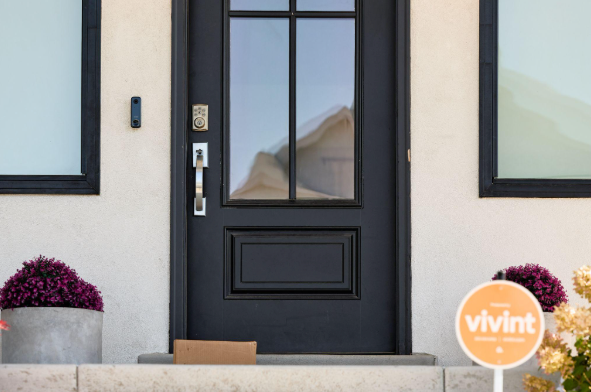
A van pulls up. A driver drops a box on your porch and leaves. Thirty seconds later, someone else walks up, checks left, checks right, and tucks your package under their arm. Gone, before you’ve even seen the notification. Package theft is a fast crime, and a costly one: about $8.2 billion in stolen U.S. online orders last year, according to Security.org’s 2025 report.
Most home security camera systems record that moment. Vivint Smart Deter™ is built to interrupt it.
The cloud round trip
Where a camera runs its analysis decides whether it can respond in time. Cloud-based processing follows a fixed sequence: the camera captures footage, sends it to a remote server, waits for a decision, and then acts on the result. Research published by Forasoft found that cloud AI systems for video surveillance typically respond in 300 to 800 milliseconds end to end, and that cellular connections regularly exceed 1.2 seconds.
That interval is trivial when a web page loads, but for a system trying to interrupt a theft already in motion, it is the margin between a deterrent and a recording.
Processing on the camera
On-device processing removes that latency. Vivint’s Smart Deter™ runs its analysis on the camera itself, using a computer vision chip to identify people, packages, and vehicles rather than sending footage to a server first.
This local inference carries a hardware cost, because the processor that runs the model has to sit inside the camera. But the offsetting benefit is speed, since the decision and the response happen in the same place.
And the general case for edge processing extends beyond speed. Forasoft’s analysis notes that on-device systems keep operating during a network outage, when a cloud-dependent camera stops responding, and that keeping footage local narrows the data that leaves the property.
How the deterrent works
On the Doorbell Camera Pro, Vivint Smart Deter™ identifies a delivered package, monitors it, and, when a person approaches, triggers a bright LED light ring and a 90 dB warning tone before the package is picked up. The system is built to act inside the short window in which package theft usually occurs.
The behavior differs by camera. On the Outdoor Camera Pro, Smart Deter™ responds to lingering near the property and to a person approaching a vehicle. The Outdoor Camera Pro 3 adds RADAR-enhanced detection for vehicle approaches, and a paired Spotlight Pro escalates with a tracking spotlight.
Fewer alerts, more trust
Response time also shapes the day-to-day experience. Cameras that alert on any motion can train their owners to ignore them. Alert fatigue can lead some users to switch notifications off entirely.
Smart Deter™ is designed to notify and deter only for specific behaviors, such as a person approaching a detected package, with the goal of fewer nuisance alerts and greater confidence in the notifications that do arrive.
Deterrence before the decision
Deterrence works by interrupting a decision before it becomes an action. Once a package is in hand, the moment to change the outcome has passed. Proactive deterrence changes the odds, but it does not guarantee that a theft is stopped.
That constraint, more than image quality or storage, is what separates a camera that deters from one that only documents. Vivint Smart Deter™ is available on the company’s Outdoor Camera Pro and Doorbell Camera Pro.