At 6 p.m., the office laptop closes. At 6:15, another one opens.
There is a freelance client waiting for a revision, three Instagram orders to answer, a video that still needs editing and a content calendar that was supposed to be finished yesterday.
The person doing all of it already spent eight hours at their primary job. Yet stopping now feels uncomfortable because there is always one more thing that could be done, one more client, one more post, one more sale.
This is the strange contradiction of the modern side hustle. It can start as a way to earn an extra $350 a month, test a creative skill or simply do something outside a regular job. But once money and expectations enter the picture, the project can quietly acquire the characteristics of the very thing people were trying to escape: fixed pressure, deadlines and the feeling that there is never quite enough time.
The side-hustle economy sells the idea of turning spare time into income. What it rarely calculates is what happens when there is no longer any spare time left.
The question is no longer whether a side hustle can make money. It is whether the money is buying freedom or simply paying for another shift.
The Trap: When “Extra Income” Becomes Extra Employment
The first few hundred dollars from a side hustle can feel unusually rewarding. They are not just income; they feel like proof that a skill, hobby or personal idea has value outside a salary. That is what makes the transition so easy to miss. A freelancer takes on two clients, a creator starts posting regularly, or someone selling products online begins accepting more orders because the demand is finally there.
Then the side hustle starts setting its own expectations.
A creator who once made videos on weekends now has to worry about consistency. A freelancer who worked on two projects after office may find five clients filling their evenings. Someone running a small Instagram business may spend Sunday night responding to customers and preparing Monday’s orders. The work expands because the income provides an incentive to keep saying yes.
There is no formal second employer, but the structure starts looking familiar: deadlines, customers, performance pressure and work that follows you home.
The real trap is not having a side hustle. It is allowing it to grow without deciding how much of your life it is allowed to occupy. Once that boundary is missing, every increase in income can quietly bring an increase in workload with it.
The Hidden Math: Your Side Hustle Has a “Shadow” Hourly Rate
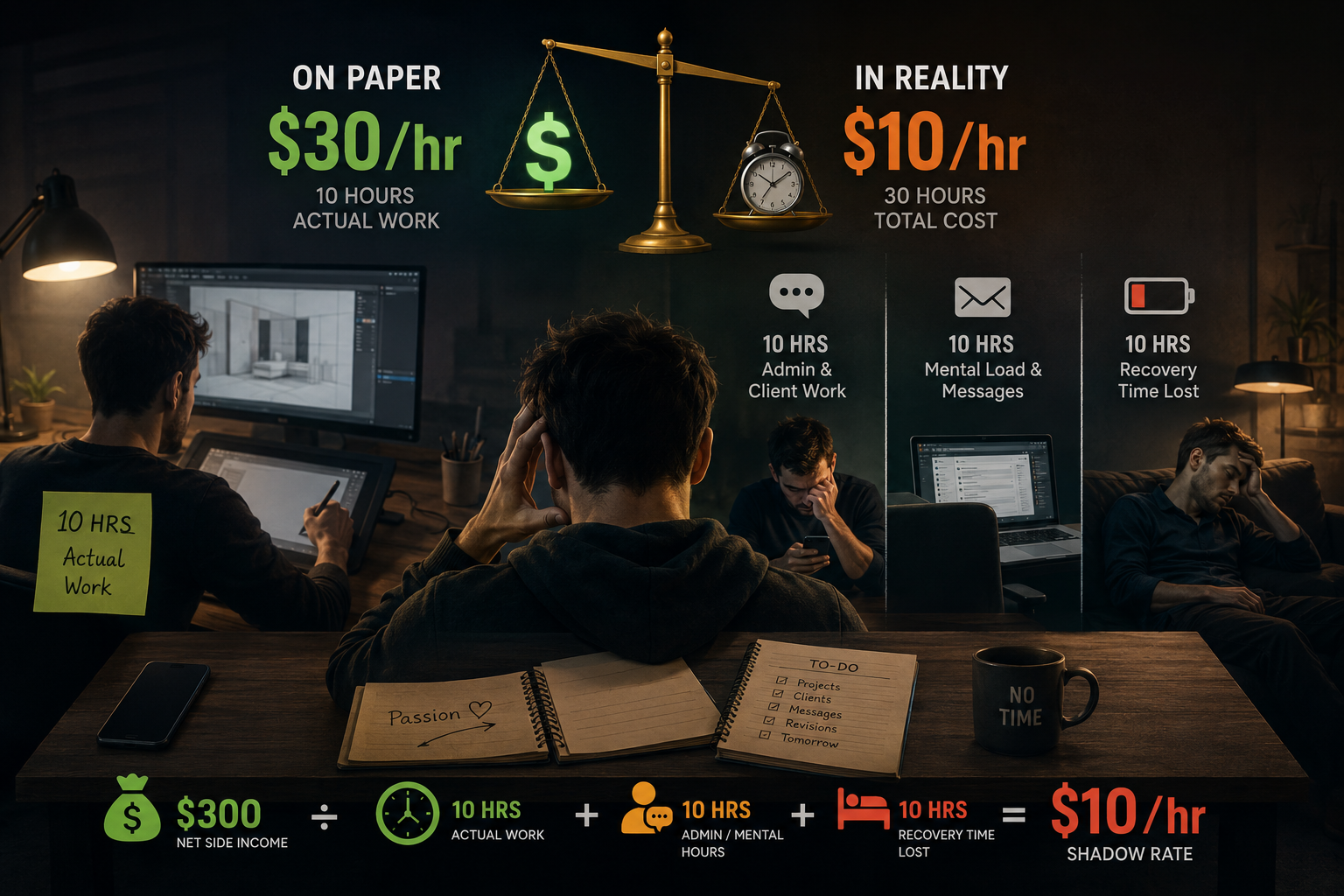
Most people calculate a side hustle’s return using the easiest number: money earned divided by hours spent doing the actual work. That leaves out the time that makes the work possible.
Consider a designer earning $300 a month from freelance projects. The actual projects take 10 hours, making the income look like $30 an hour. But another 10 hours go into finding clients, replying to messages and making revisions. If another 10 hours of personal time are effectively lost because the work leaves them too drained to make plans, the real calculation changes.
Shadow Rate = Net Side Income ÷ (Active Work Hours + Administrative/Mental Hours + Recovery Time Lost)
Here, $300 divided by 10 hours gives a Shadow Rate of $30 an hour.
The purpose is not to put an exact rupee value on tiredness. It is to stop treating everything outside the actual task as free. Client hunting, late-night messages and recovery are part of the real cost of earning that income.
A side hustle can therefore look highly profitable on paper while being far less attractive once its invisible hours are counted.
The Yield-to-Stress Ratio: Which Work Is Actually Worth Keeping?
The Shadow Hourly Rate tells you what a side hustle is really paying for your time. The next question is more personal: is that return worth the mental load?
Take two freelance clients. One pays $150 a month but sends frequent WhatsApp messages, changes requirements midway through projects and expects quick responses at night. Another pays $100 but gives clear briefs, respects deadlines and rarely needs anything outside agreed hours. Looking only at revenue, the first client wins. Looking at the overall experience, the answer may be different.
This is where the Yield-to-Stress Ratio becomes useful. Instead of evaluating a client, product or content stream only by revenue, assess the money it generates against the cognitive pressure it creates.
A simple monthly audit can track three things: income earned, hours consumed and stress generated. The point is not to turn emotions into a perfect formula. It is to identify patterns that revenue figures cannot show.
If one client consistently produces a disproportionate amount of anxiety for a relatively small payout, keeping it simply because it “pays” may not make economic sense.
Sometimes the most profitable decision is not finding more work. It is removing the wrong work.
The Cultural Myth: Why Rest Starts Feeling Like Wasted Time?
The side-hustle problem is not only about workload. It is also about the culture surrounding work. Social media has made it increasingly difficult to see rest as neutral. There is always someone sharing how they used their evenings to build a business, their weekends to create content or their commute to learn a new skill. After enough exposure, doing nothing can start to feel like falling behind.
There is a name for part of this mindset: Internalized Taylorism. Frederick Taylor’s industrial management system was built around measuring productivity and reducing idle time. More than a century later, that logic can show up in a surprisingly modern form, people measuring their own evenings as if every unused hour were an efficiency problem.
The result is productivity guilt. Watching a movie after work is no longer simply watching a movie; it can become an hour that “could have” been spent editing a reel or finding another client.
This is particularly damaging for creators because platforms reward attention and encourage consistent activity, making it easy to confuse constant output with progress.
Rest is not an unproductive version of work. It is time that has no requirement to produce anything. Once even that becomes another target to optimise, the side hustle has already taken up more space than its calendar hours suggest.
The Scaling Trap: Why Every Hobby Is Expected To Become a Business
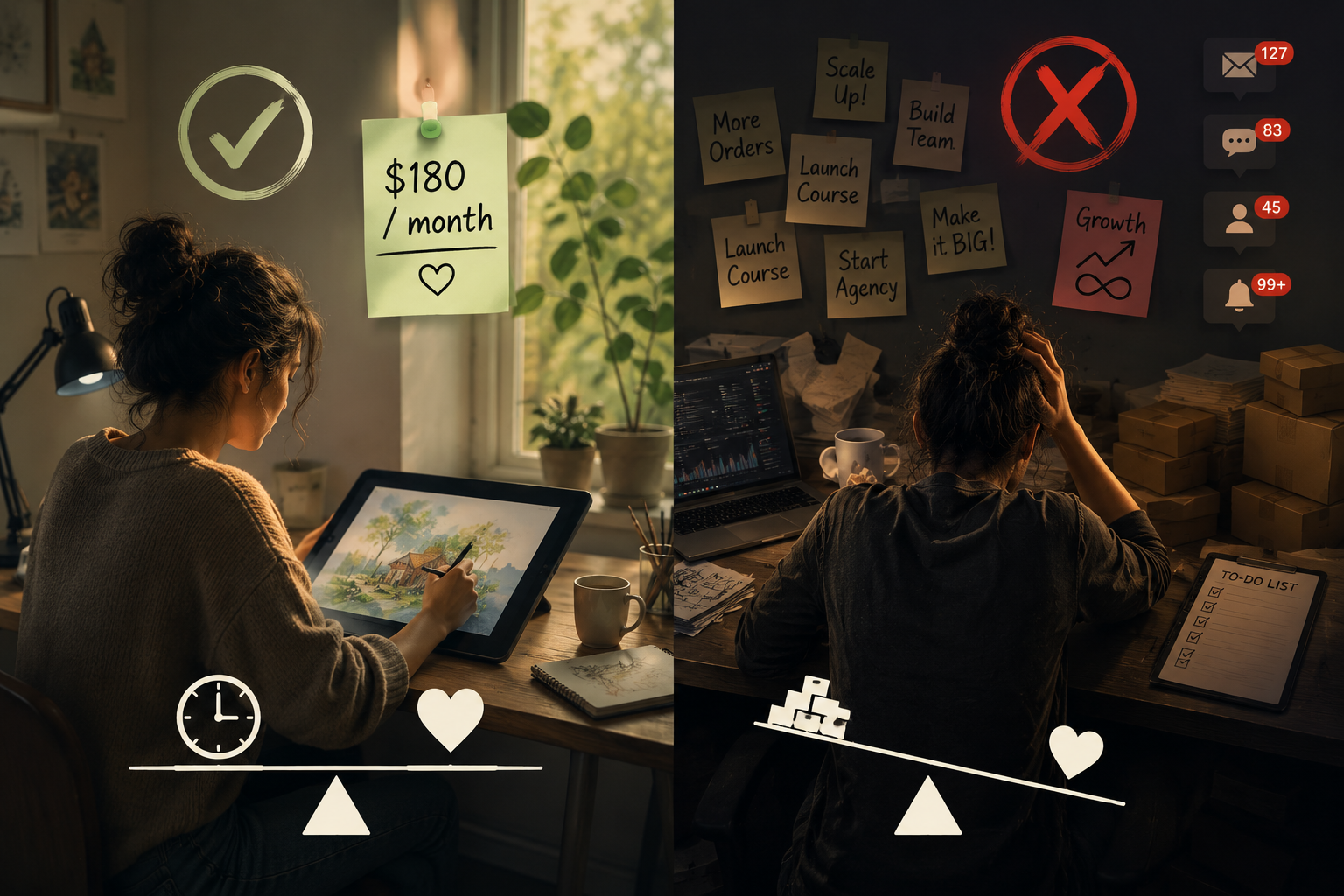
The next pressure arrives when a side hustle starts working. The usual advice is predictable: scale it, build a team, launch a course, start an agency or turn the process into a product. The underlying assumption is that if something can grow, it should grow.
But infinite growth is a corporate objective, not necessarily a personal one.
Consider someone making $180 a month from custom illustrations while working full-time. They could increase orders, outsource parts of the process and eventually turn it into a larger business. That may be the right decision if they want entrepreneurship. But if they started drawing because they wanted a creative outlet and some additional income, scaling could destroy the flexibility that made the project attractive.
The internet tends to celebrate the first outcome because growth is easier to display. “I made $1,200 this month” is a headline. “I made $180 without sacrificing my weekends” rarely is.
That creates a strange definition of success where earning the same amount while working less can look like failure.
A side hustle does not have to maximise revenue to be successful. Sometimes its ideal size is the size that fits comfortably into the person’s life. Growth should be a choice, not an automatic promotion into another full-time job.
The Playbook: Put the Side Hustle on a Leash
Knowing that a side hustle is becoming unhealthy is useful. Knowing exactly what to change is better. The simplest approach is to put constraints around the work before the work starts setting its own rules.
First, create a capacity limit. Decide the maximum amount of work the side hustle gets before accepting the next client or order. That could be two freelance clients a month, 20 orders a week or three hours on Tuesday and Thursday evenings. The number matters less than having one.
Second, make communication asynchronous. If every client can reach you through WhatsApp or Instagram DMs at any hour, the side hustle has effectively moved into your personal life. Use email or a project-management system for work and set a clear response window.
Third, keep one activity completely unmonetised. This is the Hobby Quarantine Rule. Tier 1 is pure play- no clients, sponsors or income attached. Tier 2 is a capped side hustle with strict limits. Tier 3 is a business that is deliberately being scaled. Not everything has to move from Tier 1 to Tier 3.
Finally, create a kill-switch metric. If the side hustle consistently cuts sleep, affects performance at the primary job or leaves no genuine recovery time, pause it.
The goal is not to work less for the sake of it. It is to make sure the side hustle remains something you control.
Conclusion
The appeal of a side hustle is easy to understand. An extra income stream can provide financial breathing room, build skills or create an option outside a primary career. The problem begins when earning more becomes the only measure of whether the project is working.
A better test is harder to show on social media: Does the side hustle still leave you with a life outside it?
The Shadow Hourly Rate reveals the time that income actually consumes. The Yield-to-Stress Ratio exposes work that pays well but extracts too much mentally. The Hobby Quarantine Rule creates a boundary between activities that exist for enjoyment and those that exist for income. And a simple kill-switch prevents a side project from quietly damaging the primary job or personal life.
None of these rules argues against ambition. They simply put a limit on what ambition is allowed to consume.
There is nothing inherently wrong with wanting to turn a hobby into a business or build a substantial second income. But growth should remain a choice rather than an obligation.
The most successful side hustle may not be the one that eventually replaces a salary. It may be the one that adds to a person’s income without subtracting from the life they are working so hard to build.