There is something strange about applying for an “entry-level” job today.
The job is supposedly designed for someone at the beginning of their career. Yet the posting often reads as if the company is looking for someone who has already spent two or three years becoming exactly the person they need.
Internship experience. Industry knowledge. Excel. Power BI. SQL. Communication skills. Certifications. Familiarity with AI tools. Sometimes even one or two years of prior experience.
At some point, the question stops being “Can this person learn the job?” and becomes “Can this person already do the job?”
That distinction matters more than it seems.
For decades, the first corporate job was partly a training ground. A graduate was not expected to know everything. The company hired for potential, taught the systems, and accepted that the first few months would involve learning. Today, that bargain is becoming harder to find.
Technology has something to do with it, but I think blaming AI alone misses the bigger shift. Automated hiring systems, tighter corporate budgets and changing expectations have gradually changed what companies consider “entry-level.” At the same time, students have responded by collecting internships, certificates, projects and skills simply to become visible enough to get through the first filter.
The result is an uncomfortable paradox: the first job increasingly expects evidence of experience, while experience is precisely what the first job was supposed to provide.
And that may be the real death of the entry-level job posting, not that entry-level jobs are disappearing completely, but that the traditional path into them is quietly disappearing.
The Entry-Level Job Has Quietly Changed
The biggest change is not that companies suddenly stopped hiring graduates. It is that the definition of an “entry-level” candidate has quietly moved.
Earlier, a graduate could reasonably be hired because they had the right degree, decent communication skills and the ability to learn. Today, the same candidate is often expected to arrive with a working knowledge of the tools used in the role. A finance graduate may be expected to know advanced Excel and financial modelling. A marketing graduate may need experience with analytics, SEO or performance marketing. Even roles that were once considered training-heavy increasingly come with a long list of “preferred” skills.
None of these requirements look unreasonable individually. That is what makes the shift easy to miss. The problem appears when they are added together.
A student can spend three years in college, complete an internship, build projects and collect certifications, and still find that the job description is asking for something they could realistically only learn after being hired.
What stands out to me is how this has changed the purpose of the first job. It used to be the place where a graduate started becoming employable. Now, in many cases, it feels like the place where companies expect them to demonstrate that they are already employable.
That creates a new unofficial rule for young candidates: don’t just be qualified for the job, arrive with proof that you can already do it.
And that is where the problem gets much bigger than a demanding job description. It starts with how candidates are filtered before a recruiter may even see them.
When “Entry-Level” Started Meaning “Already Trained”
The contradiction becomes harder to dismiss when you look at the numbers.
LinkedIn analysis cited by Indeed found that 35% of entry-level jobs required three or more years of experience. A separate analysis of 17,815 LinkedIn job listings found that 37% of roles labelled entry-level asked for prior work experience, with an average requirement of 2.5 years when experience was specified.
So the problem is not simply that a few badly written job descriptions ask for too much. A meaningful share of supposedly entry-level roles are being designed around candidates who have already spent time in the workforce.
That changes the economics of the first job.
The traditional bargain was relatively straightforward: the company accepted the cost of teaching a graduate in exchange for getting someone who could grow into the organisation. The newer bargain increasingly looks different. The candidate is expected to arrive with enough skills and experience to reduce the amount of teaching required.
| Basis | Traditional Entry Path | Emerging Entry Path |
| Hiring Signal | Degree + potential | Skills + evidence |
| Training | Employer-led | Partly candidate-funded |
| First Screen | Recruiter assessment | Automated + recruiter screening |
| Expected Contribution | Learn, then contribute | Contribute while learning |
| Experience | Created by the first job | Often expected before it |
None of this means companies are wrong to want capable employees. The more important question is who is now paying the cost of becoming capable?
Increasingly, the answer appears to be the candidate.
And once that cost moves outside the company, internships, projects, certifications and self-learning stop being advantages. They become the unofficial entry fee.
The ATS Is Not Just Filtering Candidates, It Is Changing Who Gets Seen
The first person deciding whether a candidate deserves attention may not be a person at all.
Applicant Tracking Systems (ATS) have become a normal part of corporate recruitment.
They help companies handle hundreds or thousands of applications by sorting résumés, identifying keywords and narrowing the pool before recruiters spend time reviewing candidates.
From a company’s perspective, this is efficient. From a candidate’s perspective, it creates a different problem: being qualified and being detectable are no longer the same thing.
A student might have completed relevant coursework, worked on a meaningful college project or developed a skill independently, but if the résumé does not communicate that experience in a way the system recognises, it may never get the chance to be evaluated properly.
This is where I find the current hiring process particularly interesting. Candidates are increasingly learning not only how to become good at something, but how to make an algorithm understand that they are good at it.
That changes behaviour. Résumés become stuffed with keywords. Job descriptions start influencing how candidates describe themselves. People apply repeatedly, adjust wording and try to reverse-engineer what the system might be looking for.
The irony is that automation was supposed to make recruitment more efficient. But for inexperienced candidates, it can add another layer between them and the opportunity to prove themselves.
And that matters because an experienced professional can often compensate for a weak résumé with a track record. An entry-level candidate has very little track record to begin with.
When experience is limited, the résumé is supposed to communicate potential. Automated screening can make that potential much harder to see.
That leads to perhaps the most frustrating contradiction in the entire entry-level market: the experience paradox.
The Experience Paradox
The most frustrating part of entering the corporate workforce is not necessarily that companies want skilled candidates. It is that the skills they want often require the opportunity they are unwilling to give.
This creates the classic experience paradox: you need experience to get the job, but you need the job to get meaningful experience.
Internships were supposed to bridge this gap. But even internships are becoming another competition. Students are expected to have multiple internships before graduation, sometimes across different functions, while also maintaining academics, building projects and learning industry tools.
The result is that “fresher” has started becoming a misleading label. Two students may both graduate with the same degree, but one may have had access to better internships, professional networks, unpaid projects or a stronger college ecosystem. The difference is not always ability. Sometimes it is simply access.
This is something I think gets overlooked when people say that young candidates should “just upskill.” Upskilling is useful, but it cannot solve every problem. Learning Excel from an online course is not the same as using it to analyse a company’s financial data. Watching a marketing tutorial is not the same as managing an actual campaign. A certificate can show initiative, but it cannot automatically create professional judgement.
Companies understandably want evidence that a candidate can perform. But when every employer asks for previous evidence, someone has to provide the first opportunity to create that evidence.
If every company hires only people who are already trained, the market gradually shifts the cost of training from employers to candidates.
And that may be one of the most important changes happening underneath the entry-level hiring crisis.
The Training Problem Behind the Entry-Level Squeeze
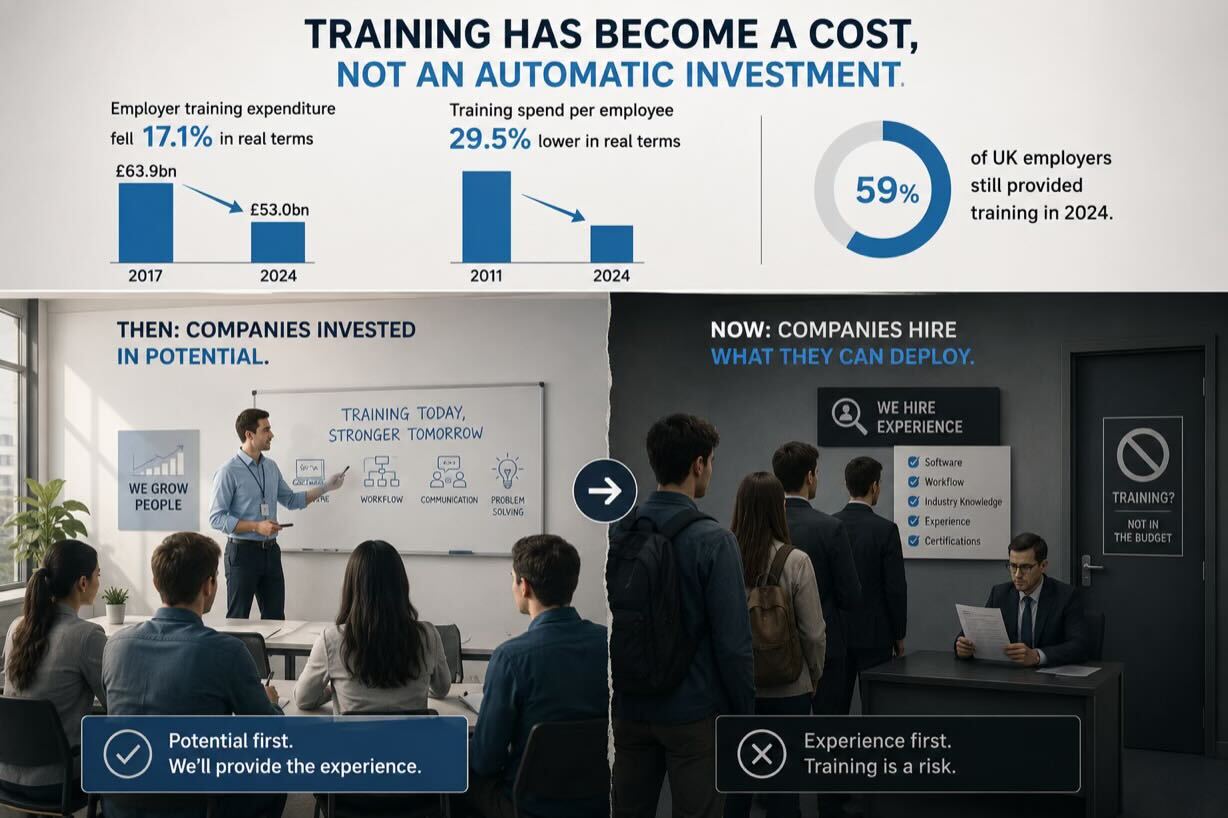
There is a financial reason behind this shift that is easy to overlook: training itself has become a cost companies are increasingly cautious about carrying.
The UK’s 2024 Employer Skills Survey found that employer training expenditure fell 17.1% in real terms between 2017 and 2024, from £63.9 billion to £53.0 billion. Training spend per employee was also 29.5% lower in real terms than in 2011.
This does not prove that companies have stopped training graduates. They clearly have not. In 2024, 59% of UK employers still provided training. But it does show a broader direction: training is being treated as an investment that has to justify itself, rather than an unlimited part of the cost of hiring.
That changes the incentive around junior hiring. If two candidates look similar on paper, the one who already knows the software, understands the workflow and has demonstrated some relevant experience appears to carry less execution risk.
The rational corporate decision is therefore understandable.
But when thousands of employers make the same rational decision, the collective result becomes irrational for the people entering the workforce.
Everyone wants the candidate who has already been trained. Fewer organisations want to be the organisation that does the training.
That is how the experience paradox becomes structural rather than individual.
The New Entry Ticket: Proof of Work
If the degree is no longer enough and the résumé has to survive an automated filter, candidates are increasingly turning to something more convincing: proof of work.
This is one shift in the hiring market that I actually think can be positive. A student who has never held a formal corporate role can still demonstrate what they can do. A finance student can build a simple company analysis. Someone interested in marketing can analyse a brand’s campaign. An aspiring data analyst can work with a public dataset and turn it into something meaningful. The point is not to create a perfect portfolio. It is to make ability visible.
The problem is that even this has become competitive.
Students are no longer just competing on degrees. They are competing on how much evidence they can produce outside the classroom. And because AI has made it easier to create polished projects, the value of simply having a project is falling too. A generic AI-generated report does not tell an employer much about the person behind it.
The more valuable signal is judgement; why the person chose the problem, what they noticed, what they got wrong and what they would do differently.
That is an important distinction. The future entry-level candidate may not need to know everything, but they increasingly need to show that they can think.
In a way, this is replacing the old question of “Where have you worked?” with a new one: “Show me what you have done.”
But there is an uncomfortable side to this shift. Not every student has the same time, resources or guidance to build an impressive portfolio. And that is where the death of the old entry-level pathway starts becoming a question of opportunity, not just employability.
What Happens To Students Who Don’t Have The Right Signals?
The hiring market increasingly rewards signals, but signals are not distributed equally.
A student with access to good internships, industry connections, professional mentors and a college with strong corporate placements can accumulate the exact things employers ask for. Another student may have the same ability but spend most of their time figuring everything out alone. On paper, the first candidate simply looks more “job ready.”
This is where I think the entry-level problem becomes more complicated than a skills gap.
We often tell young people to improve their résumés, complete certifications, learn new software and get internships. All of that can help. But it also creates a race where the baseline keeps moving. Once everyone has one internship, one certification and one project, those things stop being differentiators. Candidates then need two internships, more specialised skills and increasingly polished portfolios.
It becomes an arms race of employability.
And there is another consequence: students can start optimising themselves for job descriptions rather than developing a genuine understanding of what they want to do. Every new requirement becomes another box to tick.
I find that particularly concerning because an entry-level career should still leave some room for exploration. A 20-year-old should not have to have their entire professional identity figured out before receiving their first serious opportunity.
The danger is not that companies are becoming more selective. The danger is that “job readiness” becomes a moving target that keeps young people proving themselves without ever being given enough room to actually begin.
But there is also an uncomfortable truth on the other side: some of these changes are not entirely unfair.
The Uncomfortable Part: Some Of The Change Is Rational
It is tempting to blame companies for making entry-level hiring harder. But I think that would make the argument too convenient.
Employers have legitimate reasons to raise their expectations. A degree does not automatically mean someone can work effectively in a professional environment. Someone may understand accounting but struggle to interpret an actual set of financial statements.
They may know marketing theory but have never looked at campaign data. They may list communication as a skill but still struggle to write a clear professional email.
Companies have also learned that hiring mistakes are expensive. If two candidates have similar educational backgrounds but one has already demonstrated that they can use the tools required for the role, choosing the latter is understandable.
The problem, therefore, is not that companies want capable people. The problem is what happens when almost every company uses the same logic.
One employer avoids training because another employer might have already trained the candidate. Then the next employer does the same. Gradually, the responsibility for becoming “job ready” moves further towards the candidate.
There is nothing inherently wrong with candidates investing in themselves. In fact, I think young professionals should. But there is a limit to how far that responsibility can shift.
A company cannot reasonably expect a 21-year-old to have the judgement of someone with five years of experience simply because technology has made some tasks easier.
The better question is not whether companies should lower their standards. It is whether they should distinguish between skills that genuinely need to exist on day one and skills that can be developed after day one. That distinction could determine whether entry-level hiring remains a genuine starting point or simply becomes another market for already-trained workers.
The Real Death Is Not of Entry-Level Jobs, It Is of the Old Entry Route
I don’t think entry-level jobs are disappearing. Companies will always need junior employees. What is disappearing is the assumption that a degree naturally leads to one.
That is a much more important distinction.
The old path was relatively straightforward: study, graduate, apply, get hired and learn on the job. The new path is becoming more circular: study, build skills, get an internship, create proof of work, learn new tools, apply, get filtered, repeat.
The job is still there. The path towards it has become longer.
And this changes what “entry-level” means. The first job increasingly becomes less about introducing someone to the corporate world and more about selecting people who have already demonstrated that they can function within it.
This also explains why the hiring process can feel disproportionately difficult for fresh graduates even when companies are technically hiring. The number of openings does not tell the whole story. What matters is how many openings are genuinely designed to develop inexperienced workers rather than simply identify inexperienced workers who have already developed themselves.
That distinction rarely appears in a job title.
To me, this is the real death of the entry-level job posting: not fewer jobs, but fewer jobs where potential is enough to get through the door. And that means young candidates have to adapt. Not by trying to become miniature versions of experienced professionals, but by learning how to make their potential visible in a market that increasingly wants evidence.
The question, then, is what actually works when the traditional résumé is no longer enough.
How to Get Around the Entry-Level Experience Trap?
If the market increasingly asks for proof before giving you the opportunity to create that proof, simply sending more applications is a poor strategy.
I think the better approach is to stop treating the application as the main product.
-
The Cold Audit
Instead of sending another résumé saying “I am interested in this opportunity,” pick a company you genuinely want to work for and find something small that could be improved.
It could be a confusing page on its website, an obvious gap in its reporting, a competitor doing something better or an inefficient part of its customer journey.
Then write a short audit: what you noticed, why it matters and what you would change.
You are no longer asking the company to imagine what you might contribute. You are giving them a small sample.
-
Show the Decision, Not Just the Deliverable
A polished project is becoming less impressive in a world where AI can produce polished work in minutes.
What is harder to fake is judgement.
Instead of showing only the final analysis, explain what you initially assumed, what the data contradicted, what you changed and why. The mistakes are often more valuable than the finished presentation because they reveal how you think.
-
Replace “Can You Mentor Me?” With Micro-Value
Cold messages asking senior professionals for mentorship are easy to ignore.
A better opening is to give something useful first. A concise observation about an industry trend, a small analysis of their company’s public data or a thoughtful question based on their recent work gives the conversation a reason to exist.
This is not about pretending to know more than someone with ten years of experience. It is about demonstrating curiosity before asking for access.
-
Build a Public Learning Loop
There is another advantage young candidates have that previous generations did not: they can publicly document what they are learning.
A short company analysis, a breakdown of an industry trend or a lesson from a failed project creates a trail of evidence over time.
One post proves very little. Twenty thoughtful pieces can start to create a professional identity. The goal is not to manufacture experience. It is to make the learning process itself visible.
That is a much more realistic advantage for someone who genuinely does not have three years of corporate experience yet.

The Candidate Is Paying the Entry Fee
The biggest shift in entry-level hiring may not be the technology at all. It may be who pays for employability.
A few years ago, much of that cost was built into the employment relationship. You were hired, trained, made mistakes and gradually became more productive. Today, a growing part of that process happens before employment begins.
Students pay through unpaid or low-paid internships, online courses, certifications, software subscriptions, projects and, most importantly, time. They spend years accumulating enough signals to convince an employer that they are worth training.
This creates an unusual transfer of risk.
The company wants a lower-risk hire. The candidate absorbs more of the risk required to become one.
And there is an inequality hidden inside that model. A student with financial support can afford to spend months on internships, build projects outside college and experiment with different career paths. Someone who needs immediate income has fewer opportunities to accumulate those signals.
So the entry-level hiring problem is not purely about skills.
It is also about access.
When “job readiness” increasingly has to be demonstrated before employment, the people with more time, money and networks can start the race several steps ahead.
That is why the death of the traditional entry-level pathway matters beyond recruitment.
It can change who gets the opportunity to become experienced in the first place.
Conclusion
The entry-level job is not disappearing. But the old idea of what an entry-level candidate looks like is.
A degree is no longer enough. Internships, certifications and projects have become signals rather than differentiators, while automated screening can make it harder for potential to even reach a recruiter.
Young candidates can respond by making their skills visible through real work, not just credentials. But companies also need to recognise that experience has to start somewhere.
Otherwise, we create a system where everyone wants experienced workers, while fewer companies are willing to give people their first real experience.
The first job used to be where you became ready for work. Increasingly, you are expected to become ready before you get the chance to start.