Every vial of plasma-derived medicine sitting in a hospital refrigerator cleared a paper trail before it cleared customs. Behind that paper trail, which can run into hundreds of pages of equipment qualification records, cleaning validation studies, and process performance data, is a class of engineers most patients will never hear about. They do not formulate the drug. They do not synthesize the molecule. Their job is to prove, to a regulator’s satisfaction, that the system used to make the drug works exactly as specified, every single time. When they miss something, consequences arrive quickly. A Form 483 observation can escalate to a warning letter, a voluntary recall, or a supply disruption that reaches patients months later.
The regulatory pressure on pharmaceutical manufacturers has intensified steadily. Data integrity deficiencies and inadequate process validation remain among the most cited inspection observations year over year. The FDA’s 21 CFR Part 11 framework, which governs electronic records and signatures in FDA-regulated environments, became effective in August 1997 and has seen increasingly rigorous enforcement as manufacturers shift more operations to digital platforms. Globally, EU Annex 11, the parallel European guidance for computerized systems in GMP-regulated activities, adds requirements around supplier oversight, data backup, audit trails, and incident management that do not map identically onto Part 11. Satisfying both simultaneously requires not just knowledge of the regulations but the practical ability to translate them into executable protocols that manufacturing teams can actually run.
This is the environment in which validation engineering has grown from a compliance exercise into a discipline with genuine strategic weight. Biologics and plasma-derived therapies carry a heavier validation burden than small-molecule drugs. Their manufacturing processes are inherently variable, their fill-finish steps are sensitive to environmental conditions, and their cleaning validation requirements must account for the difficulty of removing proteinaceous residues. A gap in any of those areas does not simply create paperwork problems. It can render a commercial batch unreleasable and delay a therapy that may have no readily available alternative.
Manaliben Amin works at the intersection of those pressures. A CQV and Digital System Implementation Engineer with experience across major biologics and plasma manufacturing sites, she has spent her career converting regulatory intent into documented, executable evidence, the kind that survives an FDA inspection and keeps critical therapies moving through to patients.
Protocols written for the first time
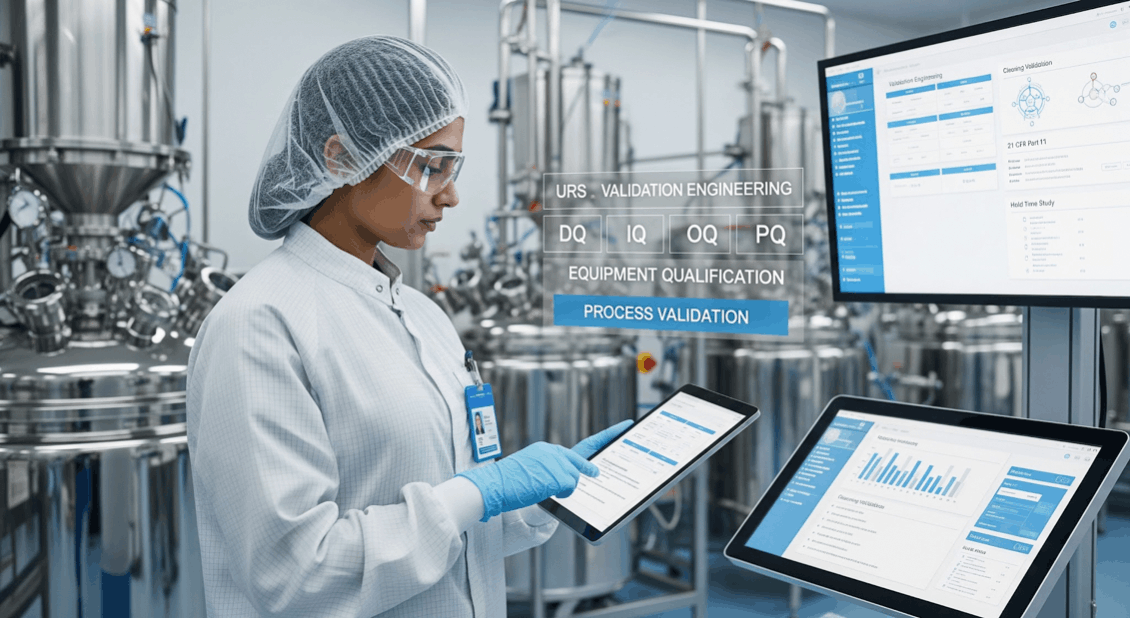
Her path into the field was shaped by the specific demands of large-scale biologics manufacturing. At a global plasma products manufacturer, she took on full quality oversight of a major facility expansion project. The scope covered QA approvals, technical reviews, and the validation of equipment, utilities, and the facility itself. She led the development and approval of the complete GMP documentation suite, including User Requirement Specifications, Factory Acceptance Testing and Site Acceptance Testing protocols, Design Qualification, Installation Qualification, Operational Qualification, Performance Qualification, and Process Performance Qualification protocols, along with formal risk assessments across each stage. Budget and timeline alignment for cycle development programs, including Vaporized Hydrogen Peroxide sterilization, Steam in Place, and Clean in Place cycles, also sat within her remit. Projects of this scale, running across equipment, utilities, and physical infrastructure simultaneously, require a coordinator as much as a technical author. Someone has to hold the documentation thread together while different engineering and operations teams work at different speeds.
“Managing a project of this scope means you are constantly connecting what the regulation requires to what the facility is actually doing. The documentation is not separate from the work. It is the evidence that the work was controlled,” says Manaliben Amin.
The work she did for commercial products at a second organization, a major plasma-derived therapy manufacturer, illustrates a challenge more common in the industry than is publicly acknowledged: critical validation protocols that simply do not yet exist. For established commercial products, including a reconstituted high-density lipoprotein therapy and a C1-esterase inhibitor concentrate used in hereditary angioedema, she authored and executed validation protocols covering equipment qualifications, cleaning validations, hold-time studies, and full requalification of fill-finish facilities. Building upon existing procedural frameworks, she played a key role in strengthening cleaning validation and hold-time studies by defining scientifically justified acceptance limits and process thresholds. Her work introduced greater rigor in how residue limits and hold-time criteria were established, improving the reliability and regulatory defensibility of these studies. These enhancements contributed to more consistent validation outcomes and provided a stronger foundation for future validation cycles and regulatory submissions.
The technical challenge in cleaning validation for biologics is not trivial. Acceptable residue limits must be scientifically justified, analytical methods must themselves be validated, and worst-case surface area calculations must be defensible to an inspector who has spent a career looking for exactly this kind of gap. Hold-time studies determine how long product, cleaned equipment, or process intermediates can remain before the next manufacturing step without compromising quality. They require experimental design, statistical analysis, and documentation that ties results directly to the commercial process. She managed the GMP document control side of this work through TrackWise, LIMS, and GDRS systems, keeping the document lifecycle, from authoring through review, approval, and change control, moving in a regulated environment where a missed signature or an out-of-sequence approval can delay a batch release.
As Manaliben Amin states, “The protocols I developed for cleaning validation and hold-time studies were not documented anywhere in the company’s existing procedures. Having them integrated into the SOPs means the organization now has a validated, repeatable approach that did not exist before, and that protects both the product and the patient.”
Digital systems and the compliance gap
The compliance landscape she navigates has been reshaped in recent years by the accelerating adoption of electronic quality management systems. Under 21 CFR Part 11, any electronic system used to create, modify, or store records required by FDA regulations must meet specific criteria for audit trails, access controls, and system validation. For manufacturers operating across both the US and European markets, EU Annex 11 adds requirements around system lifecycle management, data integrity controls, and electronic signature governance that do not align perfectly with Part 11. The practical burden of meeting both simultaneously, and documenting that the systems themselves are validated, falls largely on validation engineers. Her work implementing Kneat, a purpose-built validation execution platform, is part of a broader industry shift toward paperless validation that reduces transcription errors and creates a more auditable and searchable record than paper-based systems. When validation records exist inside a structured digital system rather than a binder, every gap in the workflow becomes visible in a way it was not before.
She has been involved in the implementation and optimization of digital validation systems, including Kneat-based platforms, supporting the transition from traditional paper-based processes to structured, paperless validation workflows. Her work has focused on configuring templates, workflows, and traceability structures that align with regulatory requirements while improving usability for validation teams.
In practical terms, these implementations have contributed to measurable improvements across validation programs, including: Reduction in documentation cycle time through standardized workflows, improved traceability, and audit readiness through structured data capture, and decreased risk of documentation errors associated with manual processes.
Such outcomes reflect a broader industry trend, where digital validation systems are increasingly viewed not just as efficiency tools but as critical components of data integrity and compliance strategies.
For manufacturing organizations, the operational stakes of getting validation wrong are direct. A single unresolved observation on a process validation protocol can place a commercial batch in quarantine. A missing cleaning validation study for a product contact surface can trigger a broader review of historical batches. The downstream effect reaches patients when therapies with limited alternative sources face supply disruption. Plasma-derived therapies in particular operate in markets where supply is constrained by the availability of raw plasma, making any production delay difficult to absorb quickly.
Where the field is heading
The move toward continuous process verification, an approach the FDA has been encouraging as part of its pharmaceutical quality initiative, places new demands on validation engineers. Rather than a one-time qualification followed by periodic revalidation, continuous process verification requires ongoing statistical monitoring of process performance data against predetermined criteria. That changes the role from event-based documentation to something closer to a continuous data management function. The engineers who navigate that transition most effectively will be those who already work fluently across both the regulatory text and the manufacturing data systems that generate process records.
Manaliben Amin’s career, spanning facility expansions, commercial product validations, and digital system implementations, reflects the evolving demands of validation engineering: the ability to design protocols that withstand regulatory scrutiny, execute them in complex manufacturing environments, and embed results into sustainable quality systems. In areas such as cleaning validation and hold-time studies, her work focused on strengthening established procedures by defining scientifically sound acceptance limits and refining process thresholds. These contributions improved the consistency, reliability, and regulatory defensibility of validation outcomes, creating a more standardized approach for future validation cycles. In a field where documentation is the foundation of compliance, such enhancements represent meaningful contributions that extend far beyond individual projects.