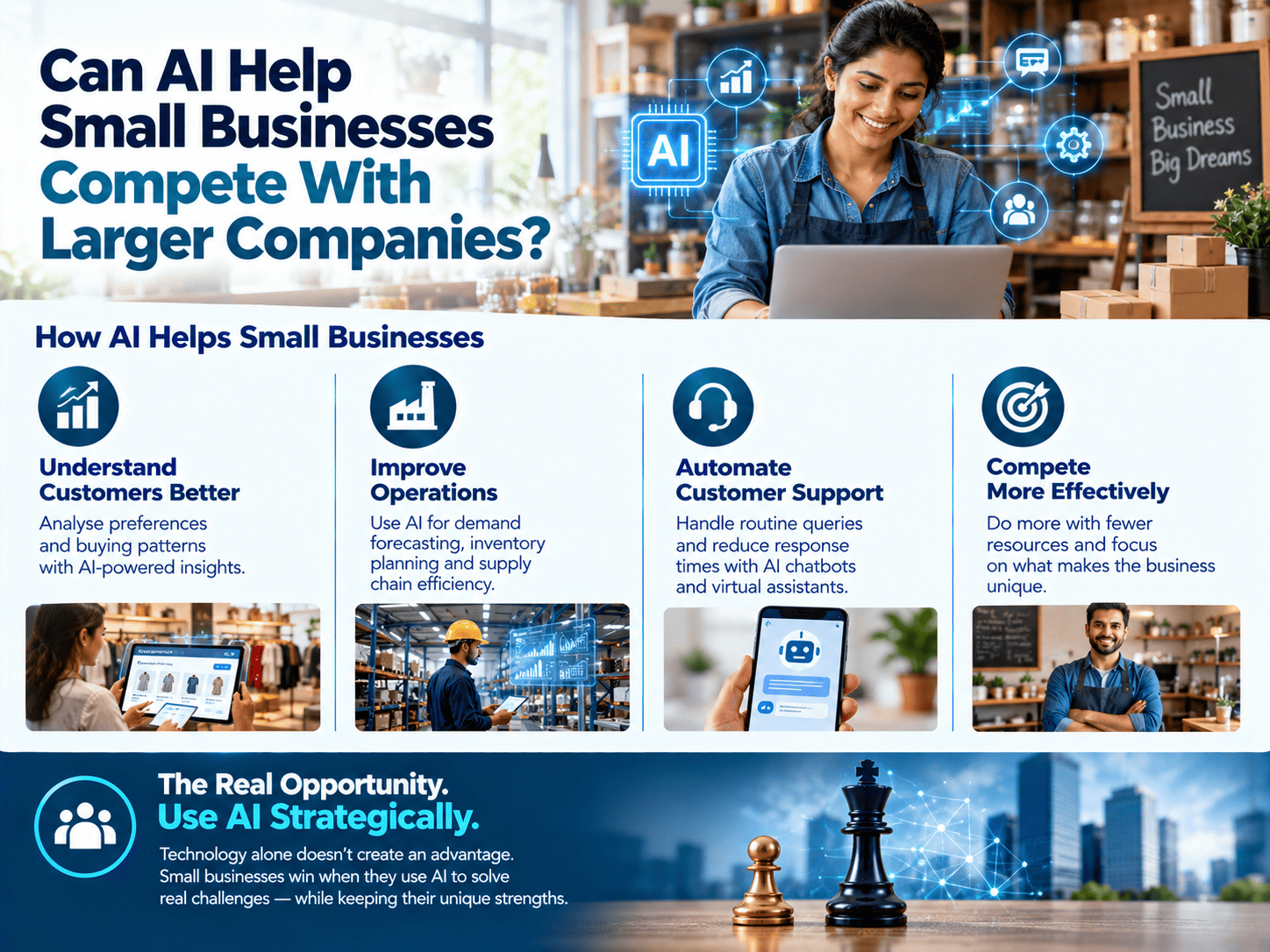
A small business does not need a large marketing department, a dedicated data team or round-the-clock customer support to compete effectively anymore. Artificial intelligence (AI) is making some of these capabilities accessible to businesses with smaller budgets and fewer employees. A local retailer can analyse customer preferences, an independent manufacturer can improve demand planning, and a small service provider can automate routine customer queries using AI-powered tools.
However, access to technology does not automatically create a competitive advantage. Large companies can also use AI, often with more data, stronger technical teams and greater financial resources. The real opportunity for small businesses lies in using AI to overcome specific limitations while preserving the qualities that make them competitive in the first place.
AI Is Reducing The Cost Of Running A Business
Large companies can afford specialised employees for marketing, customer support, research and administration. Small businesses often expect the same person to manage several of these responsibilities. AI can help narrow this operational gap by handling repetitive tasks and giving employees more time for activities that directly generate revenue.
According to the Federal Reserve Banks’ 2026 Report on Employer Firms, 71% of businesses using AI reported increased productivity, while 31% reported higher sales. However, these findings reflect businesses’ reported experiences, not proof that AI alone caused the improvements.
Small businesses can use AI to:
- Draft marketing emails, product descriptions and social media posts.
- Summarise documents and prepare initial research.
- Organise customer enquiries and generate routine responses.
- Analyse sales records to identify changing demand.
The financial advantage comes from redeploying saved time. If AI helps an owner complete routine administrative work faster, the benefit is meaningful only when the recovered time improves sales, customer service or operational efficiency.
Businesses should therefore measure whether AI reduces the time and cost required to complete a task rather than adopting tools simply because competitors are using them.
Can Small Businesses Market Like Large Brands?
Marketing has traditionally favoured companies with larger budgets. They can hire specialists, conduct extensive customer research and run campaigns across several channels. AI gives smaller businesses access to some of these capabilities without requiring a large in-house team.
For example, a neighbourhood clothing retailer can use AI to create different product descriptions for different customer groups. A small online store can analyse its sales records to identify popular products and prepare targeted promotional messages. A local restaurant can develop social media content and respond to common customer questions more efficiently.
The advantage, however, is not simply producing more content. The real opportunity is making limited marketing expenditure more relevant.
A small business should focus on three areas:
- Customer understanding: Identify which products, services and offers attract existing customers.
- Campaign testing: Compare different messages and offers to determine which generates more enquiries or purchases.
- Personalisation: Adapt communications to customer preferences without overwhelming people with unnecessary promotions.
AI-generated content still requires human review. Generic messages, inaccurate product descriptions and repetitive advertisements can damage a business’s credibility.
Large brands may have greater advertising budgets, but smaller businesses can compete by understanding a specific customer group more closely. AI can support that understanding; it cannot replace genuine knowledge of the market.
Better Customer Service Without A Large Support Team
Customers increasingly expect quick answers, clear information and convenient service. Large businesses can employ dedicated support teams, while smaller firms may struggle to respond promptly during busy periods.
AI-powered chatbots and automated messaging systems can help smaller businesses answer frequently asked questions about opening hours, delivery policies, appointment availability and product information. These tools can also organise incoming enquiries so employees can prioritise urgent or complicated requests.
Consider a small online retailer receiving dozens of daily questions about order status and returns. Automating routine responses could free employees to resolve delivery problems, handle complaints and assist customers who need individual attention.
Nevertheless, automation can become a disadvantage when businesses use it without considering customer needs.
- Simple enquiries: Automation can provide quick, consistent answers.
- Complex complaints: Human employees should handle situations requiring judgement, empathy or exceptions.
- High-value customers: Personal communication may be more useful than a standard automated response.
There is also a practical risk: AI can provide incorrect information if its answers rely on outdated policies or incomplete records.
The objective should not be to eliminate human interaction. It should be to reserve human attention for situations where it creates the greatest value.
For a small business, better service can become a competitive differentiator because customers may choose reliability and responsiveness over the convenience of dealing with a much larger brand.
AI Can Help Small Businesses Make Better Decisions
Large companies often have dedicated analysts who study customer behaviour, sales trends, inventory and market conditions. Small businesses may make important decisions using spreadsheets, personal experience or incomplete information.
AI tools can help owners analyse existing records and identify patterns that might otherwise go unnoticed. A retailer could examine seasonal sales, a wholesaler could compare customer purchasing patterns, and a manufacturer could investigate recurring production delays.
However, the quality of the analysis depends on the quality of the information supplied.
For example, if a retailer’s sales increase during a festival season, an AI tool might identify the increase without correctly explaining whether it resulted from discounts, higher footfall, better availability or seasonal demand. Acting on an incorrect explanation could lead to excess inventory or unnecessary spending.
Small businesses should use AI to support decisions in three stages:
- Identify a pattern: Examine sales, costs, inventory or customer enquiries.
- Check the explanation: Compare the suggested finding with actual business conditions.
- Measure the outcome: Determine whether the resulting decision improves margins, reduces waste or increases sales.
This approach is particularly valuable when cash is limited. A small business cannot afford to tie up substantial working capital in products that customers may not purchase.
AI can improve the analysis, but the owner must still understand the business well enough to question its conclusions.
The Biggest Opportunity May Be In Business Operations
AI’s competitive value extends beyond marketing and customer communication. It can also help smaller businesses improve purchasing, inventory management, scheduling and internal workflows.
These improvements matter because small businesses often operate with limited financial reserves. An avoidable inventory surplus, an inefficient delivery schedule or repeated manual errors can affect profitability even when sales remain healthy.
A small distributor, for instance, could combine historical sales, current inventory and supplier lead times to identify products that require closer monitoring. A manufacturer could analyse production records to identify recurring delays or unusually high material consumption.
The benefits depend on how closely AI connects with actual operations.
- Inventory: Better demand analysis may help reduce unnecessary stock accumulation.
- Purchasing: Reviewing order histories can help identify changing requirements and purchasing patterns.
- Quality control: AI-assisted inspection can help flag defects when suitable equipment and reliable data are available.
- Administration: Automating repetitive data entry can reduce manual effort, although important records still require verification.
Businesses should begin with one measurable operational problem rather than attempting to automate everything simultaneously.
For instance, reducing stockouts may be a better initial objective than implementing an expensive system across the entire business.
The underlying insight is that small businesses do not always need to increase revenue dramatically to become more competitive. Improving inventory turnover, reducing avoidable expenses and completing orders more reliably can strengthen profitability without requiring equivalent growth in sales.
Why AI Will Not Automatically Eliminate The Advantage Of Large Companies?
AI can reduce certain operating disadvantages, but it does not remove the structural benefits enjoyed by larger businesses.
Large companies may have proprietary datasets, established distribution networks, stronger supplier relationships, greater financial resources and the ability to invest in specialised technology. They can also spread the cost of developing and implementing AI across more customers and transactions.
Small businesses face a different set of constraints.
First, affordable AI tools may not integrate easily with existing accounting, inventory or customer-management systems. Second, employees need time and training to use them effectively. Third, businesses may expose confidential customer or commercial information if they upload sensitive records to unsuitable platforms.
The Federal Reserve Banks’ 2026 small-business survey identified accuracy as a challenge for 46% of AI-using firms. Another 43% reported difficulties adapting AI tools to their business needs. These findings show why access to AI is only the beginning of adoption.
Small businesses should therefore establish basic safeguards:
- Verify important AI-generated information before acting on it.
- Avoid sharing confidential information with tools that lack appropriate data protections.
- Train employees to recognise inaccurate or misleading outputs.
- Review subscription, integration and maintenance costs before committing to a system.
The competitive gap will not disappear simply because AI becomes widely available.
Businesses that combine technology with reliable processes, customer trust and sound financial management are more likely to benefit.
How Small Businesses Should Decide Whether AI Is Worth The Investment?
The best starting point is not choosing an AI product. It is identifying a recurring problem that consumes time, increases costs or prevents the business from serving customers effectively.
A small business can follow a simple evaluation process.
Step 1: Select one problem. Identify a task such as preparing quotations, answering routine enquiries or analysing inventory.
Step 2: Establish a baseline. Record the time required, existing costs, error frequency or current conversion rate before introducing AI.
Step 3: Run a limited trial. Test an affordable tool on a defined task rather than changing the entire workflow.
Step 4: Measure the results. Compare the new process with the original one, including subscription fees, employee time, verification requirements and errors.
Step 5: Expand only when the results justify it. If the tool produces measurable benefits, consider extending its use to similar activities.
This method prevents a common mistake: confusing technology adoption with business improvement.
A tool that saves time but creates additional correction work may deliver little value.
Likewise, a system that increases enquiries but fails to convert them into paying customers may not justify its cost.
The most useful measure is the net business benefit after accounting for implementation and ongoing expenses.
Small businesses should also recognise when AI is unnecessary. A straightforward manual process may be cheaper and more reliable when a task occurs infrequently or involves very little work.
Conclusion
AI is making selected business capabilities more accessible to small enterprises. It can help owners analyse information, improve marketing, respond to customers and manage routine operations without building large departments.
However, the evidence does not support treating AI as a guaranteed route to higher profits or a replacement for the advantages of scale. Adoption, by itself, is not a measure of success.
The more important question is whether a business can use AI to solve a problem more effectively than it could before. A retailer that manages inventory better, a service provider that responds faster or a manufacturer that reduces avoidable errors may strengthen its competitive position without matching a large company’s resources.
There is also a longer-term consideration: as more businesses gain access to similar AI tools, simply using AI may no longer distinguish one business from another. The advantage will increasingly depend on how well each company combines technology with its own customer relationships, operational knowledge and ability to execute.
For small businesses, AI is best viewed as a force multiplier rather than a substitute for good management. It cannot guarantee that a small company will defeat a large competitor. It can, however, help a well-managed business make better use of its limited resources—and that can be enough to compete more effectively.