I used to think the biggest entertainment companies won by telling better stories. The evidence seemed obvious. Better scripts attracted bigger audiences, bigger audiences generated higher box office numbers, and successful films naturally led to sequels. It was a simple equation where storytelling quality determined commercial success.
The more I watched the industry evolve, however, the more incomplete that explanation felt. Some films became cultural moments before quietly fading away, while others seemed to take on a life of their own. Years after their original release, people were still debating theories, creating fan art, attending conventions, building online communities, buying collectibles, and introducing entirely new generations to these fictional universes. The movie had ended, yet the experience hadn’t.
That made me realize something I hadn’t appreciated before. The most valuable entertainment companies today are no longer in the business of selling stories. They are in the business of building worlds. A story is simply the invitation. The real product is an ecosystem that audiences continue exploring long after the credits roll.
This distinction matters because it changes how we think about competitive advantage in entertainment. Stories are consumed once. Worlds become places people repeatedly return to, contribute to, and eventually make part of their own identity. In an economy where attention has become the scarcest resource, creating a destination is proving far more valuable than creating a single hit.
From Storytelling To World-Building
For most of entertainment history, success was measured one release at a time. A novel stood on its own. A film had a beginning, a middle, and an end. Even if audiences loved it, the relationship was largely transactional. People paid for an experience, enjoyed it, and moved on to the next story.
Franchises extended that relationship by bringing familiar characters back for another adventure, but they still revolved around individual narratives. The audience returned because they wanted to know what happened next. The story remained the center of gravity.
Today’s entertainment leaders operate very differently. Instead of asking audiences to follow a plot, they invite them into a universe. That universe has its own history, geography, rules, cultures, conflicts, and endless possibilities. Every new movie, game, series, or book doesn’t restart the relationship; it expands an existing world that people already understand and care about.
I think this is the biggest strategic shift the entertainment industry has undergone in decades. Companies are no longer trying to create isolated masterpieces. They are constructing environments capable of generating stories indefinitely. The world becomes the asset, while individual stories become different ways of exploring it.
Unlike a traditional story, a well-designed world never truly ends. Every unanswered question becomes an opportunity. Every unexplored corner becomes the foundation for another film, game, comic, or entirely new experience. The audience doesn’t simply consume content; they remain inside the ecosystem, waiting for what comes next.
When Stories Become Places
For decades, great entertainment was judged by the quality of a single story. A film succeeded if audiences walked out satisfied. A novel succeeded if readers reached the final page feeling something memorable. The relationship between creator and audience had a clear beginning and a clear end. Once the story was over, so was most of its value.
I think that definition of success has quietly changed. Today, the biggest entertainment companies aren’t trying to answer every question or neatly wrap up every storyline. They’re doing almost the opposite. They’re creating worlds that feel too large to be fully explored, leaving audiences curious about what exists beyond the edges of the current story. Every new release doesn’t close the experience, it expands it.
That’s why companies like Marvel, Pokémon, and Minecraft continue growing long after their original success. The movie, game, or series is only one doorway into a much larger universe. Fans don’t just remember the main characters; they learn the world’s history, understand its rules, debate its possibilities, and imagine stories that haven’t even been told yet. The fictional world becomes familiar enough that returning to it feels less like consuming new content and more like revisiting a place they’ve already invested emotionally.
To me, that’s the real competitive advantage. A compelling story can capture attention for a weekend, but a believable world can hold attention for years. In an age where every company is fighting for increasingly fragmented attention spans, creating a place people genuinely want to return to is proving far more valuable than simply telling another great story.
The Economics of Emotional Real Estate
I’ve started thinking about fictional worlds as a form of emotional real estate. Just as prime locations become more valuable because people want to spend time there, certain fictional worlds grow more valuable because millions of people want to keep returning to them. Entertainment companies are no longer just owning stories; they’re owning destinations that audiences willingly revisit.
The real advantage is that every new release builds on years of existing familiarity. A new Marvel film, a Pokémon game, or a Minecraft update doesn’t begin from scratch. It enters a world people already understand, discuss, and care about. That shared history lowers the effort required to attract audiences because the emotional connection already exists.
To me, this is what separates a successful story from a valuable world. Stories create moments, but worlds accumulate meaning. The more people invest their time, memories, and imagination into a fictional universe, the harder it becomes for competitors to replicate. In entertainment today, the most valuable asset isn’t just a great narrative, it’s a world that feels worth coming back to.
The Audience Stops Being an Audience
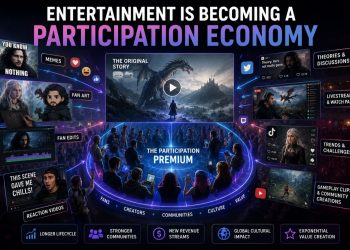
One of the biggest differences between a story and a world is what it asks of its audience. A story expects you to watch, read, or play until the end. A world invites you to stay long after the official experience is over. That shift turns passive consumers into active participants.
Fans begin creating value that no studio could have planned on its own. They discuss theories, make videos, design artwork, write fan fiction, organize conventions, build online communities, and introduce new people to the universe. The audience doesn’t just consume the world, they continuously expand its cultural presence. In many ways, they become part of the product itself.
I think this is why the strongest entertainment ecosystems keep growing even between major releases. Their communities never really go offline. As long as people continue talking about the world, sharing it, and adding to it, the franchise remains relevant. The companies creating the biggest worlds aren’t simply producing content anymore, they’re creating communities that keep the experience alive.
When The World Becomes The Business
This is where the economics become far more interesting than storytelling. A successful world doesn’t generate value from one blockbuster release; it creates a flywheel where every product strengthens the next. A game introduces new fans, a streaming series keeps them engaged, merchandise deepens their attachment, and that growing audience makes the next game or film easier to market. The world begins promoting itself.
We’ve already seen this play out in unexpected ways. Cyberpunk 2077 looked like a cautionary tale after its troubled launch, yet the release of Netflix’s Cyberpunk: Edgerunners reignited interest in the game years later. The world proved stronger than the product. Likewise, Riot Games didn’t make Arcane simply to tell another story, it expanded League of Legends into an entirely new audience without requiring viewers to play the game first.
What fascinates me is how this changes the economics of entertainment. A movie ticket has a limited financial ceiling, but a compelling world can generate value for decades through games, subscriptions, collectibles, licensing, live experiences, and future stories. The longer people remain inside the ecosystem, the greater their lifetime value becomes. At that point, the business isn’t selling individual releases anymore, it’s steadily increasing the value of belonging to the world itself.
The Risk Of Expanding Too Far
Building a world is powerful, but it also creates a temptation that many companies struggle to resist: endless expansion. Once audiences are emotionally invested, every new spin-off, sequel, or streaming series looks like another revenue opportunity. The challenge is that audiences don’t reward quantity, they reward coherence.
I think the contrast between Dune and Star Wars illustrates this perfectly. Legendary has treated Dune like carefully designed architecture, expanding the universe selectively and allowing anticipation to build. By comparison, Star Wars spent years releasing content at such a rapid pace that the universe sometimes felt less like a destination and more like an assembly line. More stories didn’t necessarily make the world feel richer.
That is the paradox of world-building. Every addition should deepen the universe rather than simply occupy it. The companies that understand this know their greatest asset isn’t the number of titles they release but the trust audiences place in the world itself. Once that trust weakens, even the largest franchise begins to lose its gravitational pull.
Conclusion
I think the importance of world-building will become even clearer in the age of AI. Before long, generating a well-written action film, fantasy novel, or animated short from a simple prompt may become remarkably inexpensive. When stories become abundant, individual narratives will inevitably lose some of the scarcity that once made them valuable.
What won’t be so easy to generate is a world that millions of people collectively believe in. AI can imitate a writing style or invent fictional characters, but it can’t instantly create decades of shared memories, fan communities, cultural references, traditions, and emotional investment. Those things aren’t technological achievements, they’re social ones.
That’s why I believe the future competitive advantage of entertainment companies won’t simply be intellectual property. It will be shared worlds that people choose to inhabit together.
In a future overflowing with infinite AI-generated content, the rarest asset may no longer be a great story. It may be a fictional universe that people agree is worth returning to, discussing, and passing on to the next generation.