Most people think airports make money from airplanes.
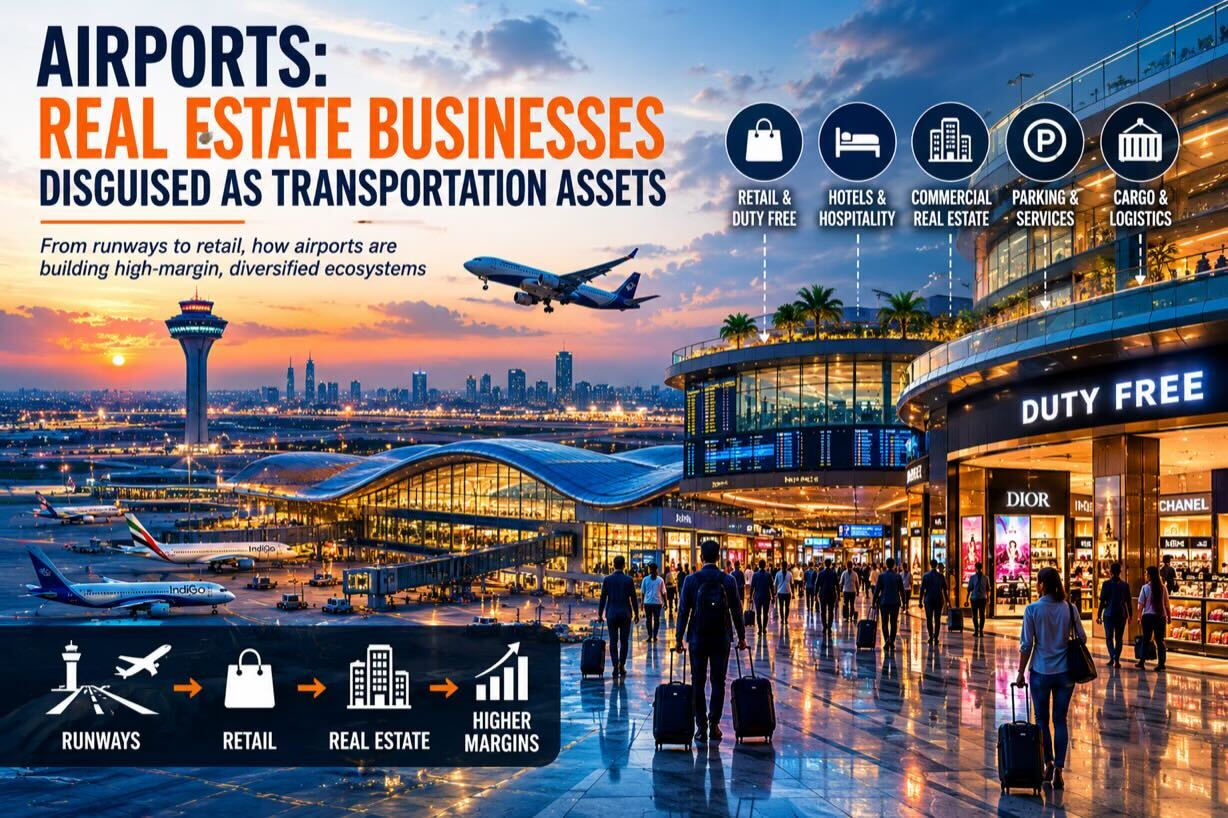
In reality, the industry’s biggest growth opportunities increasingly come from activities that have little to do with flying. Retail stores, restaurants, advertising, parking facilities, hotels, logistics hubs, and commercial real estate are becoming major profit drivers for airport operators.
As passenger traffic rises, airports are evolving beyond transportation infrastructure into integrated commercial ecosystems. The runway may bring travelers through the gate, but it is the surrounding businesses that are generating some of the industry’s most attractive returns.
This shift is transforming airport operators from aviation assets into diversified infrastructure giants with powerful long-term growth opportunities.
From Aviation Infrastructure to Commercial Platforms
For decades, airport operators relied primarily on aeronautical revenue streams such as landing fees, passenger service charges, aircraft parking fees, and ground-handling services. While these remain essential to airport operations, they share a common limitation: they are often regulated and closely tied to airline activity.
This has pushed airport operators to diversify beyond traditional aviation revenues.
Today, modern airports generate income from a wide range of commercial activities, including retail stores, duty-free shopping, restaurants, advertising, parking facilities, lounges, cargo operations, and hospitality services. These businesses are often less regulated and offer greater flexibility to increase pricing and expand margins.
The result is a significant shift in how airports create value. Rather than functioning solely as transportation infrastructure, airports are increasingly operating as integrated commercial platforms that monetize the movement of millions of passengers every year.
The Revenue Mix is Quietly Changing
The financial performance of major airport operators highlights this transformation.
Aena, the world’s largest airport operator by passenger traffic, generated €6.38 billion in revenue during 2025. While aeronautical activities remained the largest contributor, commercial revenue reached nearly €2 billion and grew faster than aviation revenue during the year. Passenger traffic rose 4.2% to almost 385 million passengers, demonstrating how growing footfall continues to support commercial expansion.
This trend is not unique to one operator. Across the industry, airport companies are increasing their focus on non-aeronautical revenue streams because they often deliver higher returns than traditional aviation activities.
The reason is simple: every passenger creates multiple spending opportunities. Beyond purchasing a flight ticket, travelers may pay for parking, buy food and beverages, shop at duty-free stores, use premium lounges, stay in airport hotels, or interact with advertising displays. As airports expand these offerings, the value generated from each passenger rises even when flight activity grows at a slower pace.
For many operators, the goal is no longer just to increase passenger volumes. It is to increase passenger spending.
Airports Are Real Estate Businesses Disguised as Transportation Assets
The transition to an “aerotropolis” is not simply a growth strategy. It is a hedge against airline volatility.
Airlines routinely add and cut routes, face cyclical demand swings, and operate on thin margins. Airport operators have increasingly responded by building businesses that generate revenue regardless of which airline is flying.
The clearest example is Singapore Changi’s Jewel development. More than an airport shopping area, Jewel was designed as a lifestyle destination featuring an indoor waterfall, attractions, restaurants, and retail outlets that attract visitors even when they are not traveling. The objective was simple: reduce dependence on airline traffic and create an ecosystem that can generate spending beyond the terminal.
This is the new airport playbook. Rather than relying solely on passenger fees, operators are building hotels, business parks, logistics hubs, and entertainment destinations that continue generating revenue even when aviation markets weaken.
Aircraft bring people to the airport. Real estate keeps them spending.
That distinction is becoming increasingly important as airport operators seek to reduce their exposure to the cyclical nature of global air travel.
Passenger Growth Creates Powerful Operating Leverage
Passenger growth remains the foundation of airport economics, but its impact extends far beyond aviation revenues.
Every additional traveler passing through an airport increases demand for retail stores, restaurants, parking facilities, lounges, advertising space, and other commercial services. Since much of the underlying infrastructure is already in place, a large portion of this incremental revenue flows through at attractive margins.
This creates powerful operating leverage.
A 10% increase in passenger traffic does not necessarily result in only a 10% increase in earnings. Commercial revenues often grow faster than passenger volumes, while many operating costs remain relatively fixed. As a result, airport operators can generate disproportionate growth in EBITDA and cash flow as traffic expands.
This dynamic helps explain why airports are often viewed as high-quality infrastructure assets. Passenger growth provides a relatively predictable source of demand, while commercial activities allow operators to capture increasing value from that demand over time.
The combination of traffic growth, pricing power, and operating leverage creates a business model capable of delivering long-term earnings expansion even in mature aviation markets.
Not Everyone Loves the Airport Gold Rush
The transformation of airports into commercial ecosystems has created tensions across the aviation industry.
Airlines have long argued that airport operators benefit from monopoly-like positions while continually increasing fees and commercial charges. Industry groups such as IATA have frequently criticized airport pricing structures, claiming passengers ultimately bear the cost of ambitious expansion projects and non-aviation developments.
Consumers are also beginning to push back. Modern terminals increasingly route travelers through lengthy retail corridors and duty-free zones before they can reach departure gates. For airport operators, these layouts maximize passenger spending opportunities. For travelers, they can feel less like transportation hubs and more like shopping malls attached to runways.
This raises an important question: how far can airports push commercial monetization before regulators step in?
As airports become more dependent on retail and commercial revenues, balancing profitability with passenger experience may become one of the industry’s most important challenges.
The Hidden Threat to the Airport Business Model
The biggest risk facing airport operators may not be another pandemic or economic slowdown. It may be technology.
For decades, airport retail thrived because passengers spent large amounts of time waiting. Long security lines, manual identity checks, and early arrival requirements created a captive audience for shops and restaurants.
That dynamic is beginning to change.
Biometric identification, digital travel credentials, automated baggage systems, and next-generation security technologies are gradually reducing passenger processing times. As airports become more efficient, travelers may spend less time browsing retail stores and more time arriving closer to departure.
This creates a paradox. The same technologies that improve passenger experience could weaken one of the industry’s most profitable revenue streams.
Airport operators will likely respond by transforming terminals into destinations rather than waiting areas, offering experiences, entertainment, and services that encourage passengers to spend time and money beyond the necessities of travel.
Airport Privatization is Creating New Infrastructure Giants
The transformation of airports into commercial ecosystems helps explain why airport privatization has accelerated across the world.
Governments have traditionally owned and operated airports, viewing them primarily as public infrastructure assets. However, rising passenger traffic, growing capital requirements, and the need for modernization have encouraged many countries to invite private operators into the sector.
For governments, privatization provides access to capital, operational expertise, and infrastructure investment without placing additional pressure on public finances. For private operators, airports offer a rare combination of long-term concessions, predictable cash flows, inflation-linked pricing mechanisms, and significant commercial development opportunities.
This has triggered a wave of airport privatization across countries such as India, Brazil, Australia, and several European markets. Operators are increasingly competing not only for airport traffic but also for the long-term economic ecosystems that develop around these assets.
The result is the emergence of larger airport platforms with growing scale advantages. Operators that manage multiple airports can leverage shared expertise, attract global retail partners, negotiate better commercial agreements, and spread investments across a broader asset base.
As privatization expands, airport operators are evolving from local infrastructure providers into globally significant infrastructure businesses.
The Competitive Moat Most Investors Underestimate
Airport operators possess several structural advantages that are difficult to replicate.
The first is their status as natural monopolies. Most major cities can support only a limited number of large airports, making direct competition rare. Once an airport becomes established, replicating its infrastructure is often economically and politically challenging.
The second advantage is the exceptionally high barrier to entry. Developing a new airport requires enormous capital investment, extensive regulatory approvals, environmental clearances, and access to large tracts of land. These challenges can take years, or even decades, to overcome.
Third, airport operators often benefit from long concession agreements that can extend for several decades. These agreements provide visibility into future cash flows and allow operators to invest with a long-term perspective.
Finally, airports benefit from a powerful ecosystem effect. Higher passenger traffic attracts more retailers and commercial partners. A stronger commercial offering improves the passenger experience and increases spending. This, in turn, enhances the value of airport real estate and commercial assets.
Together, these advantages create a durable competitive moat that few infrastructure sectors can match.
Can Airports Keep Growing in a Net-Zero World?
A second challenge is emerging from environmental regulation.
Many airport business models still assume long-term passenger growth. Yet governments around the world are under increasing pressure to reduce aviation emissions, expand carbon pricing mechanisms, and impose stricter sustainability requirements.
If future regulations limit flight growth, airports may need to find new ways to expand earnings.
This is another reason why commercial real estate, logistics operations, cargo infrastructure, and airport-city developments are becoming strategically important. They provide growth opportunities that are not directly tied to aircraft movements.
The most resilient airport operators of the next decade may not be those with the most runways, but those with the most diversified revenue streams.
In that sense, sustainability is accelerating rather than slowing the industry’s transformation into a broader infrastructure and real estate business.
Risk Investors Should Watch
Despite their attractive characteristics, airport operators are not without risks.
Passenger traffic remains sensitive to economic slowdowns, geopolitical disruptions, and unexpected events that affect travel demand. Periods of weak traffic growth can temporarily pressure both aviation and commercial revenues.
Regulation also remains an important consideration. Governments and regulators often influence airport tariffs and concession terms, limiting the flexibility operators have in certain markets.
The sector is also highly capital intensive. Expanding terminals, runways, and supporting infrastructure requires significant upfront investment, with returns often realized over long periods.
Finally, airport operators remain connected to the broader health of the airline industry.
Financial stress among airlines can affect route expansion, passenger growth, and overall airport activity.
While these risks do not undermine the long-term investment case, they highlight the importance of balancing growth ambitions with disciplined capital allocation.
Conclusion
The biggest misconception about airport operators is that they are transportation businesses.
Increasingly, they are not.
The industry’s leading operators are building ecosystems that combine infrastructure, real estate, logistics, retail, hospitality, and digital services. Passenger traffic remains the foundation, but the value creation is increasingly happening beyond the runway.
This distinction matters for investors. Transportation businesses are typically valued based on cyclical demand and limited pricing power. Commercial real estate platforms, by contrast, often command premium valuations because of their recurring cash flows, strategic land assets, and multiple growth avenues.
Not every airport will benefit equally from this transformation. Global hubs with large land banks, strong passenger growth, and commercial development opportunities are likely to emerge as the biggest winners. Smaller regional airports may struggle to replicate the model due to limited footfall and weaker economics.
The future of the industry will therefore be defined not by who moves the most aircraft, but by who extracts the most value from the ecosystem surrounding them.
The runway may remain the airport’s most visible asset. It is no longer its most valuable one.