Written by Adam Gebb
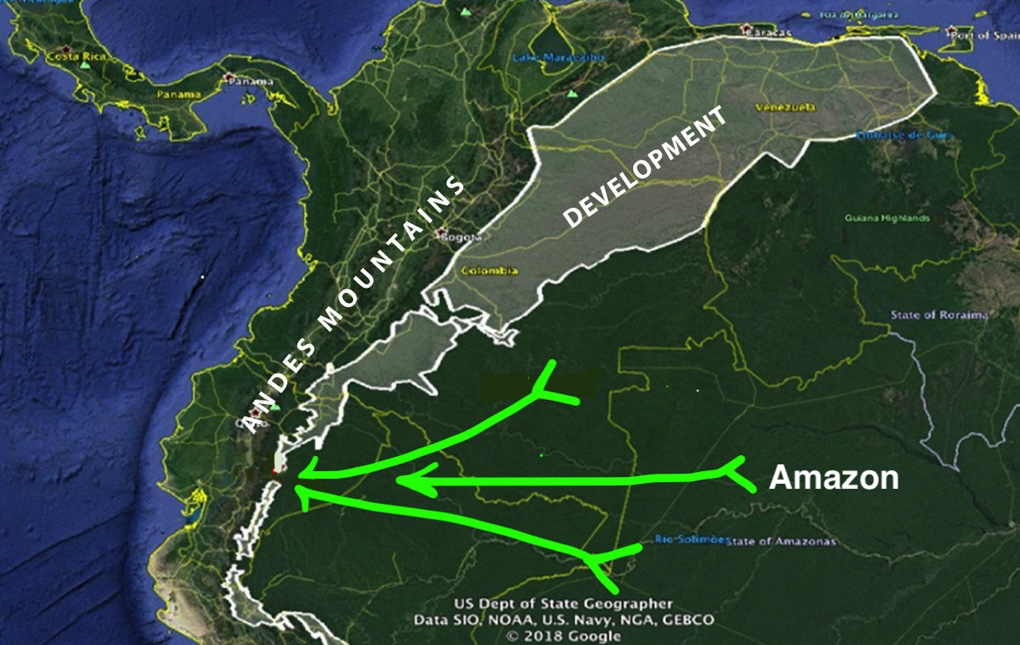
The development wall, shown in white, is mostly deforested, with a mix of agriculture and human development.
Ecuador holds the last viable route for wildlife migrating from the warming Amazon up into the cooler Andes Mountains.
The Pressure Is On
Most of the transitional lands between the warming Amazon and the cooler Andes Mountains must now support human settlements or agriculture. Yet, reconnecting these iconic biomes is a global conservation imperative. Stretching 3,000 kilometers along the base of the Andes, a nearly continuous wall of human development blocks the path of thousands of Amazonian species seeking refuge in the cooler Andean climates. With human populations rising rapidly, only one forested corridor remains with the potential to sustain large-scale migrations of species escaping the heat.
The Urgency of Landscape Connectivity
Road construction is fragmenting ecosystems into smaller and smaller patches, isolating once-connected habitats into vulnerable ecological “islands.” These fragmented areas are more susceptible to overexploitation and can no longer support the levels of biodiversity they once sustained. This reality must be central to conservation planning: small, isolated remnants of native ecosystems, surrounded by deforestation and human development, simply cannot function as they once did.
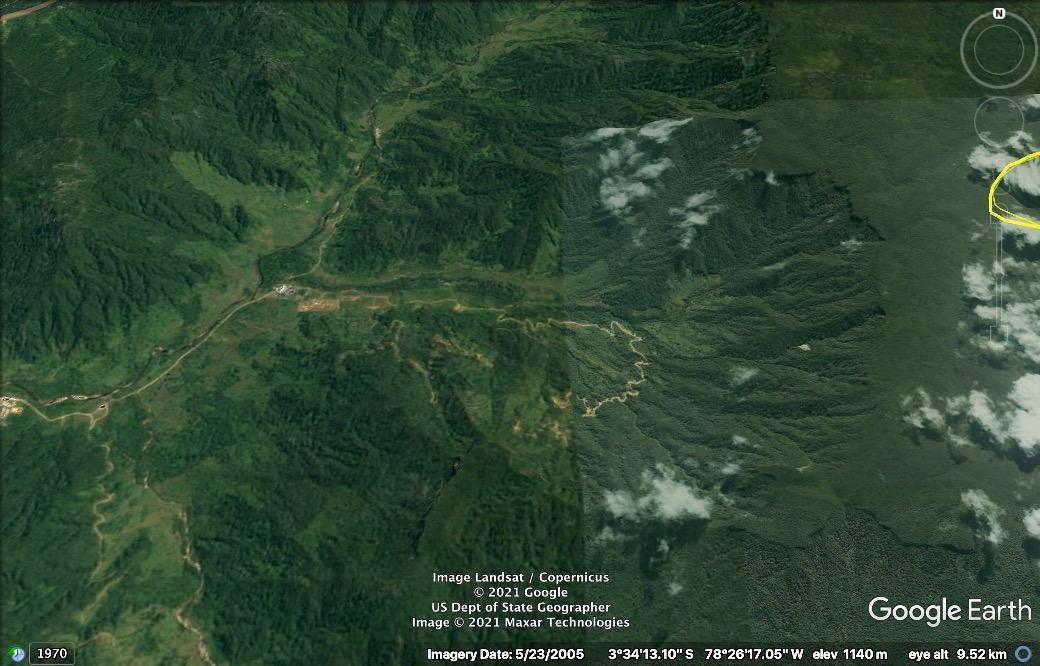
The old paradigm of conserving isolated ecological “hotspots” within relatively small protected areas is no longer a good investment. Long-term resilience requires connectivity, linking these areas to larger, more diverse landscapes that include a range of elevations, microclimates, and habitat types. Only through such landscape-scale connectivity can we sustain natural communities in the face of accelerating climate change.
Insects, the foundation of both natural ecosystems and agricultural productivity, are in steep decline due to breaks in landscape connectivity which cause numerous edge effects such as brighter, hotter, windier conditions. As these losses continue, the vulnerability of human food systems will only grow.
Traditional agricultural lands are particularly vulnerable in this era of climate disruption, facing increasing threats from extreme temperature fluctuations, flooding, and prolonged drought. With biodiversity and human agriculture at risk, the time has come to rethink where and how we grow food, how we live on the land, and how we restore ecological connectivity at every scale.
A New Conservation Paradigm
In many areas, human populations have soared beyond the point where there is space for conservation of wildlife habitat without people.
Redefining landscape connectivity to encompass wildlife migration, human food sovereignty, and the permanent protection of clean water resources is crucial for building a sustainable future. We have to balance the needs of human communities and the Andes/Amazon region’s legendary biodiversity.
In this new paradigm, wildlife migration networks become the ecological backbone of resilient food systems, supporting both nature and people. In roaded areas, these conservation networks will be stitched together by Wildlife Road Crossings (WRCs), a practical and scalable solution for reconnecting fragmented landscapes.
As human development continues to encroach on the planet’s remaining native ecosystems, replicating this model globally offers one of the few viable paths to maintaining the evolutionary processes of these natural communities amid human population growth. True conservation success occurs when ecological resilience is intertwined with human well-being.
Regenerative Corridors—WRCs and Edible Forests
Communities facing hunger can not afford conservation in its outdated form. Effective food sovereignty programs are required for success.
Wildlife Road Crossings (WRCs) designed with diverse edible forests offer a powerful, multifunctional approach. By guiding animals to cross roads at low-speed zones, reinforced in places like Ecuador by speed bumps, we can restore movement between habitats while minimizing animal-vehicle collisions.
These WRCs can be planted with highly diverse native forests, which in the Amazon include fruit, nut, and edible palm trees. They don’t just serve wildlife and people; they are fostering sustainable local economies.
These edible forests function as highly resilient permaculture systems, offering food, habitat, and long-term ecological stability. By supporting both wildlife and human communities, they lay the foundation for a self-reliant, climate-resilient future. As the climate crisis deepens, these regenerative systems provide a dependable, adaptive solution.
Indigenous Wisdom Is Creating New Ecological Infrastructure
These emerging landscape connectivity systems allow entire forest communities, including mammals, plants, and insects upon which all life depends, to migrate. But for this vision to succeed, it must be guided by the people who know these landscapes best: Indigenous and rural communities.
With generations of lived experience in rainforest ecosystems, Indigenous and rural peoples can feel the pulse of the forest more deeply than scientists or outsiders ever could. Their understanding of migrations, seasonal shifts, and interspecies relationships is intuitive, adaptive, and experiential.
Unlike conventional conservation models, where external experts arrive, conduct studies, and leave with prescriptions, Indigenous wisdom is producing conservation plans far more robust than current science alone can justify.
Their stewardship is built on reciprocity, responsibility, and continuity. These communities are not passive stakeholders. They are the primary architects of a new conservation model that protects biodiversity while advancing food sovereignty, cultural continuity, and ecosystem health.
The Human Dimension
A conservation mindset is just as vital as the conservation networks themselves. Without local care and investment, even the best-designed systems will not last. This is why deep community involvement is not optional; it’s essential.
Communities that develop their own sustainable land-use plans, rooted in traditional knowledge and adapted to modern pressures, are far more capable of responding to future ecological and economic challenges. When local people see that these landscape connectivity systems also improve their livelihoods, they are more likely to protect and expand them.
In doing so, they reaffirm a timeless truth: humanity’s fate is inextricably linked to the health of the natural world.
Investing in Indigenous-Led Ecological Resilience
As climate disruption intensifies and biodiversity declines at an alarming rate, it is increasingly clear that conventional conservation models are not succeeding. Governments, NGOs, funders, and scientists must pivot from top-down approaches to true partnerships, working hand in hand with Indigenous and rural communities.
When conservation networks are seen as the backbone of human survival, they will be protected by the communities that depend on them as socio-economic pressures increase.
We must invest in creating landscape connectivity networks that prioritize food sovereignty, clean water, and cultural continuity. This emerging conservation paradigm is not only bold and inclusive, it offers one of the most powerful and practical strategies for global ecological renewal, urgently needed to protect the last remaining intact ecosystems on Earth.
For more information on Wildlife Road Crossing, read: Wildlife Road Crossings Are Essential for Creating Conservation Networks