
It is refreshing to experience a love story from all angles, at such close range. Lina Mushcab’s Where Love Takes Us is not only unique because of its format as a poetic memoir, but also because of the intimacy with which the author approaches the story, trusting her readers with the events surrounding her relationships and closest family. Lina’s book is about divorce, raising children, making difficult choices, taking responsibility, and finding hope. As Lina makes her choices, she must also learn to be there for herself, without neglecting others. Ultimately, it is about the worlds and networks we build around ourselves and the way we navigate those connections. That is to say, it is about the infinite possibilities of love.
Love, in Lina’s world, takes on many forms. The book begins with the fading and eventual end of Lina’s first marriage to her partner of 34 years, with whom she has four children. In this sense, she introduces a kind of slow burning love that is eventually snuffed out by differing paths and newly formed, but unfortunately separate, desires. The book follows the outcome of Lina’s divorce and eventually arrives at the discovery of new hope, personified in the form of her second husband, with whom she finds peace and friendship. While the story starts with a door closing, it ends with a whole host of windows being thrown open. Lina and her new husband join lives and families, learning to create new networks of relationships, evolving in the way they love each other and others around them.
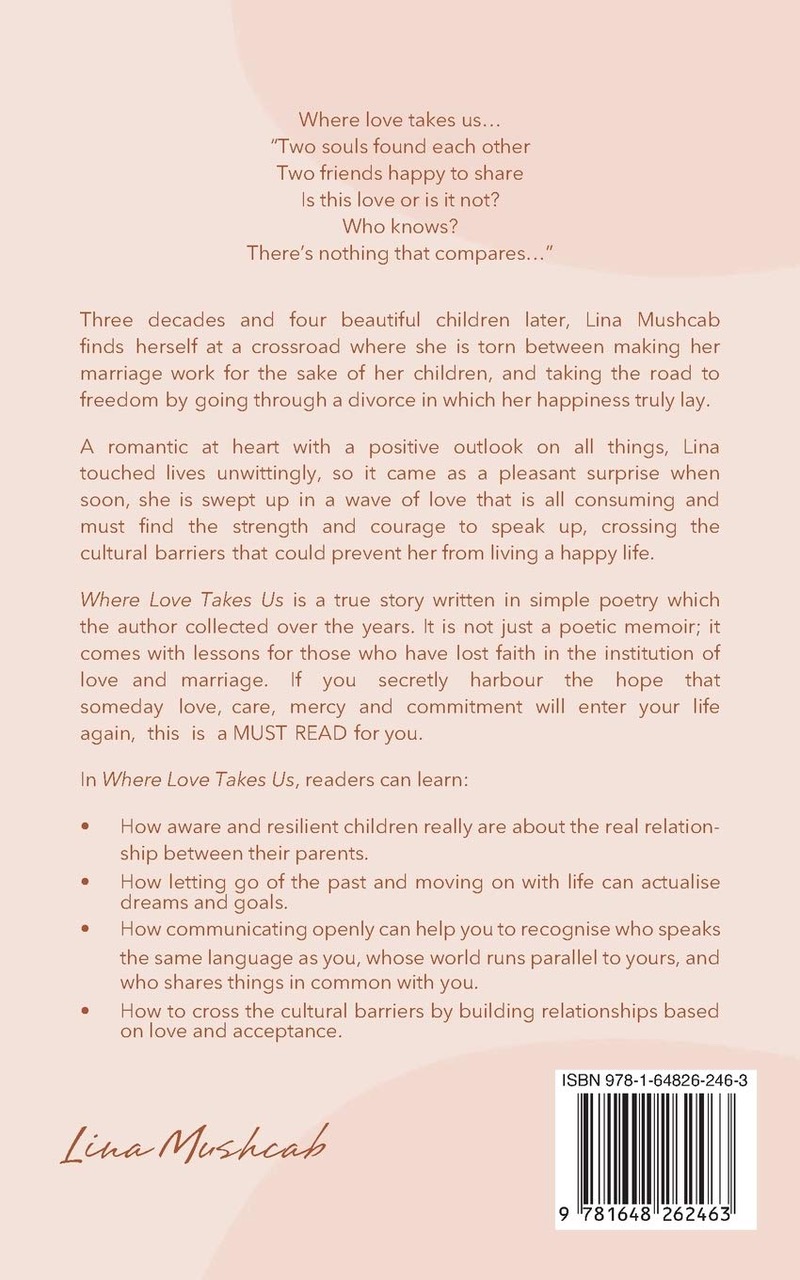
Although being a poetic memoir, the style of the book actually oscillates between prose and poetry. There are several layers happening at once in the narrative. Lina’s explanatory prose sections offer context and speak more directly to the reader. Her poetry is personal, a window into the secret thoughts of a woman who is trying her best to find compassion, acceptance, and hope as she negotiates transition and change. The combination of these two styles allows the reader the chance to take a step back and reflect on the more universal messages in Lina’s story. At the same time, the narrative also shifts between voices, including Lina, her children, and her second husband. This dynamic use of styles and perspectives creates a more holistic picture of the events than Lina’s writing alone could have. In these ways, Lina reveals to the reader how, in her own words, “love is like that tapestried carpet with its variants of wools, colours, and intricate designs.”
Love is really the primary message of Lina’s book. Every narrative point in the story comes back to another form of love. Heartbreak, loss, faith, hope, devotion-these are all ways in which the people in Lina’s life express their connections to each other. When we remove the personal details of her life, Where Love Takes Us is really a manifestation of the endless potential for love to exist in our lives. From children to adults, the messages of acceptance and forgiveness are empowering and relatable. At the end of the book, Lina writes, in large, bold letters, “Everyone is Created for Somebody!” While this is true for Lina’s story, it would also be accurate to take it a step further and understand that along the path to finding that ‘somebody’, we also form networks of multiple ‘somebodies’, and that, despite losing connections or nodes in that network, we are never disconnected from the people who care for us, and who we care for. Where Love Takes Us respects the fluid nature of love and offers a chance to hope in a time when we need it most.