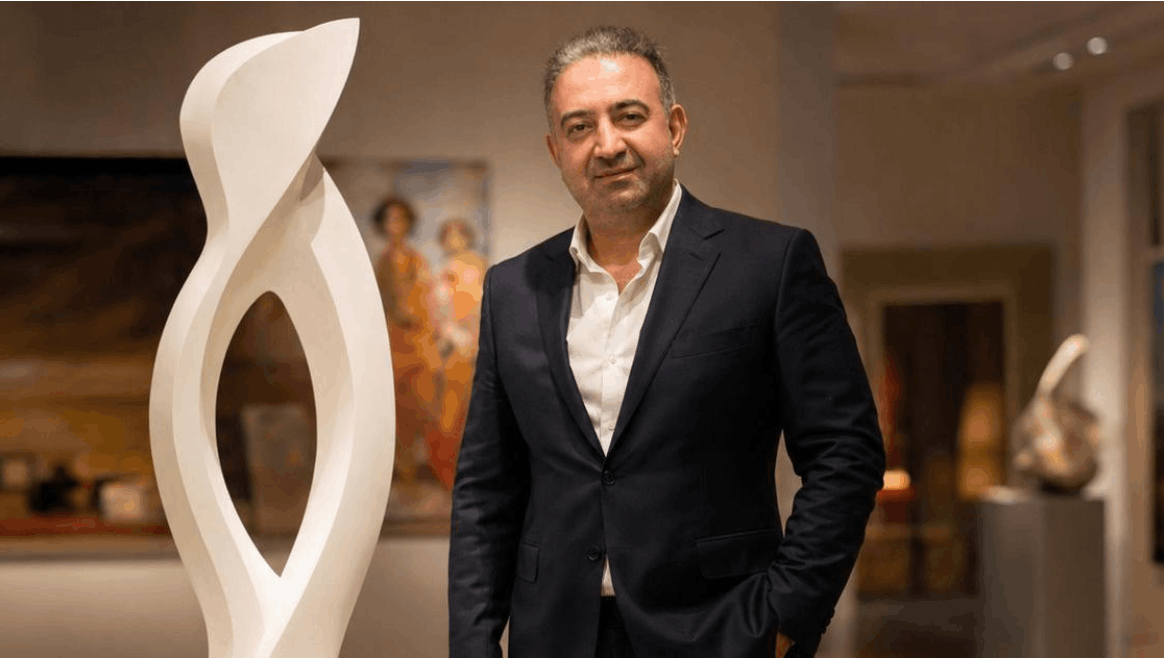
Hamid Taherypour’s sculpture begins with a small act of translation. Its source is a single letter in Persian and Arabic that carries the sound H. By adding, removing, or relocating dots, the same basic form can become other letters, and those letters can change words, meanings, and entire sentences. The idea is simple, but not simplistic. It suggests that language can turn on the smallest visual decision.
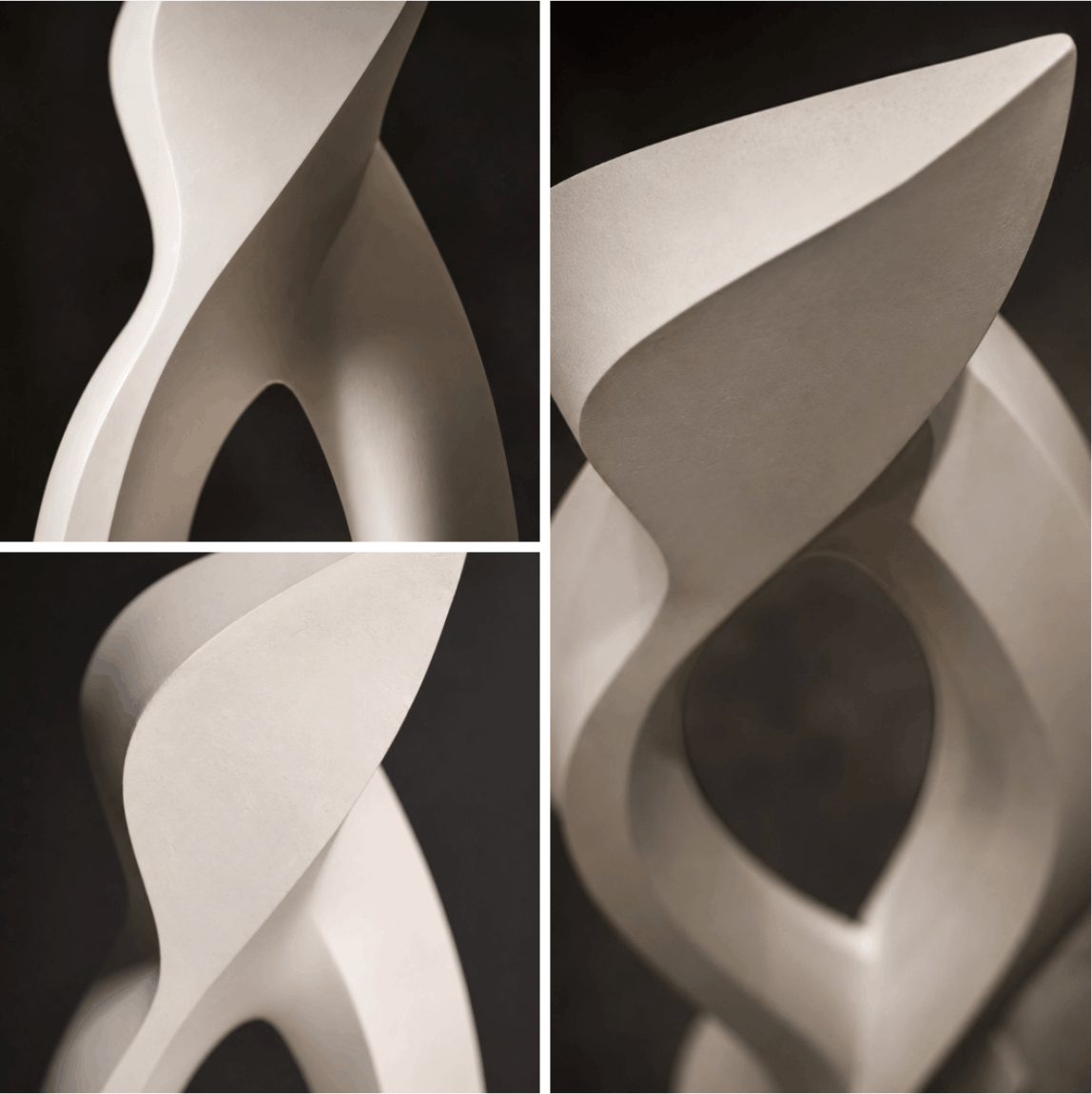
The sculpture does not present this idea as a lesson in script. It avoids literal illustration and instead draws from the memory of the letter. The form rises in a tall, pale curve, opening at the center and closing again near the base and upper edge. It has the elegance of a written sign, but also the stillness of an object that has left the page behind. What was once a mark becomes a body.
The central opening is the most compelling part of the work. It gives the sculpture breath. The void is not empty in a passive sense. It holds the space where sound, language, and meaning might pass through. This makes the piece more than a formal exercise. It asks the viewer to consider how absence can carry weight, and how a missing or displaced mark can alter what we understand.
There is a calligraphic quality here, though the work is not calligraphy. The gesture has been slowed, thickened, and made architectural. A written movement that might normally take less than a second is turned into something one must walk around. That shift from speed to duration is one of the sculpture’s strengths. Taherypour seems interested not only in the shape of the letter, but in the physical experience of following its movement.
The white surface gives the piece calmness and clarity. It allows the play of light and shadow to become visible without distraction. At the same time, this restraint has a cost. The surface can feel slightly too controlled for a concept built on transformation, uncertainty, and the fragile movement from one meaning to another. A more tactile finish, or a stronger trace of process, might have added tension. The sculpture is elegant, but at moments its elegance softens the risk of the idea.
Still, the work has a thoughtful presence. It does not rely on scale or spectacle. Its ambition is quieter: to turn a linguistic structure into a spatial encounter. The viewer does not need to read the original letter to feel the movement of the form, but the conceptual background adds a necessary depth. Without that context, the piece may be seen mainly as an abstract vertical sculpture. With it, the work becomes a meditation on how language, identity, and perception can shift through minute changes.
This dependence on context is both a limitation and an opportunity. The sculpture benefits from explanation, but it is not weakened by it. Some works need a story to open fully. Here, a carefully written title or wall text would help connect the formal grace of the object to the linguistic instability that inspired it.
As part of Hamid Taherypour’s recent practice, the sculpture shows a serious engagement with form, sign, and inner experience. It is not a flawless work, and that is part of its interest. Its strongest moments come when it resists becoming merely beautiful and begins to suggest the instability of meaning itself. A dot moves, a letter changes, a word becomes another word. In that small shift, Taherypour finds a sculptural language of transformation.