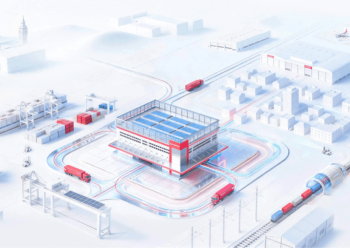
In today’s fast-paced world, goods, services and other essential resources travel across nations every second. Here, the global supply chain acts as both a support to modern life along with being a maze of complexity. Over three-quarters of senior supply chain leaders state that they still lack complete visibility in their worldwide networks, and this discrepancy of real-time insight results in billions of losses to the companies on account of inefficiencies and slow responses to disruptions every year. When artificial intelligence tools are applied to supply chain operations, they can bring down expenses by around 4% of total functional spend, making yearly savings in billions of dollars, while allowing quicker fulfillment cycles and more reliable inventory routing across markets, according to PYMNTS research.
Today’s supply chains are dynamic ecosystems and not just simple conveyor belts. In these ecosystems, demand signals from a city in Europe can affect manufacturing schedules in Asia, a weather event in the U.S. Midwest can slow deliveries on another continent, and a missing component deep within a supplier network can bring production to a standstill for millions of consumers on the other side of the world. Traditional supply chain processes depending on static reports, quarterly planning cycles, and manual analysis, simply cannot keep pace with the rapid changes modern commerce demands. This tension between operational complexity and customer expectations is seen everywhere, from large retail chains trying to keep shelves stocked to manufacturers trying to match production plans with unpredictable demand.
The supply chain industry is at an inflection point, says Dr. Yossi Sheffi, Director of MIT Center for Transportation and Logistics. Companies that can integrate real-time intelligence into their operations will define the next decade of global trade. Against this backdrop of such complexity, the work of Ramakrishna Garine represents a significant shift in the way global supply chains operate. His contributions are focussed on pioneering next-generation decision intelligence systems that bring real-time context and actionable insights to the people and processes that propel global logistics and manufacturing. Central to this transformation are four key initiatives that includes the development of one of the first generative AI-enabled supply chain chatbots, what he refers as Supply chain Genie, powered by Gemini & housed in ResilienceXAI. This makes the design of a Clean-to-Build (CTB) intelligent data ecosystem faster with the utilisation of AI-driven analytics and decision dashboards; and the integration of enterprise data pipelines including tools like Snowflake that bring together previously disconnected sources into a unified base for smarter decisions.
These innovations are crucial, as they not just improve performance within one company, but they address industry-wide issues that have long troubled supply chains around the world. Fragmented systems across planning platforms, manufacturing records, logistics feeds and supplier databases develop silos that conceal risk and slow response times. By integrating data from Oracle, DB2, Excel and modern cloud data platforms such as Snowflake into a coherent CTB ecosystem, Ramakrishna helped overcome those problematic areas, allowing information to flow where it is needed most. In doing so, he helped change traditional decision-making from slow, periodic reports to continuous, real-time intelligence that brings better results for businesses, partners, and ultimately customers.
The results have been measurable. At Amazon, Garine’s predictive analytics models contributed to supply chain optimizations valued at over $15 million in annual savings. His capacity planning frameworks have improved forecast accuracy by 35% while reducing excess inventory carrying costs. These outcomes align with broader industry findings: McKinsey estimates that AI-enabled supply chain management can reduce forecasting errors by 20-50% and cut lost sales due to product unavailability by up to 65%.
One of the most concrete outcomes of this initiative was the launch of ResilienceXAI, a generative AI-powered assistant that allows supply chain professionals to interact with complex data using simple, natural language questions and simulations. Instead of questioning multiple systems and waiting hours for a static report, analysts, planners, and operations teams can ask intuitive questions and get responses grounded in live data. For example, a logistics manager can inquire about current inventory positions in a given region, or a planner can evaluate near-term supplier risk without struggling between screens or deciphering code. As one industry expert mentioned in a recent Forbes article, generative AI in supply chains functions not as a replacement for human judgment but as a digital co-pilot that simplifies complex information and helps stakeholders make faster, more informed decisions.
This conversational access to intelligence has relevance far beyond a single firm’s internal metrics. In retail, smarter decision systems assist companies in anticipating demand shifts, decrease stockouts, and reduce waste. When inventory is better matched with real purchasing behavior, retailers avoid expensive markdowns and enhance availability for customers, directly influencing consumer satisfaction and brand loyalty. For manufacturers worldwide, real-time visibility implies lesser costly disruptions, shorter lead times, and more ability to balance production with fluctuating demand across international markets. These improvements in responsiveness and coordination highly support supplier networks, improving trade flows that innumerable businesses and workers depend on.
Beyond commercial efficiency, this approach also aligns with broader community needs. Consider supply chains that deliver essential goods during crises like natural disasters, public health emergencies, or abrupt policy changes. Improved intelligence lets organizations reroute supplies, adjust sourcing strategies and prioritize deliveries to communities in need. This further helps in mitigating shortages before they become humanitarian difficulties. Reports from global economic forums stress that better supply chain visibility, powered by real-time systems, is very important for reducing waste, strengthening resilience, and enabling equitable access to vital resources.
Ramakrishna’s contributions also speak to the evolution of skill and strategy within the supply chain profession itself. As supply chains have grown more data-rich, the role of technology has shifted from back-office accounting toward strategic decision support. AI and machine learning guide practitioners to look forward, not just backward, using predictive analytics to forecast risk, anticipate demand, and optimize logistics. This shift reflects in industry analyses that show organizations adopting AI are not only automating routine tasks but are fundamentally changing the decisions made at every level of the supply chain.
Yet, embedding AI into operational workflows requires high-quality integrated data, thoughtful governance, and tools that are developed for actual users rather than just data scientists. Many companies still struggle with data silos, slow adoption, and fragmented technology stacks, which points out the importance of foundational work like creating a unified CTB ecosystem. It’s not just about having machine learning models, but about ensuring that data is clean, accessible and meaningful for decisions that impact entire networks of suppliers, distributors, and customers.
Considering the impact of these initiatives, companies adopting real-time intelligence systems report better coordination across functions, quicker response to disruption, and providing reliable outcomes in both normal and stressed conditions. Decision dashboards that consolidate key performance indicators from across the supply chain allow stakeholders to see inventory, orders, and supplier performance in one place, lowering reaction times and providing more proactive planning.
Looking toward the future, the significance of this approach lies in its influence on global commerce operations in an increasingly uncertain world. As supply chain disruptions continue to evolve from geopolitical tensions to climate risks and changing consumer behavior, the ability to see, interpret, and act on real-time intelligence will be a defining capability for resilient economies. Systems that support faster, more informed choices not only safeguard commercial outcomes but also contribute to more stable markets, better service levels for communities, and more efficient use of resources.
Ultimately, the change from reactive reporting to real-time decision intelligence is not simply a technological upgrade; it is a structural shift in supply chains’ ability to assist trade, access, and opportunity across the world. By supporting this shift, Ramakrishna Garine’s work plays a part in helping industries adapt to change, innovate responsibly, and build better systems that benefit businesses and people alike.