Author: Du Yuxin
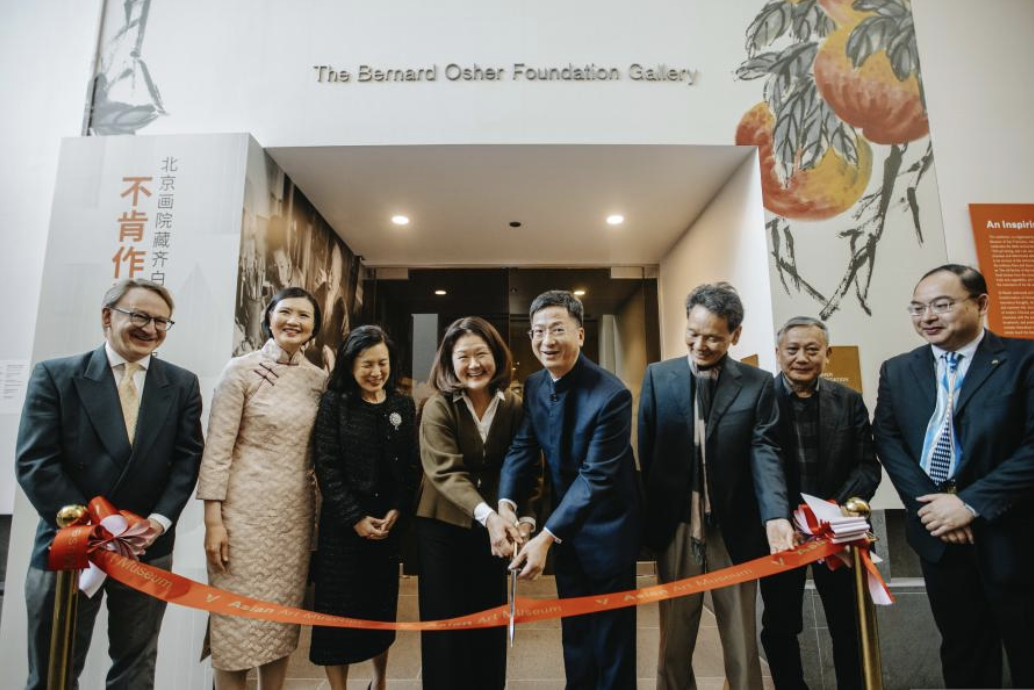
Qi Baishi is one of the most renowned and influential Chinese artists of the 20th century, known as the “Picasso of the East.” In 2024, on the 160th anniversary of Qi Baishi’s birth, the Beijing Fine Art Academy and the Asian Art Museum of San Francisco have joined forces to present the exhibition “Qi Baishi——Inspiration in Ink”, opening on December 12 at the Asian Art Museum.
The alternative Chinese title named as “Old yet strong, I choose not be an immortal” inspired by a seal carved by Qi. The seal reflects the artist’s resilience and life philosophy. Over nearly a century of life, Qi Baishi witnessed societal changes, from the late Qing Dynasty to the Republic of China and the founding of the People’s Republic of China. On a personal level, he rose from humble beginnings in Xiangtan, Hunan Province, to become a carpenter, a portraitist, and eventually an internationally celebrated artist. Across decades, he remained steadfast in his commitment to depicting the natural world as he saw and felt it. Through this iconic seal, the exhibition honors Qi’s enduring artistic charm and revisits the vibrant legacy he left to the world.
The exhibition features about 50 sets of paintings selected from over 2,000 original paintings and manuscripts in the Beijing Fine Art Academy’s collection, encompassing themes such as figures, landscapes, flowers, aquatic life, and meticulously painted insects. Using reconstructed scenes, art installations, and AI technology, the exhibition offers an immersive exploration of Qi Baishi’s dwelling place where his art emerged, particularly the Hutong culture of Beijing, and the profound philosophical reflections embedded in Chinese ink painting.
A Walk Through Time: Immersive Hutong Culture
This exhibition recreates the atmosphere of early 20th-century Beijing life, allowing the audience to immerse themselves in the cultural context of Qi Baishi’s residence and creative environment in Beijing.
After officially settling in Beijing in 1919, Qi Baishi spent the later half of his life there. He initially lived in several temples in Beijing, and later resided in a hutong courtyard with his family. If his hometown, Hunan, gave him his first dreams in life, then the city of Beijing helped to further his artistic career, providing countless sources of inspiration and nourishment. Here, he met many like-minded friends and participated in numerous exhibitions both at home and abroad. As a result, his reputation spread globally, and he earned the admiration and support of overseas artists and collectors such as Noguchi Isamu(1904-1988), Vojtěch Chytil (1896-1936), Yakichirō Suma (1892-1970), Alice Boney (1901-1988), and Robert H. Ellsworth (1929-2014).
Inspired by this, the exhibition creates an immersive experience that explores the unique culture of Beijing’s hutongs through multiple dimensions: visual, auditory, and tactile. Upon entering the exhibition, visitors will first encounter an interactive installation titled “Letters from Qi Baishi.” Hundreds of traditional Chinese envelopes, each containing a small painting, poem, or blessing from Qi, are arranged in a way that forms a dynamic geometric pattern. This design recalls the lattice structure of hutong windows, where the interlocking wooden frames and paper create a sense of dynamic beauty.
Before leaving, visitors can randomly select an envelope as a souvenir. In addition, the exhibition offers free stationery and a submission box, where visitors can write a reply letter to share their impressions of the exhibition with “Old Master Qi.”
As visitors slowly walk into the exhibition hall, they will be immersed in an artistic world made up of bamboo curtains and rice paper. These bamboo curtains, hanging partially visible from above, resemble the semi-open, draped curtains of hutong homes. They serve both as independent space dividers and as symbols of the close, trusting relationships between neighbors. The randomly cut and assembled rice paper backgrounds recreate the lattice structure of hutong windows, conveying the relaxed, homely atmosphere of life. Rice paper also plays a crucial role in Qi Baishi’s ink painting, connecting the artist’s work and life while inviting the audience to connect and share in the creation of a story about encounters.
In the deeper part of the exhibition hall, visitors will hear the sounds of the old Beijing street vendors calling out their goods, the pigeon keeper’s whistle summoning the pigeons back to their nests, and the melodious voices of Peking opera performers. These sounds intertwine, evoking endless nostalgia for the ancient capital. On the other side, near the insect paintings, faint insect chirps are heard. This is the courtyard that Qi Baishi loved most, where countless small creatures accompanied him during his creative process. It is in such a lively environment that Qi Baishi fully explored the marvelous aspects of ordinary life, forming a naive yet humorous artistic style.
Accompanied by these sounds, visitors will find themselves in Qi Baishi’s studio. On the side wall, there is a handwritten sign by him that reads, “I do not consider friendship in selling paintings, for that is what a true gentleman should feel ashamed. Please adhere to the listed prices. In the autumn of the Gengwu year (1930), the seventh lunar month, wrote in a direct style.” This is Qi Baishi’s respectful and sincere attitude toward his profession as an artist. On the opposite wall are his written couplets and a peace dove, symbolizing the elder’s simplest wish—”To encourage people to cultivate well, and to live in peace.”
AI Meets Ink: Exploring New Horizons
The Beijing Fine Art Academy, in collaboration with Limage Studio, has carried out research and integration in the fields of Qi Baishi’s art and digital imagery creation. Through the use of AI technology, it demonstrates the evolution of brushstrokes in Chinese ink painting, refining the unique way of thinking and aesthetic awareness of Qi Baishi art.
The digital imagery consists of three sections: “Sketching and Expressiveness—From Realistic Representation to Artistic Expression”: This section uses the image of fish as an example to showcase the different approaches to representing real subjects in Eastern and Western painting, and further analyzes the transformation of the motif of fish in Qi Baishi’s paintings.“Brushwork and Ink Analysis”: This section begins with Qi Baishi’s “one brushstroke” and traces the power of ink absorption and transformation on rice paper in Chinese painting.“Learning from Ancient Masters, Yet Having My Own Style”: This section presents a computer model that learns Qi Baishi’s painting style and, through AI-assisted design, generates images of “AI Qi Baishi” depicting the landscape of San Francisco.
The digital imagery is displayed alongside Qi Baishi’s “Borrowing Mountains from Nature Album” in the exhibition hall. As Qi Baishi said when creating this set of painting, “For all the famous mountains and great rivers of the world, whatever I see with my eyes or hear with my ears, I wish to borrow it. The mountains I borrow are not from just one place.” Modern technology offers people rich tools and perspectives to understand Chinese art. With the help of digital technology’s networks, the 160-year-old Qi Baishi is “traveling” once again in a different form.
The exhibition will run until April 7, 2025, and will then tour to the Museum of Fine Arts in Boston.