Structural and earthquake engineering are prominent branches of civil engineering that focus on particular aspects of building and construction. Structural engineering is a subcategory of civil engineering that focuses on the integrity, robustness, and durability of buildings and other structures by manipulating or adjusting materials and techniques. Conversely, earthquake engineering encompasses developing and constructing structures and buildings that withstand earthquakes and natural disasters. The primary aim of structural and earthquake engineering is to reinforce buildings and structures by enhancing their durability and resistance to earthquakes and other natural disasters. Earthquake engineers strengthen buildings to withstand earthquakes by evaluating the seismic behavior of buildings or materials and utilizing the material or construction methods that offer the best resistance against natural disasters.
Research is integral for any field to develop and enhance knowledge regarding professional practice and new techniques, strategies, and approaches for completing tasks efficiently. Scholars in any field provide the conceptual framework and theoretical models for implementation by field practitioners. Professionals in any field, including structural and earthquake engineering, utilize methods, techniques, and approaches developed through research. Pedagogy or teaching also plays a primary role in shaping field practice by training people and providing the fundamental concepts, skills, and expertise required for excelling as professionals. Research bridges the gap between theory and practice by integrating field experiences and observations with established theoretical frameworks for developing new concepts and models. Sekhar Chandra Dutta is a structural and earthquake engineer making a difference in the field through teaching and research while bridging the gap between theory and practice.
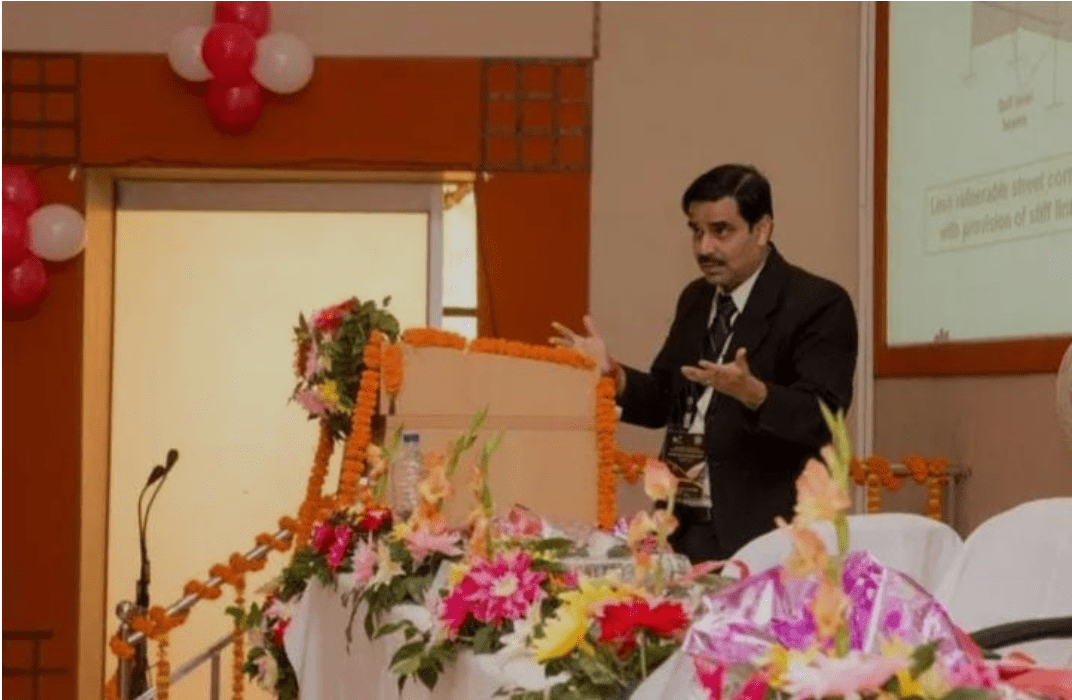
Sekhar Chandra Dutta is a civil engineer with vast teaching and research experience in structural and earthquake engineering. Dutta has over 27 years of pedagogic experience, teaching in various universities and educational institutes across India, including the prestigious Indian Institutes of Technology (IIT). He started his career as a lecturer at the Indian Institute of Engineering Science and Technology (IIES), formerly B.E. College, in 1995, before becoming an assistant professor. In 2004, Dutta joined the Bengal Engineering and Science University as a professor of civil engineering while teaching students until 2009. He founded and became the head of the School of Infrastructure at IIT’s Indian School of Mines (ISM) in 2009. Dutta continued his tenure at IIT in various capacities in different locations from 2009 onwards before eventually assuming the role of Professor and Head of the Department of Civil Engineering at IIT (ISM), Dhanbad, India.
Research and teaching are complementary because lecturers and professors engage in or supervise numerous research projects. Research is also vital for keeping practitioners up to speed with changes and updates in their field. Sekhar Chandra Dutta is a tenured structural and earthquake engineering professor and prominent scholar. Dutta published over 120 research papers, more than 80 conference publications, and three technical reports. He also supervised or participated in over 23 consultancy projects for analyzing the structural integrity of various buildings and structures. Some of Dutta’s primary research interests include structural dynamics, earthquake engineering, structures’ inelastic seismic behavior, seismic design of asymmetric buildings, seismic design of masonry structures, and evaluation of non-engineered structures.
Dutta contributed significantly to research and publications in structural and earthquake engineering. He co-authored a book, Improving Earthquake and Cyclone Resistance of Structures: Guidelines for the Indian Subcontinent, in 2014 with Parthasarathi Mukhopadhyay. Dutta also co-authored a chapter with Mukhopadhyay, Indian Cyclones and Earthquakes: Their Impact on Structures in the Encyclopedia of Natural Hazards, in 2018. Sekhar Chandra Dutta also published numerous research articles individually and in collaboration with other researchers in several scientific journals. His most recent research project was a collaboration with Pranoy Debnath and Lipika Halder entitled Damage Survey and Seismic Vulnerability Assessment of Unreinforced Masonry Structures in Low-Intensity Ambasa Earthquake of Northeast India. The article appeared in volume 44 of Elsevier’s Structures Journal in 2022.
Dutta also published an article in the Journal of Building Engineering in 2022 with Md Ahsaan Hussain and Sreekanta Das entitled the Effect of Bidirectional Ground Shaking on Structures in the Elastic and Post-Elastic Range: Adequacy of design provisions. He previously collaborated with Piyushstrengthen Mohanty and S. Bhattacharya in 2017 to write an article entitled the Proposed Mechanism for Mid-Span Failure of Pile Supported River Bridges during Seismic Liquefaction in the Soil Dynamics and Earthquake Engineering Journal. Dutta also co-authored an article in the International Journal of Disaster Risk Reduction entitled A Critical Review of Retrofitting Methods for Unreinforced Masonry Structures in 2014. Sekhar Chandra Dutta contributed significantly to the structural and earthquake engineering field to improve professional practice through teaching and scholarly research.