Author – Karthik GV, Healthcare Technology Lead, CTO Office, Brillio
In today’s fast-paced world, dominated by speed, convenience, and competition, employers, educational institutions, and healthcare stakeholders have become increasingly aware of the importance of mental health. Many have started to shift their focus towards treating and preventing the plethora of challenges associated with mental health problems for all ages. In the context of mental health, organizations are coming up with innovative ways to ensure employees have the necessary resources, while educational institutions are increasingly relying on varied content to educate and support children and teens.
The latter segment of society is quickly becoming a focus for major organizations and healthcare institutions. The American Academy of Pediatrics (AAP), the American Academy of Child and Adolescent Psychiatry (AACAP), and the Children’s Hospital Association (CHP) have declared child and adolescent mental health a national emergency. According to the Centers for Disease Control (CDC) and the National Association of Mental Illness (NAMI), about 50% of mental disorders or illnesses occur in children and adolescents, but treatment does not start until 6-14 years after symptoms appear.
The AAP-AACAP-CHA Statement of Records states that between March and October of 2020, the percentage of emergency department visits for children with mental health disorders rose by 24% for children ages 5-11 and 31% for children ages 12-17. In the first three quarters of 2021, children’s hospitals reported 42% more emergency room visits for self-injury and suicide attempts or ideation in children ages 5-18 than during the same period in 2019. There was also a more than 50% increase in emergency department visits for suspected suicide attempts among girls ages 12-17 in early 2021 compared to the same period in 2019. This article highlights a technology-driven perspective and some potential solutions to battle these mental health-related problems.
Understanding Youth Mental Health
Mental health problems among children and teens require immediate attention and support to create a sustainable and long-term positive impact. For years, the popular argument has been in favor of schools providing guidance counselors to help kids and teens in need of mental health support. While these counselors are vastly important for school systems, the statistics show that today, across all schools in the US, the average student-to-school counselor ratio is 464 to 1. All statistics aside, it’s essentially impossible for one person to give their undivided attention to and keep track of the mental health and well-being of over 400 students.
The typical support process for mental health needs in children and teens typically looks like the following graphic:
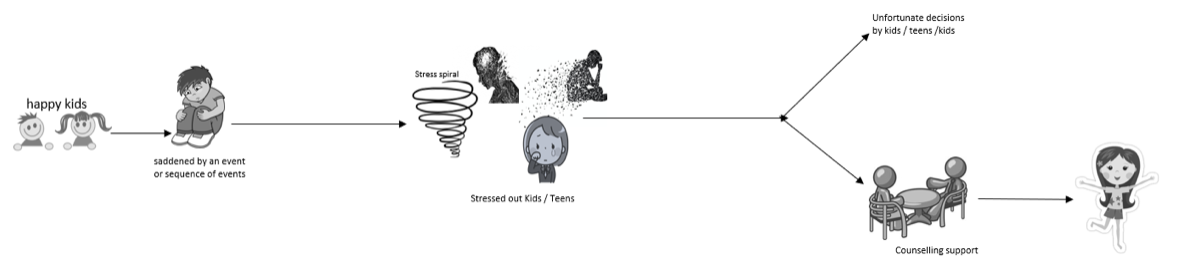 In an ideal scenario, kids and teens should have easy access to a counselor and/or a parent, guardian, or teacher for guidance without any barriers or stigmatization. Unfortunately, we know this is not true for most young people. The overwhelming number of students assigned to one counselor can often lead to longer waiting periods. During these periods, poor choices can be made, and mental health disorders can worsen in what is often colloquially referred to as a stress spiral.
There are options on the market today designed to help children and teens enhance their abilities to self-soothe and self-support, but most of these applications and websites do not cater to the current generation’s specific needs and environmental context. Many of them are designed for adults and don’t consider a younger user base. Even among the apps designed for kids and teenagers, several have entry barriers like subscriptions, requiring parental, teacher, or counselor interference.
Technology-driven Approach: Unboxing and Reboxing
Market research by NAMI (National Alliance on Mental Illness) states that “one in five children and adolescents experience a mental health disorder in a given year, and 50% of all mental illness begins before age 14.” That is an alarming statistic, coupled with the lack of technology solutions that are accessible to a young audience. Children would benefit greatly from applications, games, websites, and other software to help and support them without entry barriers. This could be done via a trusted self-help medium that hosts industry leaders and leading counselors sharing their guidance and approach to the problems they are facing.
Market research indicates that it is far easier and quicker for kids and teens to come out of stigmas if guided and acted on in the early phases of their lives when these mental health problems are first appearing.
The tech approach we are describing is diagrammed, in a simple format, below:
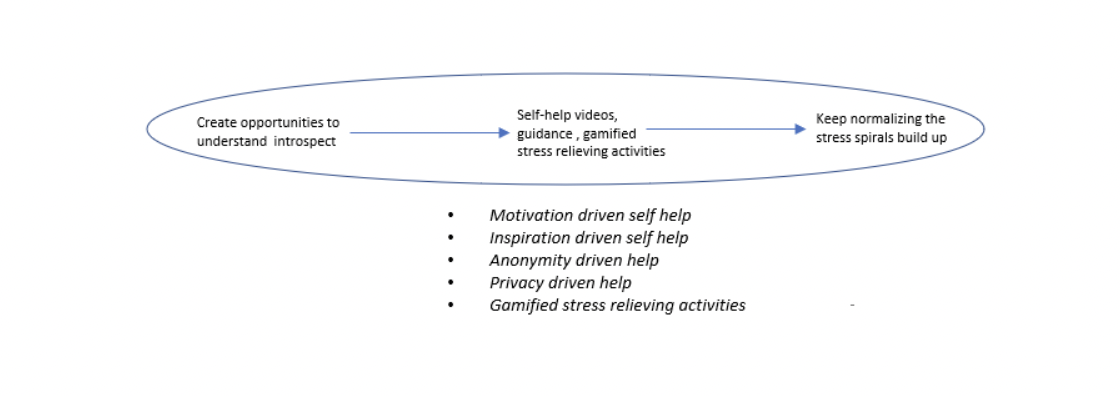
To be clear, this approach does not advocate for the substitution of counselors with technology. Rather, it aims to make self-support more accessible without any barriers at the time of need, thereby eliminating or minimizing potential stress spiral build-up. This enables prevention, by tackling issues before their manifest into major, debilitating mental crises that would require counselor support and medical treatment for years to come.
A Hopeful New Beginning
There are many interesting ways to onboard these tech-savvy, modern youth to tech solutions for mental health. It’s important to ensure that the experiences offered are hyper-personalized, gamified, and trustworthy. They should allow kids and adolescents to normalize, validate, introspect, and get guidance via informational and educational videos in a more engaged and gamified way. There should also be functions to get in touch with a trusted adult in case of emergency or need through the software.
Younger children could benefit from having cartoon characters, chosen by focus groups in the same age range, as ‘pocket buddies’ for self-help purposes, while teenagers could make their customizable avatars as their ‘multiverse buddies’. Embracing this kind of solution, combined with personalized and gamified experiences, could mark a new beginning for mental health care in kids and adolescents. They could help provide self-help and accessible support in the most critical years of their lives. That could potentially prevent years of stress, confusion, medication, and other mental health-related issues.