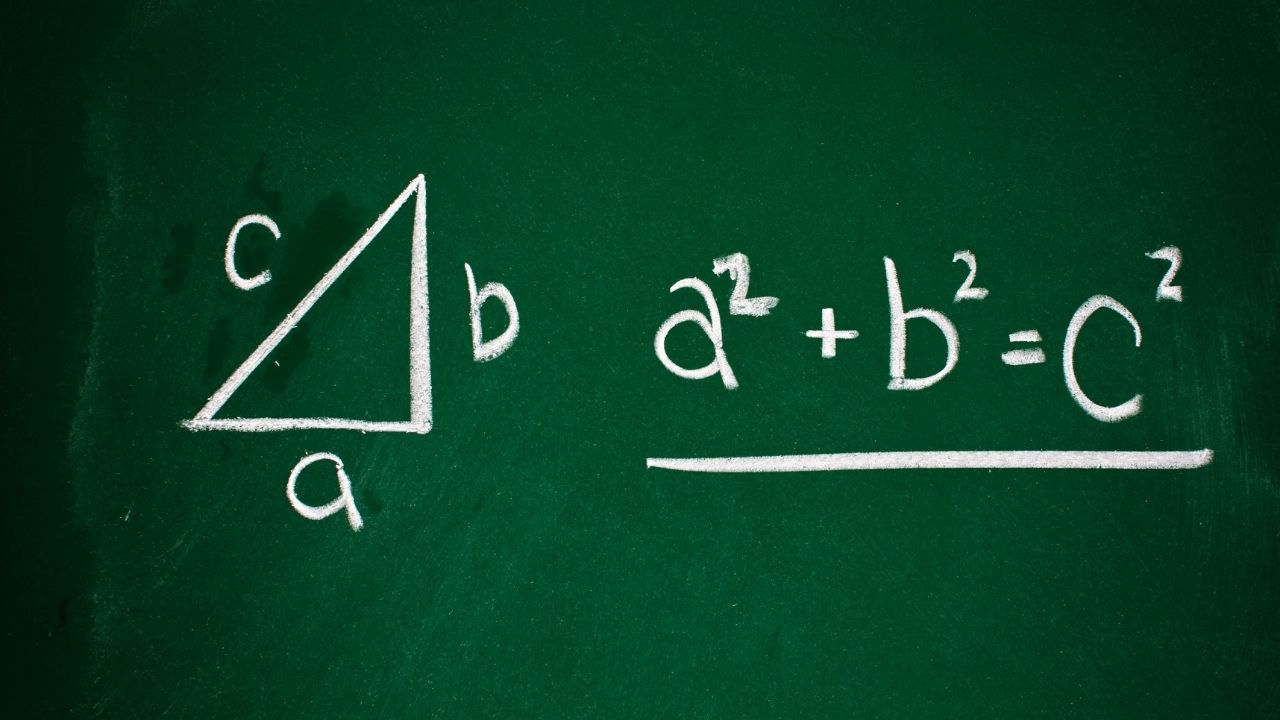
Pythagorean theorem is an important theorem used in geometry that shows the relationship between the lengths of the sides of a right-angled triangle. It is named after the famous Greek mathematician Pythagoras and is also known as the Pythagoras theorem. The Pythagorean theorem holds great significance in geometry and forms the base for solving various mathematical problems. It finds many real-life applications in the field of construction, navigation, surveying, architecture, etc.
What is Pythagoras Theorem?
Pythagoras theorem states that the sum of the square of the two sides of a right-angle triangle is equal to the square of the third side called the hypotenuse. The equation formed as per the Pythagoras theorem is a^2 + b^2 = c^2, where a, b and c are the sides of a right triangle. The ability to find the length of a side when the other two sides’ length is given makes the Pythagorean Theorem a beneficial construction and navigation technique. Here are the five real-life applications of the Pythagorean theorem:
The two main concepts used in the Pythagorean theorem are the terms “hypotenuse” and “leg”– The sides of a right-angled triangle that join to form the right angle are called the legs, and the third side, which is opposite to the right angle, is called the hypotenuse. Since the sum of all three angles of a triangle is 180 degrees, the right angle is always largest, and the length of the hypotenuse is greater than the other two sides.
Significance of Pythagorean Theorem
The Pythagorean theorem is one of the most important concepts in trigonometry. It is mainly utilized in finding the length of the third side of a right triangle when the lengths of the other two sides are already known. For example, to find the length of the third side of a right triangle when the length of one side is six and the hypotenuse is ten, you can apply the Pythagorean theorem, i.e.,
- 6^2 + b^2 = 10^2;
- 36 + b^2 = 100;
- b^2 = 100-36;
- b^2 = 64
- b = 8
Applications of Pythagorean Theorem
The fundamental formula of calculating distance in geometry is derived from the Pythagorean theorem. It is applicable to calculate the length of the diagonal connecting any two straight lines. This aspect of the Pythagorean theorem is pretty useful in designing and construction. For instance, while building a sloped roof, if you know the height and the length of the roof to cover, you can use the Pythagorean Theorem to find the diagonal length or to calculate the roof’s slope. You can utilize this data to precisely cut beams to support the roof structure or to calculate the roof’s total area. Engineers often use the Pythagorean theorem while laying out the building foundation or constructing a right-angled corner between two walls.
The Pythagorean Theorem is used to calculate many aspects of the terrain that otherwise are hard to assess, such as the steepness of slopes of mountains. A surveyor uses a telescope and a measuring stick at a fixed distance away, so when the telescope’s line of sight and the measuring stick create a right angle, a triangle is formed. Since the surveyor has the information about the two sides of the triangle that are the height of the measuring stick and the horizontal distance of the stick from the telescope, he calculates the steepness of the hill by using the theorem to find the length of the slope that covers that distance.
Pythagorean theorem is also foundational in various branches of mathematics, physics, geology, and architecture. There are various ways to reinforce the understanding of Pythagoras theorem, like math worksheets. Cuemath offers interactive worksheets designed by math experts to help students learn the applications of such math concepts in our everyday life. You can easily find some of these interactive resources by visiting cuemath.com.