The world is getting better at producing electricity. It is getting much worse at moving it.
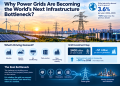
Global electricity demand is entering a new growth cycle. The International Energy Agency expects electricity consumption to increase at an average annual rate of 3.6% between 2026 and 2030, around 50% faster than the average growth rate of the previous decade. Industry, electric vehicles, air conditioning, data centres and new manufacturing capacity are all adding to demand.
Yet the infrastructure carrying that electricity has not expanded at the same pace.
The global power sector now spends around $400 billion a year on grids, compared with roughly $1 trillion on electricity generation. The IEA estimates that annual grid investment needs to increase by approximately 50% by 2030 from today’s level to keep up with electricity demand.
That creates a different kind of energy bottleneck. The problem is increasingly not whether the world can build another solar farm, wind project, power plant or data centre. It is whether the grid can connect them and deliver their electricity where it is needed.
Electricity Demand Is Entering a New Growth Cycle
For much of the last decade, electricity demand in many developed economies was relatively stagnant. That is changing.
The IEA expects global electricity demand to grow by 3.6% annually through 2030. Emerging economies are expected to account for almost 80% of additional global electricity consumption during this period. China alone is expected to contribute close to half of the global increase, while India and Southeast Asia are becoming increasingly important sources of demand growth.
The sources of demand are also changing.
Electric vehicles are replacing oil consumption with electricity. Air conditioning is becoming more important as incomes rise and temperatures increase. Manufacturing is becoming more electricity-intensive. Data centres are creating large, concentrated loads in specific locations.
In the United States, electricity demand is expected to rise by nearly 2% annually through 2030, with around half of the increase coming from data centres, according to the IEA.
This matters because electricity demand does not need to rise everywhere equally to create a grid problem. A new factory, semiconductor plant or data centre can require hundreds of megawatts in one location.
The grid therefore has to solve two problems simultaneously: generate more electricity and move it to increasingly concentrated pockets of demand.
The Grid Is Falling Behind Generation
The clearest evidence of the bottleneck can be seen in connection queues.
More than 2,500 GW of renewable, storage and large-load projects are currently stalled in grid connection queues worldwide, according to the IEA. That is more than the capacity of many countries’ entire electricity systems combined.
The problem is partly a mismatch in construction timelines.
A solar or wind project can often be developed in roughly 1-5 years. A data centre can be built in around 1-3 years. EV charging infrastructure can be deployed even faster.
A major grid project, however, can take 5-15 years when planning, permitting and construction are included.
This creates a structural timing problem.
Generation developers can build faster than transmission networks can expand. Large electricity consumers can also arrive faster than utilities can reinforce the network.
As a result, a project can have financing, land, equipment and customers in place and still wait years for a grid connection.
That turns the grid from a supporting infrastructure into a constraint on the entire electricity investment cycle.
Transformers Are Becoming a Bottleneck Inside the Bottleneck
Even when governments approve new grid projects, another problem remains: equipment.
Transmission networks require cables, transformers, switchgear and other specialised components. These are not commodities that can always be ordered and delivered quickly.
The IEA found that average lead times for cables and large power transformers have almost doubled since 2021. It currently takes around two to three years to procure cables and up to four years to secure large power transformers.
The problem is becoming particularly important because multiple regions are trying to expand their grids simultaneously.
The United States is experiencing supply-chain constraints around distribution transformers, with the Department of Energy describing them as fundamental building blocks of the electricity grid and highlighting long lead times and component shortages.
This creates a second bottleneck.
Even if regulators approve a transmission line, utilities still need to obtain the equipment required to build it.
The IEA says prices for key grid components have nearly doubled over the past five years.
That means the grid expansion cycle is not simply a question of governments allocating more money. Manufacturers must also expand capacity, utilities must place orders earlier and supply chains must become capable of supporting a much larger infrastructure buildout.
Data Centres Are Making Local Grid Constraints More Visible
Data centres have become one of the most visible examples of the problem, but they are only one part of a much larger electricity-demand shift.
Global data-centre electricity consumption increased 17% in 2025, according to the IEA, and electricity use by data centres is expected to double by 2030. AI-focused data centres are expected to see even faster growth.
The challenge is not simply the amount of electricity consumed.
It is the concentration.
A data centre can require a very large amount of electricity in a single location, often far faster than traditional industrial demand develops. If the local transmission and distribution system does not have sufficient capacity, building additional generation elsewhere does not immediately solve the problem.
This is why some developers are considering alternatives such as onsite generation, storage and flexible power arrangements.
The U.S. Department of Energy’s latest transmission needs work also points to rapid load growth from hyperscale data centres, domestic manufacturing and electrification as reasons for additional transmission infrastructure.
The result is a new relationship between electricity infrastructure and economic development.
A region with available land and cheap electricity may still struggle to attract new industry if it cannot provide a sufficiently large and reliable grid connection.
The Grid Investment Opportunity Is Larger Than New Power Plants
The investment implications extend beyond utilities.
The IEA estimates that roughly $400 billion is currently invested in grids each year, while about $1 trillion is invested in generation assets. It argues that maintaining electricity security as demand rises requires grid spending to move toward parity with generation investment.
That represents a major change in where energy infrastructure spending could flow.
Transmission developers will need to build more lines. Utilities will need to upgrade distribution networks. Manufacturers will need to produce more transformers, cables and switchgear. Grid operators will need technologies that increase the capacity of existing infrastructure without waiting years for new lines.
Not every solution requires a completely new transmission corridor.
The IEA estimates that grid-enhancing technologies such as dynamic line rating, advanced power-flow control and other upgrades could help unlock 450-700 GW of additional capacity for projects in advanced stages of connection queues. Broader measures could potentially unlock 1,200-1,600 GW of hosting capacity.
That creates two parallel markets.
The first is traditional grid expansion: new transmission lines, substations and distribution infrastructure.
The second is grid optimisation: technologies that allow existing networks to carry more electricity.
Both become more valuable as the gap between electricity demand and available grid capacity widens.
The Next Energy Infrastructure Cycle May Be About Moving Electricity
The global energy debate has spent years focusing on how much electricity the world can generate.
The next constraint may be how much electricity it can move.
The numbers point to a widening infrastructure requirement. Electricity demand is expected to grow 3.6% annually through 2030. More than 2,500 GW of projects are already waiting in grid queues. Grid investment needs to rise roughly 50% from today’s $400 billion annual level. Meanwhile, major transmission projects can take 5-15 years, and large transformers can require up to four years to procure.
That makes the grid more than an enabling infrastructure.
It is becoming the infrastructure that determines how quickly the rest of the electricity system can grow.
The world can build more generation. It can build more data centres. It can electrify transport and industry.
But without enough wires, transformers and substations between those assets and the customer, additional generation capacity remains partly stranded.
The next phase of the global energy buildout may therefore be less about producing another unit of electricity and more about building the network capable of delivering it.
Conclusion
The power-grid bottleneck is emerging because several infrastructure cycles are colliding at once: rising electricity demand, renewable deployment, industrial electrification and large new loads such as data centres.
The numbers show the mismatch clearly. Around $400 billion is currently invested in grids annually, compared with about $1 trillion in generation, while the IEA says grid spending needs to rise by roughly 50% by 2030. More than 2,500 GW of projects are already waiting for grid connections.
The constraint is also physical. New transmission can take 5-15 years to develop, while transformers and cables are already facing much longer procurement times.
That makes the grid one of the least visible but increasingly important pieces of the global infrastructure cycle.
The energy transition is no longer only a race to build power plants.
It is becoming a race to build the network between the power plant and the customer.