For years, buying a new smartphone meant looking for a better camera, faster processor, longer battery life or a sharper display. But those hardware upgrades are becoming harder to distinguish from one generation to the next. The next major difference may come from something users cannot see: the AI operating behind the screen. As AI moves deeper into smartphones, the device could become less important than the intelligence connecting it to apps, search, cloud services and personal data. The real smartphone battle may no longer be about who builds the most impressive piece of hardware, but who can make that hardware genuinely smarter.
The Smartphone Is Still Huge. The Upgrade Is Getting Harder To Sell
The smartphone remains one of the world’s biggest consumer technology businesses, but hardware improvements are becoming increasingly incremental. A brighter display, a faster processor or a modestly improved camera can make a new phone better without necessarily making the previous model obsolete.
Apple’s FY2025 numbers show just how large the hardware business remains. The company generated $209.586 billion from iPhone sales, up from $201.183 billion in FY2024. But another number is increasingly important: Apple’s Services revenue reached $109.158 billion, compared with $96.169 billion a year earlier. Services therefore generated more than half as much revenue as the iPhone itself.
That matters because AI can strengthen the value of the entire ecosystem around a smartphone rather than simply the handset.
The phone gets users into the ecosystem. AI can determine how often they interact with it, which services they use and how much computing happens behind every request.
The competitive question is therefore changing from “Which phone has better specifications?” to “Which ecosystem can make the phone substantially more useful?”
Google Shows Where The AI Economics Can Go
Google is one of the clearest examples of why the AI opportunity extends far beyond smartphones.
Alphabet’s Google Services generated $77.3 billion in revenue in Q1 2025, with Google Search and Other contributing $50.7 billion. Google Cloud generated another $12.3 billion during the quarter, up 28% year over year, with growth coming from both core cloud products and AI products.
The significance is that Google’s AI investment does not need to be monetised through the sale of a Pixel phone.
Gemini can influence Search, subscriptions, Workspace, Cloud and Android. By Q2 2025, Google said the Gemini app had surpassed 450 million monthly active users, while Google Cloud revenue reached $13.6 billion, up 32% year over year.
By Q4 2025, Alphabet reported Google Cloud revenue of $17.7 billion, up 48%, while enterprise AI products were generating billions of dollars in quarterly revenue. Google also said its Google One subscription business benefited from demand for AI plans.
This is the bigger opportunity around smartphones: AI can monetise search, subscriptions, cloud infrastructure and software even when the physical device itself generates no additional revenue.
Apple Has A Different AI Advantage: The Installed Base
Apple’s model is different because it controls the hardware, operating system and services relationship.
In FY2025, Apple generated $416.161 billion of total net sales, including $209.586 billion from iPhone and $109.158 billion from Services.
That installed base gives Apple an enormous distribution channel for AI.
Apple Intelligence does not have to create a new hardware category to matter financially. If AI makes users more dependent on their iPhone, Mac, iPad and other Apple devices, it can potentially reinforce the ecosystem that already generates services revenue.
Apple’s broader ecosystem is already economically significant. The company said the App Store ecosystem facilitated nearly $1.3 trillion in billings and sales during 2024, although that figure represents activity facilitated through the ecosystem rather than Apple’s own revenue.
This distinction is important.
AI does not necessarily need to become a standalone billion-dollar product. It can increase the economic value of an ecosystem by making existing services more useful and increasing engagement with them.
Samsung’s Numbers Show The Hardware Side Of The AI Race
Samsung demonstrates why hardware is not disappearing from the equation.
In Q2 2025, Samsung’s Mobile eXperience and Networks businesses generated KRW 29.2 trillion in revenue and KRW 3.1 trillion in operating profit. The company explicitly linked its mobile strategy to flagship sales and AI capabilities.
Samsung’s position is different from Google’s because it sits much closer to the physical device. It has to convince consumers that AI features justify buying its phones while also competing on cameras, displays, processors, design and battery life.
This creates an important test for the industry.
If AI becomes a genuine reason to upgrade, manufacturers can use AI to extend the smartphone replacement cycle in the direction of new hardware. But if most AI features can run effectively on older phones through software updates, AI could actually reduce the need for consumers to purchase new devices.
The commercial outcome will depend on how much of the AI experience requires new silicon, more memory and greater on-device computing power.
Qualcomm Is Selling The Infrastructure Behind The AI Phone
The semiconductor layer may be one of the clearest beneficiaries of this shift.
Qualcomm generated $44.3 billion of revenue in fiscal 2025, including $38.4 billion from its QCT semiconductor business. QCT supplies technologies spanning mobile devices, automotive and IoT, including processors and connectivity products.
The company has increasingly positioned on-device AI as a major growth opportunity.
That matters because running AI locally changes the requirements of a smartphone. Instead of sending every task to a remote data centre, certain workloads can be processed directly on the device. Qualcomm says on-device inference can potentially reduce AI costs compared with relying entirely on cloud processing, while hybrid architectures can combine local and cloud computing.
Qualcomm’s strategy also shows how the smartphone AI opportunity could spread beyond phones. At its 2026 Investor Day, the company raised its fiscal 2029 target for non-handset QCT revenue to $40 billion, including targets of more than $15 billion for data centres, more than $14 billion for IoT and $10 billion for automotive.
The implication is straightforward: AI is expanding the addressable market for computing rather than simply creating another smartphone feature.
The Real Battle Is Between On-Device And Cloud AI
Every AI request has an economic cost.
A simple task such as summarising a message may increasingly be handled locally. More complex reasoning may require a cloud model. This creates a hybrid architecture in which the smartphone becomes the gateway between local computing and massive data-centre infrastructure.
That has consequences for several industries simultaneously.
- For chipmakers, AI means demand for more capable and efficient processors.
- For cloud providers, every cloud-based AI request represents potential computing demand.
- For smartphone manufacturers, AI can differentiate devices and potentially support premium pricing.
- For platform companies, AI can increase engagement with search, subscriptions, productivity tools and other services.
Google’s numbers demonstrate how significant the cloud side can become. Google Cloud grew from $10.347 billion in Q2 2024 to $13.624 billion in Q2 2025, while Alphabet said AI products were contributing strongly to the segment’s growth.
The smartphone is therefore only one endpoint in a much larger computing chain.
AI Could Change What Consumers Pay For
The most interesting change may be the move from paying once for hardware toward paying continuously for intelligence.
A consumer buys a smartphone once. But an AI ecosystem can potentially generate revenue through subscriptions, cloud consumption, premium services, advertising and increased use of existing platforms.
Google is already testing this model through its subscription ecosystem. In Q4 2025, Alphabet reported $13.6 billion of revenue from Subscriptions, Platforms and Devices, up 17% year over year, with Google One benefiting from increased demand for AI plans.
That is a fundamentally different revenue model from selling another smartphone.
It also explains why companies with huge existing user bases have a potentially valuable AI distribution advantage. They do not need consumers to buy an entirely new product. They can add intelligence to products consumers already use every day.
For smartphone manufacturers, this raises a difficult question: will the AI value accrue primarily to the company selling the phone, or to the company providing the intelligence behind it?
The answer could determine where the industry’s future profits sit.
The Risk: AI May Not Be Enough To Make People Upgrade
Consumers do not buy technology because companies say it is intelligent. They buy it when it solves a problem better, faster or more cheaply.
If AI features remain limited to photo editing, message summaries, wallpapers and occasional chatbot interactions, they may not fundamentally change replacement behaviour.
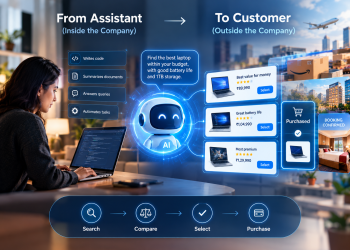
The economics become more interesting when AI can perform multi-step tasks: find information, understand context, interact with applications and complete actions with minimal user input.
That is the point at which the smartphone could stop being merely a collection of applications and become an interface for delegated work.
The difference between those two outcomes is enormous.
In the first case, AI is another feature category.
In the second, AI becomes part of the operating system and potentially a reason to remain inside a particular ecosystem.
The Smartphone May Become The Gateway To A Much Bigger Market
The numbers already show that the smartphone itself is only one part of the economic opportunity.
Apple generated $209.586 billion from iPhone sales and $109.158 billion from Services in FY2025. Alphabet’s businesses surrounding Search, Cloud, subscriptions and AI are measured in tens of billions of dollars each quarter. Qualcomm generated $38.4 billion from QCT in FY2025, while positioning AI-enabled edge computing as a major expansion opportunity.
These businesses are connected.
More capable chips enable more capable devices. More capable devices create new AI use cases. AI use increases demand for cloud computing and subscriptions. Better AI integration can increase the value of ecosystems. And stronger ecosystems can make consumers less willing to switch platforms.
That is why the next smartphone cycle may be less about the physical phone itself.
The handset remains the entry point, but the economic value increasingly stretches across chips, operating systems, AI models, cloud infrastructure, subscriptions and digital services.
Conclusion
The smartphone is not disappearing. The economics around it are changing.
Apple’s $209.6 billion iPhone business shows that hardware remains enormous, while its $109.2 billion Services business demonstrates the value that can accumulate around the device. Google’s rapidly expanding Cloud business and AI-driven subscriptions show how intelligence can be monetised away from the handset. Qualcomm’s strategy shows how AI is simultaneously increasing the importance of specialised computing at the edge.
The next smartphone may therefore be judged less by how impressive its specifications look on a box and more by what its AI can actually accomplish.
The biggest shift may not be from one phone to another.
It may be from buying a device to buying access to an intelligent ecosystem.