You download the app for free, watch the videos for free, search for answers for free and use the service without ever entering your card details. It feels like there is no transaction at all.
But behind that $0 price tag is a business model built around something else: your attention, your behaviour, your data or your willingness to eventually pay for more. The modern internet has made “free” one of the most powerful prices in business and sometimes, one of the most expensive.
The $0 Business Model Is Not Really Free
The internet changed the meaning of price. A product can now be downloaded, used and enjoyed without a payment at checkout, while the company behind it builds a valuable business around the user.
Advertising is the clearest example. The Federal Trade Commission’s 2024 examination of major social-media and video-streaming companies found that most of the companies’ revenue from these services came from advertising. Their services could remain free to consumers because advertisers, rather than users, were paying for access to audiences and targeting capabilities.
Alphabet demonstrates the scale of this model. In 2025, Google advertising generated $294.691 billion, compared with $402.836 billion of total Alphabet revenue. Search and other advertising alone generated $224.532 billion, while YouTube advertising generated $40.367 billion.
The transaction therefore has two sides. The consumer receives a service for $0, while advertisers purchase the commercial opportunity created by millions or billions of users.
That makes “free” less of a business model by itself and more of a customer-acquisition mechanism. The company first removes the price barrier, then monetizes the audience it creates.
Attention Has Become An Economic Asset
Data is only one part of the equation. Attention itself has monetary value.
For an advertising platform, a user who repeatedly opens an app creates more opportunities to show advertisements. More engagement can mean more impressions, more behavioural signals and potentially better targeting.
Meta’s 2025 results show how directly this works. Its Family of Apps averaged 3.58 billion daily active people in December 2025, up 7% year over year. During 2025, ad impressions increased 12%, while the average price per ad increased 9%. Meta also stated that substantially all of its revenue was generated from advertising on Facebook and Instagram.
That creates an important distinction between users and customers. The people using Facebook or Instagram are generally not the ones writing the advertising cheque. Advertisers are.
The economic objective is therefore not simply to maximise downloads. It is to create a large, active audience that can be monetized repeatedly.
This explains why platforms invest heavily in recommendation systems, Notifications, personalization and features designed to keep people returning. Engagement is not merely a product metric. In an advertising-funded business, it can become a revenue-generating asset.
Your Data Can Reduce The Price You Pay, While Increasing What The Company Earns
The phrase “if you aren’t paying, you are the product” is catchy, but it is incomplete.
Companies do not necessarily sell a user’s personal information directly to advertisers. Instead, they can use information and behavioural signals to improve advertising targeting, measurement, personalization and the overall value of their advertising inventory.
The FTC found that major social-media and video-streaming companies collected extensive information about users and non-users and used data in advertising, algorithms and analytics. It also found that data-collection incentives were closely connected to advertising-driven business models.
That creates a less visible exchange.
The user provides:
- Attention
- Behavioural signals
- Engagement
- Sometimes personal information
- Opportunities to interact with advertisements
The company provides:
- Search
- Communication
- Entertainment
- Storage
- Education
- Other digital services
The trade-off is not automatically harmful or unfair; many users willingly accept it because the service provides substantial value without a subscription fee. The important point is that money is no longer the only economic currency involved.
The $0 displayed on the payment screen tells only one part of the story.
Freemium Turns Free Users Into Future Customers
Another version of the $0 economy does not depend primarily on advertising. Instead, the free product acts as the first stage of a conversion funnel.
Dropbox is a clear example. As of December 31, 2025, it had more than 700 million registered users, but only 18.08 million paying users. The company explicitly says many users initially access its platform free of charge and that it encourages them to convert through in-product prompts, notifications and trials of paid plans.
Duolingo follows a similar logic in education. At the end of 2025, it had 133.1 million monthly active users, 52.7 million daily active users and 12.2 million paid subscribers. Its filing states that it converts free users into paid subscribers over time, with some users taking months or years before subscribing.
This changes the economics of launching a product.
A company does not necessarily need every user to pay. It needs enough users to create a large funnel from free → engaged → paying.
The free tier lowers customer-acquisition friction. Once users have built habits, stored information or integrated the service into their routines, the premium upgrade can become easier to sell.
Free is therefore not always the destination. Sometimes it is the first step toward monetization.
The “Free” Version Can Become More Valuable To The Company
There is another twist: companies can become better at monetizing the same free user base without dramatically increasing the number of users.
Meta’s 2025 figures illustrate this. Ad impressions across its Family of Apps increased 12%, while average price per advertisement increased 9%.
This matters because user growth and monetization growth are not the same thing.
A platform can increase revenue through:
- More users
- More time spent on the platform
- More advertising impressions
- Better targeting and measurement
- Higher advertising prices
- More effective ad formats
The result is that the economic value of a free user can rise even when the user continues paying nothing.
Google provides another example. In 2025, Google Search & other advertising revenue grew from $198.084 billion to $224.532 billion, while paid clicks increased 6% and cost per click increased 7%.
The consumer still types a search query without paying Google directly. Yet the commercial value attached to that activity can increase.
That is the paradox of the $0 economy: the user’s price can remain unchanged while the company’s monetization of the user’s activity becomes more sophisticated.
Convenience Creates Switching Costs
The hidden cost of free products is not always privacy or advertising. Sometimes it is dependency.
A free service can become deeply embedded in everyday life. Photos accumulate in cloud storage. Playlists become personalized. Documents are stored online. Social connections form around a platform. Learning progress is tracked. Search histories and preferences make the service increasingly convenient.+
At that point, the company has something more valuable than a casual user: a user with a reason to stay.
This creates a powerful economic cycle:
Free access → user acquisition → habit formation → accumulated data/content → higher switching cost → premium conversion or deeper monetization.
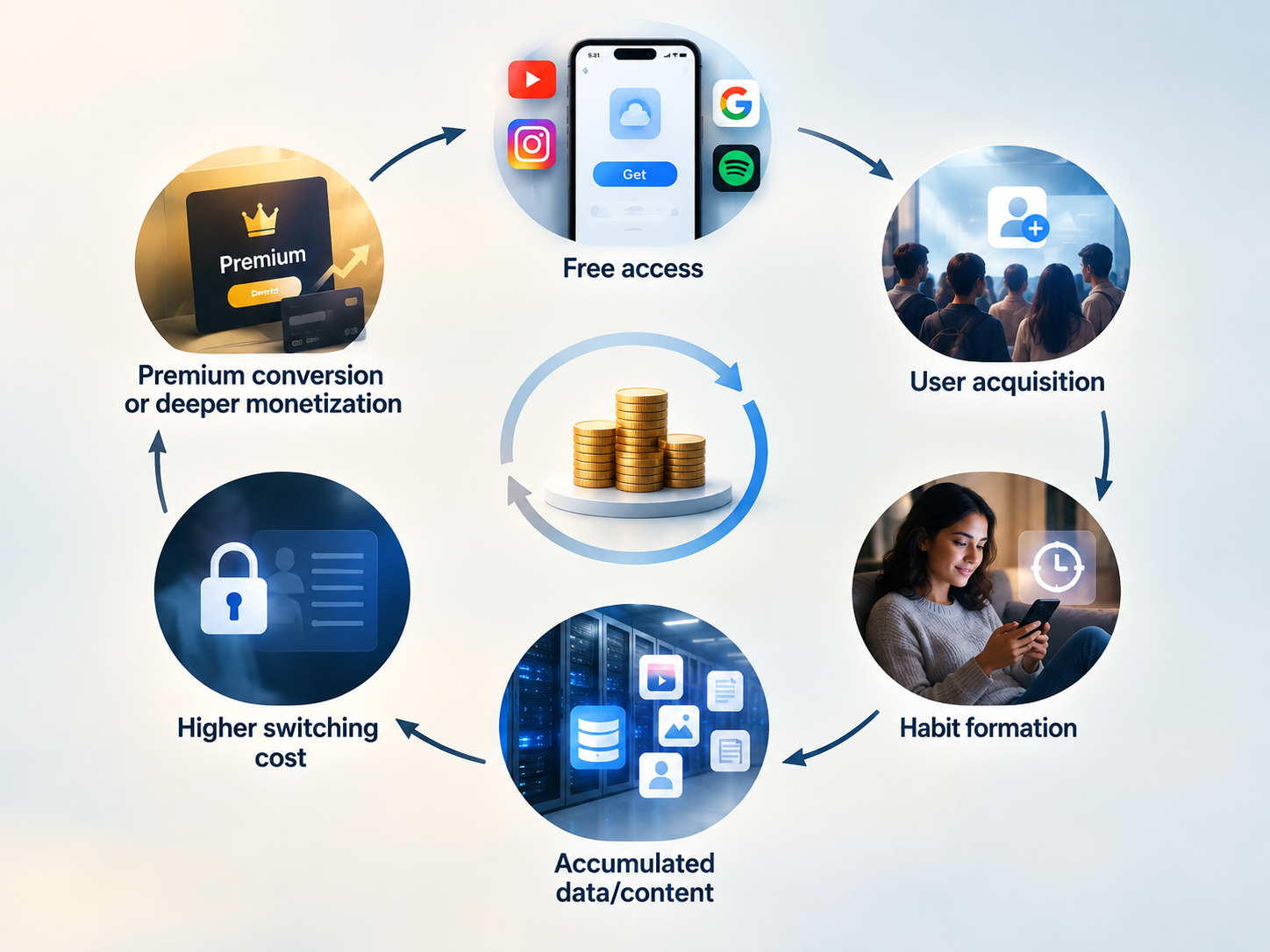
Dropbox’s filings explicitly describe the importance of converting registered users into paying users, while Duolingo says some users remain free for months or years before subscribing.
This does not mean every free product is designed to trap users. But it explains why companies can rationally spend heavily on free products even when those products generate little direct revenue from an individual user.
The objective is to build an ecosystem in which the cost of leaving gradually becomes larger than the $0 price suggests.
The Real Question Is What You Are Giving Up
The biggest misconception about free digital products is that their price can be understood by looking only at a credit-card statement.
A more complete calculation asks what happens on both sides of the transaction.
A free search engine may save money compared with a paid information service, but generates advertising value from searches. A free social network provides communication and entertainment while monetizing advertising inventory. A free education app can acquire millions of learners and convert a portion into subscribers. A free cloud-storage tier can introduce users to a paid ecosystem.
None of these models is inherently identical, and the trade-offs vary substantially between services.
The FTC’s findings nevertheless show why consumers should pay attention to the underlying model: major platforms can have strong financial incentives to collect and use information because advertising is central to their economics.
So the better question is not “Is this product free?”
It is:
“What economic value does this company receive from giving it to me for free?”
Once that question becomes standard, the $0 price tag starts looking less like the end of the transaction and more like its opening line.
Conclusion
The digital economy has made it possible to remove money from the front of a transaction without removing economics from it.
Users can pay with attention. Advertisers can pay with money. Companies can monetize behavioural signals, subscriptions, upgrades, transactions or ecosystem dependence. Sometimes several of these mechanisms operate simultaneously.
The numbers show how large the opportunity has become. Alphabet generated $294.691 billion from advertising in 2025, while Meta’s ecosystem reached 3.58 billion daily active people by December 2025. At the freemium end, Dropbox had more than 700 million registered users but 18.08 million paying users, demonstrating how a vast free audience can sit above a much smaller paying base.
The important shift is therefore not that free products have suddenly become deceptive. It is that price has become multidimensional.
The next time a product costs $0, the useful question is not whether you are paying.
It is what the company has built an economy around instead.