ESG is entering a more demanding phase. For years, companies could demonstrate sustainability credentials through disclosures, net-zero targets and ESG scores. That created transparency, but it did not always tell investors whether a business was actually becoming more resilient or profitable.
That is now changing. Institutional investors are increasingly asking a harder question: What does the transition mean for earnings, capital expenditure and returns? This is the shift from ESG 1.0 to ESG 2.0. Sustainability is moving from a reporting exercise into a corporate finance decision.
The interesting part, in my view, is that investors are no longer simply looking for “green” companies. They are looking for businesses that can adapt to a lower-carbon economy without sacrificing economic returns and potentially use that transition to build an advantage.
ESG 1.0 Measured Intent. ESG 2.0 Measures Execution
The first generation of ESG was largely about disclosure. Companies measured emissions, published sustainability reports and announced long-term targets. This was important because investors needed visibility into risks that traditional financial statements often missed.
But disclosure has a limitation: a target is not the same as a transition. A company can announce net-zero ambitions without showing how much capital will be required, how operations will change or what the impact will be on profitability. ESG 2.0 is therefore about connecting sustainability promises with measurable execution.
The ISSB’s sustainability standards are an important part of this evolution, focusing on sustainability-related information that could affect a company’s prospects. Meanwhile, transition-plan frameworks are pushing companies to explain how targets translate into actual business decisions.
That makes ESG analysis much closer to fundamental investing. The question is no longer simply “Is this company sustainable?” but “Is management executing the transition intelligently?”
Institutional Investors Are Changing The Question
The biggest shift is coming from the investors with the longest time horizons. Pension funds, insurers, sovereign wealth funds and large asset managers cannot easily ignore climate-related risks because those risks can eventually affect asset values, credit quality, insurance losses and long-term economic growth.
BlackRock’s research describes the low-carbon transition as a structural force affecting energy demand, technology, policy and capital investment. Its 2025 research found that 70% of surveyed insurance clients had increased their conviction in sustainable and transition-investing objectives.
But I think the more interesting change is how investors are using this information. Instead of simply excluding carbon-intensive businesses, investors can ask which companies are capable of adapting profitably. A steelmaker, airline or utility cannot instantly eliminate its emissions without disrupting the underlying business. The investment question is which company can reduce its carbon intensity while protecting returns.
This turns ESG into something much closer to fundamental research and scenario analysis.
Decarbonisation Needs Its Own Return Metric
“Return on transition capital” sounds useful, but investors need more than a qualitative assessment of whether green capex is worthwhile. A practical way to bring transition spending into conventional valuation is to calculate a Transition-Adjusted ROIC (t-ROIC):
t-ROIC = (NOPAT + Energy Savings – Regulatory Liabilities) / (Invested Capital + Cumulative Transition Capex)
The purpose is not to create another ESG score. It is to force analysts to connect decarbonisation with financial outcomes. Energy savings capture operational benefits from efficiency investments, while regulatory liabilities can reflect future carbon costs, compliance expenses or potential asset impairments.
The next step is to compare t-ROIC with WACC. If transition-adjusted returns consistently exceed the company’s cost of capital, decarbonisation could be creating economic value. If they remain below WACC, the company may be reducing emissions while destroying shareholder value.
That distinction matters. Lower emissions are an environmental outcome; returns above the cost of capital are an investment outcome. ESG 2.0 needs both.
Stress-Test The Carbon Price Before Buying The Story
A transition project should never be valued using management’s base case alone. Investors can build a simple carbon-price sensitivity around $50, $100 and $180 per tonne and test how the economics change at each level.
Consider a hypothetical steel project that avoids 4 million tonnes of CO₂ annually. At $50 per tonne, the avoided carbon cost is worth $200 million a year. At $100, it becomes $400 million; at $180, it reaches $720 million. Add energy savings, subsidies and maintenance benefits, then compare the resulting cash flows with the project’s cost and WACC.
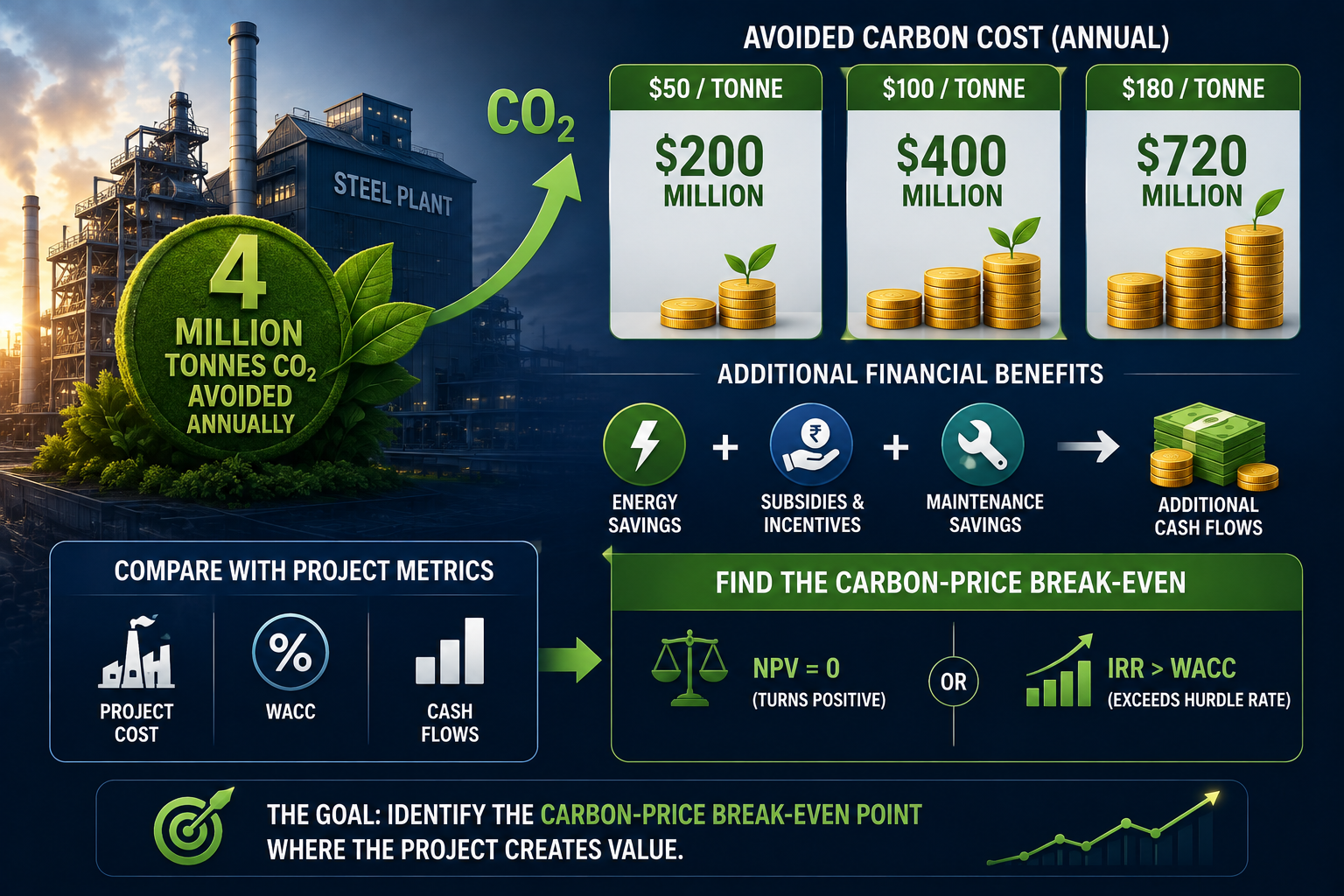
The objective is to identify the carbon-price break-even: the point at which the project’s NPV turns positive or its IRR exceeds the hurdle rate.
Then comes the more important question: what happens to the company’s existing assets? If a transition project protects a blast furnace, refinery or power plant from becoming uneconomic before the end of its useful life, it may have significant terminal-value protection that a simple project IRR misses.
That gives investors three numbers worth tracking: project return, carbon-price break-even and terminal-value preserved.
The First Mover Penalty Nobody Talks About
The usual ESG narrative assumes that companies moving first will gain an advantage. Sometimes they will. But early adoption can also become a first-mover penalty when technology is immature.
First movers often pay the highest equipment costs, absorb technology risk and build supply chains before economies of scale emerge. Second movers can wait for technology costs to fall and infrastructure to mature before committing significant capital. For investors, this creates a crucial question: Is management moving early because the economics are attractive, or simply because the sustainability narrative rewards being first?
This does not mean companies should delay decarbonisation indefinitely. It means transition strategies should be judged on timing as well as ambition. A company could create more shareholder value by piloting a technology today, preserving capital flexibility and scaling only after its cost curve becomes clearer.
The best transition strategy, therefore, may not belong to the company that moves first. It could belong to the company that knows when the economics have crossed the point where moving becomes rational.
A Real-World Test: Can Green Steel Earn Its Cost of Capital?
SSAB’s transformation in Sweden provides a useful test of whether decarbonisation can become an economic advantage rather than simply an ESG expense. Through HYBRIT, SSAB, LKAB and Vattenfall developed a process using hydrogen and fossil-free electricity instead of coal in primary steelmaking.
SSAB is now investing €4.5 billion in a new electrified steel mill in Luleå, designed to replace its existing blast-furnace production and cut emissions from the site by around 90%. The company says the new setup should also lower costs and improve production flexibility.
The ultimate test for SSAB’s investment is whether its t-ROIC clears its cost of capital once the blast furnace is decommissioned in 2029.
For investors, however, the emissions reduction is only the starting point. The real question is whether the new plant can generate returns above SSAB’s cost of capital after accounting for electricity prices, hydrogen economics, steel prices and the value of avoided carbon costs. The project becomes more attractive if European carbon prices rise or customers pay a premium for near-zero steel; it becomes less compelling if clean electricity remains expensive or conventional steel prices stay weak.
That makes SSAB a useful ESG 2.0 case study: the transition should be judged not only by tonnes of CO₂ avoided, but by whether the new asset can outperform the economics of the old one.
The Global Transition Will Create Uneven Winners
The transition is not happening at the same pace across economies, and that divergence matters for global investors. Europe has generally moved faster on climate regulation and disclosure, the US has seen a more fragmented policy environment, while emerging markets face the dual challenge of decarbonisation and rapidly rising energy demand.
That creates very different economics for companies operating in different regions. A European manufacturer investing early in energy efficiency may benefit from lower energy consumption and regulatory preparedness. Meanwhile, an industrial company in a fast-growing emerging market may have greater scope to improve emissions intensity as it expands its production base.
This means ESG analysis cannot simply compare companies using one global score. Investors increasingly need to consider regulation, energy prices, technology adoption, transition costs and competitive positioning alongside emissions.
The divergence itself can create opportunities. Companies operating under tougher transition requirements may face higher near-term costs but develop technologies and capabilities that become valuable globally. Others may initially benefit from weaker regulation but eventually face expensive catch-up investment.
For global investors, the question is increasingly where transition pressure becomes competitive advantage.
Transition Finance Could Be Bigger Than Green Finance
One of the most important changes in sustainable finance may be the shift from financing businesses that are already green to financing businesses that are trying to become greener.
The distinction matters. Funding a solar farm is relatively straightforward: the asset already fits a sustainable investment framework. The harder problem is financing a steelmaker, airline, shipping company or cement producer that needs to dramatically reduce emissions while continuing to operate.
This is where transition finance becomes important. The International Energy Agency estimates that heavy industry and transport account for a significant share of global emissions, meaning the climate challenge cannot be solved by financing renewable energy alone.
For investors, transition assets can also create a more interesting opportunity. Companies in difficult-to-abate sectors may have substantial room to improve efficiency, adopt new technologies and reduce emissions. If they can execute without destroying returns, the financial upside could be significant.
In my view, the biggest ESG winners may come from industries that are difficult to decarbonise, not industries that were already green.
The Transition Capex Trap
There is an uncomfortable risk hiding inside the transition story: green capex can itself become stranded.
Investors typically assume that spending early reduces transition risk. But technology can evolve faster than the asset’s payback period. A company could commit billions to an intermediate solution only to discover that direct electrification, cheaper storage or another technology becomes commercially superior before the original investment has recovered its capital.
This creates what I would call the Transition Capex Trap. Investors should compare three timelines: the asset’s payback period, its useful life and the expected pace of technological disruption. If a project takes 15 years to repay but the underlying technology could become uncompetitive within seven, the transition investment may simply be replacing one stranded-asset risk with another.
This is why “green” should never be treated as synonymous with “value creating.” The right question is not whether an investment reduces emissions today, but whether it can earn its cost of capital before the technology becomes obsolete.
The Cost Of Capital Could Be The Real ESG Signal
The impact of ESG may eventually be felt most clearly through a company’s cost of capital. Banks, insurers and institutional investors are becoming more sophisticated at assessing transition risks, which could influence how they price credit and equity risk.
A company with credible targets, reliable data and evidence of progress may be viewed as better prepared for a changing regulatory and economic environment. A business with carbon-intensive assets, weak disclosure and no credible transition strategy could face a higher risk premium as investors reassess the probability of future costs.
This creates an interesting feedback loop. Better transition execution could potentially improve investor confidence and financing access, giving a company more capacity to invest. Successful investment can then reduce operating or regulatory risk further.
The reverse can also happen. Companies that repeatedly miss targets may find that the market begins pricing transition risk into their valuation.
This is where ESG stops being a reputational consideration and becomes a valuation variable. Investors do not necessarily need to believe that sustainable companies deserve higher multiples. They need to understand whether transition preparedness changes the risk and return profile of the business.
Greenwashing Is Becoming An Investment Risk
As ESG becomes more financially material, greenwashing is no longer simply a reputational problem. It can become a direct investment risk. A company that exaggerates its transition progress may attract capital in the short term, but weak disclosures or missed targets can eventually expose investors to regulatory costs, stranded assets and a reassessment of future earnings.
This makes the quality of evidence increasingly important. Investors should compare sustainability targets with actual capex, emissions data, operating performance and management incentives. If a company promises a major emissions reduction but its capital allocation does not reflect that ambition, the gap itself becomes useful information.
The same applies to improvements achieved primarily through offsets or changes in reporting boundaries rather than meaningful operational change. Better disclosure standards should make these differences easier to identify, but investors will still need to scrutinise the underlying numbers.
I think this will make ESG analysis more sceptical and that is a good thing. The strongest companies will not necessarily have the most ambitious targets. They will be the ones that can demonstrate a clear chain from capital invested to operational change, emissions reduction and financial outcome.
From ESG Scores To Transition Alpha
The most interesting opportunity could be transition alpha: companies where the market has mispriced the financial consequences of decarbonisation.
That mispricing can work in either direction. Investors may underestimate a company whose transition spending creates a lower cost base, protects terminal value or opens a new market. But they may also overvalue a company because its sustainability narrative hides weak project economics, excessive capital intensity or technology risk.
This creates a practical framework for fundamental analysts. Calculate t-ROIC and compare it with WACC. Identify the carbon price at which project NPV turns positive. Stress-test technology payback periods. Then quantify the potential value of assets that could become stranded if the company does nothing.
The final step is simple: compare that transition-adjusted valuation with the market price.
If the market is pricing in successful decarbonisation but the projects cannot clear their cost of capital, the ESG premium may be unjustified. If the market is ignoring profitable transition opportunities, the upside could be substantial.
That is where ESG stops being a screening tool and becomes a source of investment alpha.
Conclusion
ESG is moving into a phase where good intentions will matter less than measurable outcomes. Institutional investors are increasingly looking beyond sustainability scores and asking how companies will finance their transition, what returns that capital can generate and whether management can turn environmental pressure into a competitive advantage.
That makes ESG 2.0 far more interesting than the compliance-driven model it replaces. The opportunity is no longer simply to find companies that look sustainable. It is to identify businesses where decarbonisation can improve efficiency, protect margins, lower risk or create entirely new growth opportunities.
The biggest winners may therefore not be the companies that are already green, but the ones capable of making the transition economically attractive. In the end, the most powerful ESG signal may not be a company’s emissions target at all. It may be what happens to its returns after the company starts spending money to achieve it.