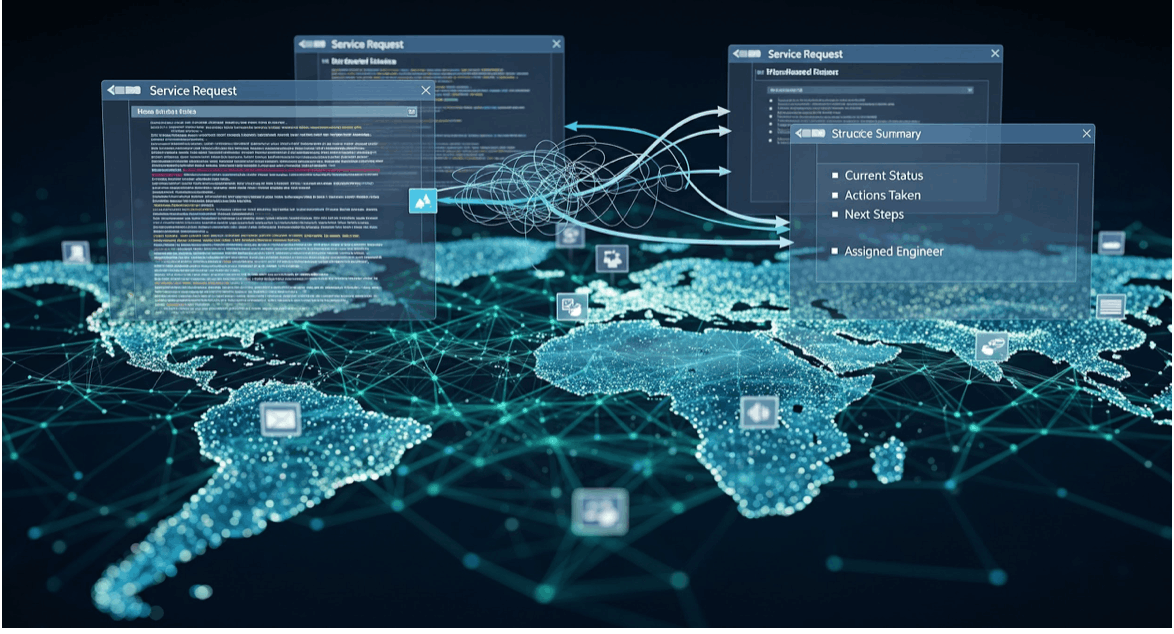
Modern digital infrastructure rarely fails in simple ways. When enterprise networks slow, or cloud platforms behave unpredictably, the explanation is often buried within layers of interconnected systems. Engineers across continents and time zones must work together to diagnose the problem.
However, for many global technology companies, the difficulty is not only technical. It is organizational.
Large support organizations handle thousands of service requests at any time, many of which pass through several engineers before resolution. Each engineer adds notes about tests, observations, or possible causes, and the documentation can quickly grow into long threads of updates.
A survey published in the International Journal of Research Publication and Reviews found that unclear or inconsistent status updates affect approximately 19.3% of respondents. This indicates persistent structural communication issues in service and support environments. In technical support environments, this often means reviewing case notes, interpreting earlier troubleshooting steps, and determining what tests have already been performed.
The issue becomes more pronounced as companies expand globally. Technical cases often move between regions as shifts change or when problems require specialized expertise. Each transition introduces the possibility that information will be misinterpreted, overlooked, or repeated.
For customers operating mission‑critical systems, financial networks, telecommunications infrastructure, and large cloud environments, these delays are not trivial. Even small inefficiencies in the way support teams communicate can prolong the time it takes to identify and resolve an issue.
Against this backdrop of growing operational complexity, Atul Khanna began looking more closely at service request communication. He focused on how it actually functioned inside large support environments. From 2019 to 2021, he worked as Manager of Data Center Technical Services at Cisco, overseeing teams responsible for supporting widely distributed infrastructure used by organizations around the world.
Over time, he noticed a recurring pattern. Engineers were skilled at diagnosing highly technical problems, yet the documentation surrounding those investigations often lacked a consistent structure. Each engineer recorded information in their own way. Some wrote detailed narratives. Others left short technical notes. While the documentation preserved valuable detail, it did not always provide a quick way to understand the current state of a case.
For long‑running issues, this could slow progress, as engineers joining a case often needed to review extensive notes to understand what had already been attempted.
Mr. Khanna began to consider whether the problem was not simply one of documentation discipline but of system design. If support organizations relied on structured processes for nearly every technical workflow, why was the communication layer around service requests so informal?
That question eventually led to what became known internally as the Support case updates consistency initiative, an operational effort aimed at improving how service request status information was recorded and shared across teams.
The initiative focused on a relatively simple idea: every service request should contain a clear and standardized summary describing its current state.
Rather than relying solely on a long sequence of chronological notes, engineers would maintain a concise “current status” update that distilled the most important information about the case. The summary identified the core issue being investigated, the diagnostic steps already taken, the next planned action, and the engineer responsible for continuing the work.
In effect, the update functioned as a single reference point inside each case. Anyone opening the service request could quickly understand where the investigation stood without first reading the entire history.
Mr. Khanna and his colleagues worked to encourage adoption of the approach across support teams, along with more consistent communication practices around case updates. Over time, the structured summary became a practical tool for engineers who were taking over cases that had already passed through multiple hands.
The approach proved particularly useful for complex cases that required collaboration among several specialists. In those situations, the standardized update acted as a shared checkpoint, an agreed description of what had been learned so far and what should happen next.
Internal operational reviews suggested that the change produced measurable improvements in efficiency. Teams reported that engineers joining ongoing investigations were able to understand the context of a case much faster than before. Estimates from internal assessments indicated that ramp‑up time for complex cases fell by roughly 40 to 50 percent.
Another improvement involved the repetition of diagnostic work. Without a clear summary, engineers sometimes repeated troubleshooting steps simply because earlier results were difficult to locate within lengthy documentation. The structured update made those steps easier to identify, reducing duplicate efforts and certain types of handoff errors by an estimated 30 to 35 percent.
Mr. Khanna has described the initiative in practical terms rather than technological ones. “In large support environments, cases move across engineers and regions all the time,” he said in discussing the effort. “If there isn’t a consistent way to summarize where the investigation stands, the next engineer has to rebuild that understanding from scratch. A clear, shared update helps everyone start from the same place.”
The project illustrates a quieter form of innovation, one focused less on building new technologies and more on improving how technical teams work together. In many technology organizations, attention naturally gravitates toward new products, new architectures, or advances in fields such as artificial intelligence and cloud computing.
Yet the systems that support those technologies also depend on human coordination. Engineers must exchange information accurately, often under time pressure and across organizational boundaries. When that communication becomes inefficient, even the most advanced infrastructure can be slowed by operational friction.
The Support case updates consistency initiative addressed that friction in a modest but consequential way. Reorganizing how information was summarized inside service requests, it made the work of understanding a problem faster and more predictable.
Such improvements rarely attract the attention given to new hardware or software breakthroughs. In large technical organizations, small gains in clarity can compound quickly.
As digital infrastructure continues to grow in scale and complexity, the challenge of maintaining operational coherence will likely become even more significant. The engineers responsible for keeping those systems running will still rely on documentation, communication, and shared understanding to coordinate their work.
Mr. Atul Khanna’s initiative suggests that even in highly technical environments, progress can begin with a simple question: how can engineers understand each other’s work more clearly? When that question is addressed thoughtfully, the effects can ripple quietly through the systems that keep modern digital infrastructure functioning.