For the last three years, the artificial intelligence industry has been obsessed with one question: which company has built the smartest model?
Every major launch was accompanied by benchmark scores, reasoning tests, coding challenges, and claims of superhuman performance. Bigger models demanded bigger GPU clusters, larger investments, and unprecedented amounts of computing power.
But something interesting happened at Snowflake Summit 2026.
The conversation quietly shifted away from intelligence and toward economics.
Enterprise customers are no longer asking whether one model is slightly smarter than another.
They are asking a much simpler question:
“Why should we pay ten times more for a model when a cheaper one gets the job done?”
That question may end up reshaping the entire AI industry.
The End of the “One Model does Everything” Era
When generative AI first entered the workplace, many companies adopted a simple strategy: connect the most capable model available to every use case.
Whether it was summarizing a meeting, sorting customer support tickets, extracting invoice details, or generating marketing copy, the same expensive AI engine often sat behind every request.
It worked, but it wasn’t efficient.
As organizations scaled from thousands to millions of AI interactions every month, executives discovered that the real challenge wasn’t building AI. It was paying for it.
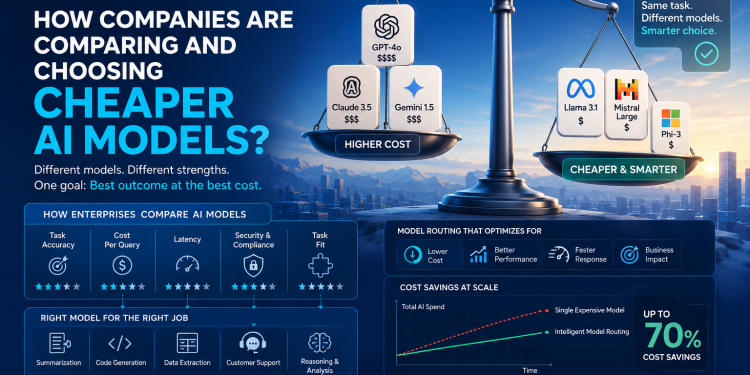
Snowflake’s latest enterprise AI capabilities reflect this changing mindset. Instead of forcing businesses to commit to a single foundation model, enterprises can evaluate multiple models for the same task and choose the one that delivers the best balance between quality, speed, and cost.
In other words, AI is becoming less of a technology decision and more of a financial one.
So companies started asking a different question:
Not “which model is best?” but “which model is good enough for this specific task?”
How Companies are Actually Comparing AI Models?
The decision-making process inside enterprises is becoming surprisingly structured. Instead of relying on brand names like GPT, Claude, Gemini, or open-source alternatives, companies are increasingly running side-by-side model evaluations.
They compare model across five core dimensions:
| Evaluation Factor | What Companies Are Measuring |
| Task Accuracy | Does the model produce correct and reliable outputs for a specific use case? |
| Cost per Query | How much does each response cost at scale (per 1M tokens or per workflow)? |
| Latency | How fast is the response time under real enterprise load? |
| Security & Compliance | Can sensitive enterprise data be safely processed without risk? |
| Task Fit | Is the model better suited for coding, summarization, extraction, or reasoning? |
This is where the real transformation is happening.
Instead of treating AI as a single system, companies are breaking it into task-level economics.
A model is no longer evaluated in isolation. It is evaluated against alternatives for the same job.
Why is This More Than Just ‘Cheaper AI’?
It is tempting to interpret this trend as companies are simply trying to cut costs.
That is only part of the story.
The deeper shift is structural: AI is becoming modular and replaceable at the task level.
A modern enterprise AI stack increasingly looks like this:
- A high-end reasoning model for legal, financial, or strategic analysis
- A mid-tier model for marketing, documentation, and internal knowledge assistants
- A lightweight open-source model for classification, tagging, and extraction tasks
The key insight is not that cheaper models are replacing expensive ones.
It is that different levels of intelligence now have different economic roles inside the same company.
Intelligence is Becoming a Commodity
The first phase of the AI race rewarded companies that could build larger and more sophisticated models.
The second phase may reward companies that can intelligently distribute work across many models.
Think of it like electricity.
Most homes don’t need maximum power flowing through every appliance all the time. The grid allocates energy where it is needed.
Enterprise AI is evolving in much the same way.
A company may use a high-end model for complex strategic analysis, a mid-tier model for internal assistants, and a lightweight open-source model for routine data processing.
The smartest AI system, ironically, may not be the one with the smartest model.
It may be the one that knows when intelligence is unnecessary.
The Hidden Economics of AI Scaling
At small scale, model choice feels like a technical decision.
At large scale, it becomes a CFO-level decision.
When millions of AI queries are processed every day, even a fraction-of-a-cent difference in the cost of each response becomes material. That forces companies to optimize AI the same way they optimize cloud infrastructure or supply chains – not for maximum performance, but for the best cost-to-output ratio.
This is also why chief financial officers are becoming active participants in AI strategy. As inference costs scale directly with usage, reducing the cost of each AI interaction by even a few cents can translate into millions of dollars in annual savings.
Snowflake’s emphasis on helping enterprises compare and route workloads across different models is significant because it enables companies to optimize not just AI performance, but AI spending. The platform isn’t merely helping businesses find better AI, it is helping them build more economical AI.
The Shift Nobody is Talking About
Public attention remains focused on the battle between companies building the next frontier model.
But enterprises appear to be moving in another direction altogether.
They are treating AI models less like luxury products and more like interchangeable infrastructure.
In the cloud era, businesses stopped caring which physical server processed their application.
They cared about uptime, performance, and cost.
AI may be entering that same stage of maturity.
If that happens, the biggest winners may not necessarily be the companies building the smartest models. They could be the platforms that help businesses decide which model should handle which task.
The competitive advantage shifts from creating intelligence to managing it efficiently.
Conclusion
The biggest lesson from this year’s summit isn’t that cheaper AI models are replacing smarter ones.
It’s that businesses are finally learning to measure artificial intelligence the same way they measure every other investment: by return on capital.
Technology history is filled with examples where efficiency ultimately mattered more than raw capability.
Cars became mainstream not because they were the fastest machines ever built, but because they became affordable.
Cloud computing transformed business not because servers became more powerful, but because companies could access computing more efficiently.
Artificial intelligence may be approaching the same moment.
The future AI leaders may not be those that build the world’s smartest models.
They may be the ones that answer a far more practical question better than anyone else:
How much intelligence is actually worth paying for?