Not long ago, using artificial intelligence meant opening one website.
Whether it was writing an email, debugging code, summarizing a report, or planning a vacation, the answer was almost always the same: “Ask ChatGPT.”
That dominance made many people believe the AI industry would follow a familiar pattern where one company builds the best product and everyone else struggles to catch up.
But something unexpected is happening.
ChatGPT may still be the biggest name in AI, yet millions of users are quietly changing their habits. Instead of relying on one assistant, they are switching between multiple models depending on what they want to accomplish.
The latest user data suggests something interesting that is happening beneath the surface.
Let’s find out.
The Number Behind the Shift
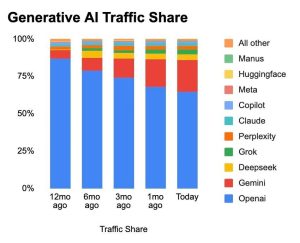
The latest Global AI Tracker of 2026 suggests that the AI market is becoming increasingly competitive. While ChatGPT remains the dominant platform, its share of global generative AI traffic has declined significantly over the past year as newer players gain traction.
| Platform | 12 Months Ago | Today | Change |
| ChatGPT | 86.7% | 64.5% | -22.2 percentage points |
| Gemini | 5.7% | 21.5% | +15.8 percentage points |
| Claude | 1.5% | 2.0% | Small but stable |
| Grok | ~0% | 3.4% | Rapid emergence |
| DeepSeek | ~0% | 3.7% | Rapid emergence |
The numbers tell an interesting story. ChatGPT has not lost its leadership position, but it has lost more than 22 percentage points of traffic share in just one year. Meanwhile, Gemini has nearly quadrupled its share, while niche players like Claude, Grok, and DeepSeek continue to build dedicated user bases.
The End of the Default AI
The first phase of the AI revolution was driven by discovery.
People wanted to know what these new systems could do, and ChatGPT happened to be the product that introduced millions of users to the technology. Being the first widely adopted generative AI platform gave OpenAI an enormous advantage.
But technology markets rarely stay that simple.
Nobody expects one piece of software to handle every digital task. We use different apps for meetings, messaging, spreadsheets, navigation, and design because specialization usually produces better results.
Artificial intelligence appears to be following the same path.
Instead of asking, “Which AI is the smartest?” users are increasingly asking, “Which AI is best for what I’m trying to do right now?”
That subtle shift may explain why ChatGPT’s market share is slipping even while the overall AI market continues to grow.
How Users are Actually Choosing AI Models?
Rather than searching for one perfect AI assistant, users are increasingly selecting models based on the specific task they need to accomplish.
Coding & Software Development → Claude
- Leads on real-world coding benchmarks like SWE-bench Verified.
- Preferred by many developers for debugging, code reviews, and handling large codebases.
- Claude Code integration has strengthened its position in professional development workflows.
Research & Current Information → Gemini
- Native integration with Google Search provides access to live information.
- Particularly useful for news, market updates, policy changes, and fast-moving topics.
- Reduces the need to verify whether information is outdated.
Large Documents & Context-Heavy Work → Gemini and Claude
- Gemini’s massive context window allows it to process extremely large datasets and document collections.
- Claude is widely regarded for maintaining coherence and effectively using long-context information.
Accuracy & High-Stakes Professional Work → Claude
- Often preferred for legal, financial, academic, and enterprise tasks where factual reliability is critical.
- More likely to acknowledge uncertainty instead of generating a confident but incorrect answer.
Everyday Productivity & Feature-Rich Experience → ChatGPT
- Combines writing assistance, image generation, voice mode, file analysis, web browsing, and a broad ecosystem of custom GPTs.
- Remains one of the most versatile all-purpose AI assistants available.
Value for Money → Depends on the User
- Developers may find Claude offers the strongest productivity gains.
- Google ecosystem users often benefit most from Gemini.
- Users seeking an all-in-one AI experience may still prefer ChatGPT.
Why is ChatGPT Losing Ground?
Ironically, ChatGPT’s biggest challenge is not that it has become a weaker product.
It is that everyone else has become better at something specific.
Gemini benefits from one of the world’s largest digital ecosystems. Millions of users already rely on Google Search, Gmail, Drive, Docs, and Android. Adding AI to products people already use every day lowers the barrier to adoption.
Claude has taken a different approach. Rather than chasing the broad consumer market, it has built a strong reputation among developers, researchers, and enterprise users who value long-context reasoning and high-quality technical output.
ChatGPT remains one of the most versatile AI products available. It offers voice interaction, image generation, web browsing, file analysis, and one of the broadest feature sets in the market.
But versatility is not always enough.
Technology history shows that specialists often outperform generalists once industries mature.
The Rise of Multi-AI User
The most important trend in artificial intelligence may not be model performance.
It may be user behaviour.
A growing number of people no longer rely on one assistant. They use Gemini to gather current information, Claude to review code or long documents, and ChatGPT to brainstorm ideas or handle general-purpose tasks.
In effect, users are building personal AI portfolios.
That is a profound shift because it breaks the habit that helped ChatGPT dominate in the first place.
The battle is no longer about convincing someone to use AI.
It is about convincing them to use your AI first.
The Hidden Challenge For OpenAI
Most discussions frame the AI race as OpenAI versus Google versus Anthropic.
The real competition may be much simpler.
AI assistants have almost no switching costs.
Trying a different search engine requires changing habits. Switching smartphones requires buying new hardware. Changing enterprise software can take months.
Opening another AI model takes a few seconds.
Once users become comfortable moving between multiple assistants, loyalty naturally weakens. Every task that migrates elsewhere becomes one less reason to return to the default platform.
This may explain why ChatGPT can remain one of the largest AI products in the world while simultaneously losing traffic share.
The market itself is expanding, but users are spreading their attention across a growing number of specialized tools.
Conclusion
So, is ChatGPT really losing badly to Gemini and Claude?
Not in overall scale. It remains the world’s largest AI platform. But it is steadily losing its position as the default choice for every task.
Gemini is winning users who need real-time information and Google’s ecosystem, while Claude has become a preferred tool for many developers and professionals. Instead of one AI dominating everything, users are choosing different models for different jobs.
In that sense, ChatGPT’s biggest challenge is not that it has become weaker – it’s that the AI market has become far more specialized.