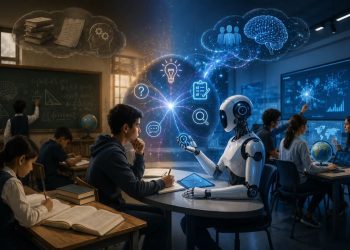
[Image Shows Attendees and speakers at the Toastmasters Roundtable on AI and the Future of Work at Purdue University. ]
AI has redefined how various industries operate, including the education, finance, and telecommunications industries, and how professionals innovate, collaborate, and make decisions within them. The said theme formed the basis for the most recent Toastmasters Roundtable at Purdue University, where eight distinguished speakers converged to address the impact of AI on the workplace and education systems. Ascend HSI Advisory Partners co-organized this event with Purdue University’s Roger C. Stewart Leadership and Professional Development Department and Toastmasters at Purdue, where industry leaders and students sought AI adoption as a tool for responsible AI use to enhance efficiency and stir creativity within the folds of professional development.
AI is no longer the vision of the future, as its adoption becomes an operational reality. Organizations use automation and machine learning to enhance productivity, streamline processes, and uncover new value. Maintaining the equilibrium of human oversight and innovation has proven a challenge, as highlighted in most comments from Urvish Pandya, Technical Program Manager at Google. He has spent over 16 years at Amazon, State Farm, Kraft Heinz, and other global leaders as a major technology initiative guide. He argues that the true value of AI advancement is way less about technology and more about the improvement of decision-making and coordination among complex and interdependent teams.
“AI helps us move from reactive management to predictive insight,” shared Pandya during the discussion. “When you’re driving multi-phase technology programs, it’s not just about automation; it’s about recognizing patterns that inform smarter execution.”
In industries as diverse as technology, insurance, telecommunications, and consumer packaged goods, program managers are using AI-driven analytics to improve the accuracy of project risk forecasting, identify interdependencies, and optimize resources. At Google, Pandya demonstrated how AI-powered tools can enhance cross-functional alignment and improve delivery timelines. His background in both computer science and business administration, along with his PMP and PMI-ACP certifications, represents the combination of technical and strategic leadership talent that characterizes AI-driven management today.
While Pandya’s insights reflected how AI supports organizational innovation, Senthil Nathan, Senior Technologist at J.P. Morgan, broadened the discussion to AI’s evolving role in workforce transformation. Having over 25 years of experience in delivering payment technology solutions across diverse international markets, Nathan currently leads teams that are working on real-time payment platforms and digital infrastructure. His experience in product strategy and technology transformation places him at the forefront of how financial institutions embrace AI to modernize legacy systems while maintaining both ethical and operational integrity.
“AI is not replacing people; it’s amplifying potential,” Nathan said. “The future belongs to the ones who can guide these systems ethically and make them align with human goals.”
Drawing from his experience mentoring students and early-career professionals, Nathan also spoke about the importance of literacy in AI across disciplines. He explained that as automation increases, professionals in all fields-from engineering to education-need to know not only how to use AI tools but also how to evaluate their outputs critically. His message aligned with the roundtable’s broader mission: to help students and emerging leaders use AI safely, effectively, and with a mindset rooted in continuous learning.
Nathan’s example represents a wider landscape in which large enterprises such as J.P. Morgan leverage AI in a bid to further improve transaction efficiency, fraud detection, compliance monitoring, and improve customer experience. But more importantly, beyond these technical achievements, was his staunch advocacy for education. He urged AI literacy among students as a way to equip the next generation for a future where technology and ethics are fully intertwined aspects of leadership.
Central to the success of the event was the participation of Ascend HSI Advisory Partners, a Chicago-based organization focusing on immigration law and professional development. Its founder and CEO, Vasanthan Ramakrishnan, emphasized in his opening remarks that participation by Ascend HSI in the roundtable was a function of a shared belief in empowering professionals to use AI correctly. Co-hosting with Purdue Toastmasters, Ascend HSI tried to bridge the gap between academic exploration and real-world application essential link as students transition into AI-driven workplaces.
The commitment of Purdue University to ensure communication, leadership, and technological literacy also played a very important role. According to the president of Toastmasters at Purdue, the roundtable represented one of the most high-profile events of the club, offering students a very unique opportunity to engage directly with professionals shaping up the future of AI. Collaboration with Ascend HSI and Purdue’s Leadership, Stewardship, and Professional Development department (LEAD) reflected the integrated effort of infusing AI discussions into larger leadership education and perfectly matched the culture at Purdue for practical learning and ethical innovation.
The roundtable showed that AI is not a remote abstract notion but a collaborative agent for transformation, one that redefines how teams work, programs are managed, and individuals strive for excellence in the professional sphere. From Pandya’s presentation on Intelligent Program Management to Nathan’s presentation on Responsible AI Adoption, the discussion showed that there was a general optimism among them: the application of AI in schools and workplaces was not about replacement but an enhancement in efficiency, creativity, and human potential.
As organizations continue to evolve, discussions such as the Toastmasters Roundtable at Purdue are a reminder that technology and humanity do not work in opposition to each other but are interdependent in moving forward. By fostering informed discussion and ethical practice, institutions like Purdue and partners like Ascend HSI ensure that the impact AI has on the workforce remains innovative yet inclusive, preparing the next generation of leaders to navigate the age of intelligent systems with insight, responsibility, and confidence.