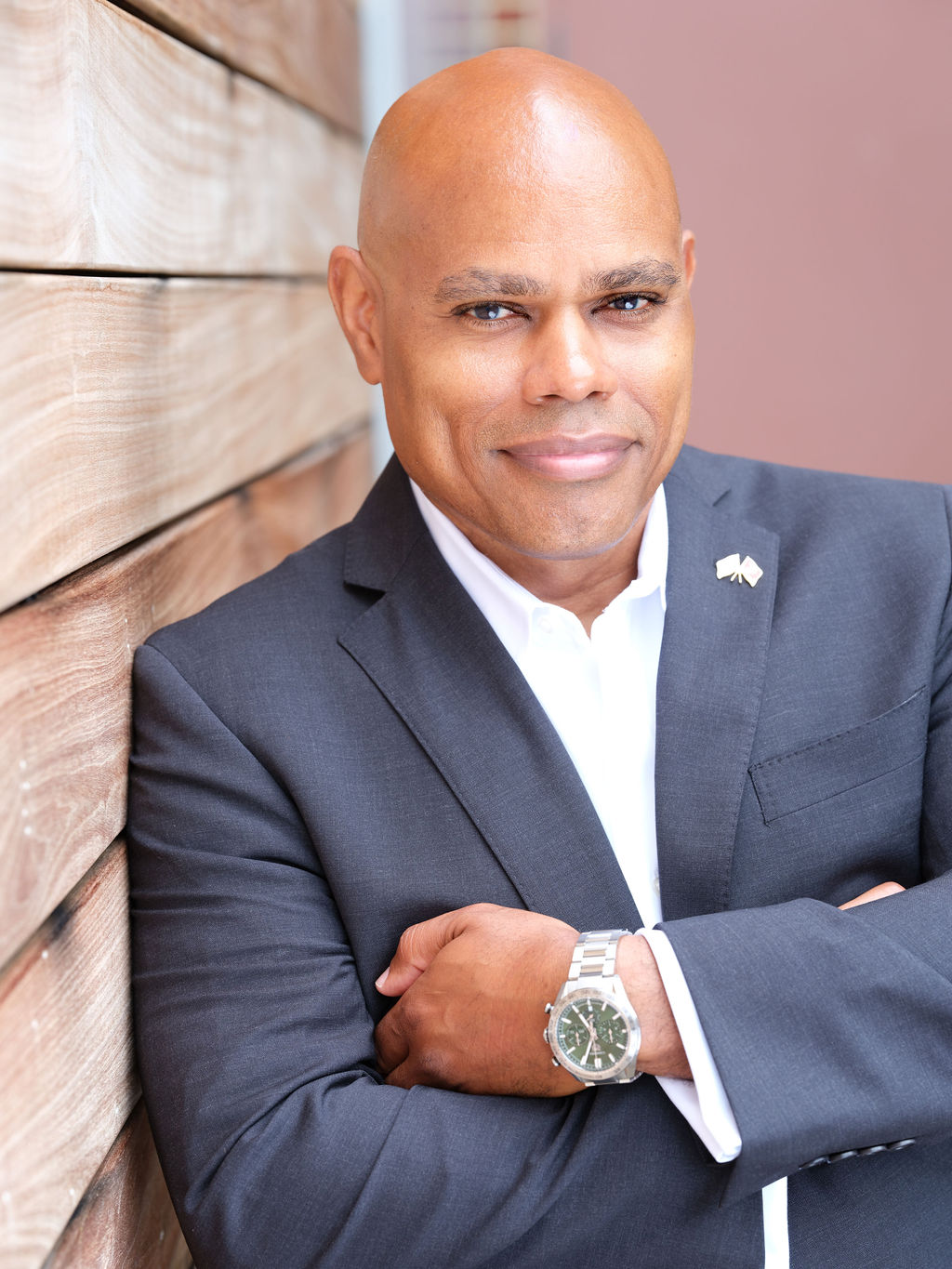
When he was in high school Douglas Lemott Jr.’s mother wanted to keep him focused and out of trouble, so she issued him a challenge that would shape his future as a cybersecurity expert. The deal: If he earned a 4.0 GPA in school, she would buy him a computer.
Lemott was up for the challenge – he achieved a 4.0 and got his computer. He went on to be accepted to the U.S. Naval Academy where he earned his Bachelor of Science degree in computer science and was commissioned into the U.S. Marine Corps. As a Marine Corps officer, he was assigned the Communications Office Military Occupational Specialty (MOS) and attended the Naval Postgraduate School in Monterey, CA, where he earned a Master of Science Degree in Computer Science.
A Distinguished Military Career
Throughout his military career, he was responsible for leading teams in installing, operating, and maintaining networks to support a commander’s ability to command and control their units. A desire to dive deeper into the security of those networks led him to take graduate-level coursework to support his operational requirements, leading him to be certified as a Chief Information Security Officer (CISO) through the National Defense University.
As a senior officer, Lemott led the Marine Corps Cyberspace Operations Group (MCCOG), where he was responsible for the security, operation, and defense of the Marine Corps Enterprise Network (MCEN), supporting over 300,000 users. Under his leadership, MCCOG operated both the Network Operations Center and Security Operations Center, executing defensive cyberspace operations to safeguard Marine Corps data from persistent adversarial threats.
In his final assignment, Lemott transitioned to Headquarters Marine Corps, where he led a branch overseeing the Chief Information Officer (CIO) and Chief Information Security Officer (CISO) portfolios. In this role, he provided strategic oversight and cybersecurity governance while directly supporting the Marine Corps Authorizing Official, ensuring compliance with critical security and risk management initiatives.
After his 27-year military career, Lemott knew he wanted to remain in the cybersecurity field as Chief Information Security Officer for an organization with an important mission. He found that opportunity at the Analysis and Resilience Center for Systemic Risk (ARC), where he now leads efforts to provide a secure and scalable infrastructure supporting financial services firms in mitigating systemic risk.
His transition to the private sector included key leadership roles at VMware and SAP NS2, where he leveraged his military-honed expertise to navigate complex security challenges. At VMware, he guided government and healthcare organizations through evolving cybersecurity landscapes, while at SAP NS2, he focused on cloud security, ensuring compliance with FedRAMP and DoD standards. Throughout his career, Lemott has combined technical expertise with a commitment to mentoring and team-building, ensuring that security measures are as strong as the teams implementing them.
Douglas Lemott Jr. is now the Chief Information Security Officer (CISO) for the Analysis and Resilience Center for Systemic Risk (ARC). He is responsible for developing and implementing secure and compliant technology solutions and infrastructure to support ARC member collaboration to address systemic risk to critical functions that support our economic and national security.
Leadership and Core Values Learned in the Marine Corps
Leadership is a very important component of Lemott’s personal character. During his military career, he lived the core values of the Marine Corps – honor, courage, and commitment. “They are ingrained in me and I still strive to abide by those values every day. Honor – treat others with dignity and respect. Courage – stand up to challenges and conquer them. Commitment – be devoted to professionalism and discipline,” Lemott explained.
Lemott noted that these values easily translate to the private sector. “I seek to be courteous and considerate of others regardless of seniority. I treat the service staff and senior leaders with the same due respect. I have the courage to seek out challenging assignments and step outside of my comfort zone. Performing well in challenging assignments is a great way to set yourself apart. I am committed to my profession and have a growth mindset,” he said. Lemott is always willing to explore and learn new things and considers himself a lifelong learner.
“As a leader, I strive to meet my team where they are and get them to achieve beyond their perceived limitations,” Lemott added.
He defines success, particularly as it relates to protecting sensitive information and empowering his teams to excel in cybersecurity by the performance of his team, especially in his absence. The questions he wants to answer about his team are: Are they well trained for the responsibilities he and the organization expect them to achieve? Are they a cohesive unit- drawing on each other’s strengths? Do they feel empowered to act boldly and decisively without constantly seeking permission or approval? Cybersecurity, said Lemott, is a team sport and if the team is performing well then there is a high probability that will translate to an enhanced cybersecurity posture. “There will always be security events that may lead to a security incident. “That is ‘game time’ and the response and the resultant outcome are most important,” he added.
Giving Back as a Mentor for Aspiring Cybersecurity Professionals
Lemott lends his vast expertise to his role as a coach and mentor, working one-on-one with those who want to enter the cybersecurity profession. He is often asked to speak to groups of aspiring cybersecurity professionals, and he is on the Leadership Board for the Northern Virginia Cybersecurity and Privacy Community. His local public school district established the Cyber 4+ program, a Dual Enrollment, Career, and Technical Education pathway allowing high school students to receive four Cyber Security certifications (CompTIA) and an Associate’s degree upon completion of their first year of college.
Giving back and being in service to others is important to Lemott. He said, “ Service comes in various forms, and serving in this field is my way of giving back and continuing to support our national security. As a Marine, service affiliation was obvious. As a private citizen, I still gravitate towards organizations that support our national security. Protecting those types of institutions gives me purpose and meaning.”
Douglas Lemott Jr. equates cybersecurity to a chess match. “You must have a good strategy to be successful and ultimately claim ‘checkmate.’ Being a good strategist requires one to think critically and act decisively. Cybersecurity brings all of those specialized skills into play and is a source of motivation for me.”