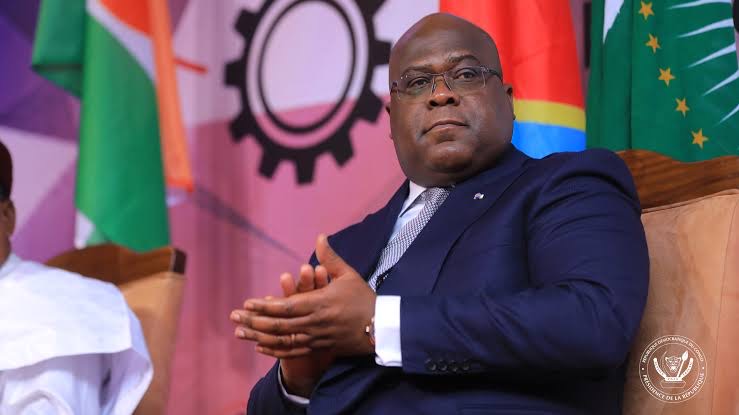
In recent years, the Democratic Republic of Congo has embarked on a process of diplomatic, political and economic rebirth. Like a phoenix rising from its ashes, it has broken the curse of natural resources, established by Joseph Kabila, plunging the country into a vicious circle. Having emerged from its autarky, this Central African state has managed to establish itself as a key regional and international player. This beautiful Congolese comeback is the fruit of a well-defined strategy, that of its president: Félix Antoine Tshisekedi.
Long identified as a state in crisis, under the era of President Joseph Kabila, the Democratic Republic of Congo has now shattered this neglected and pejorative image, to embrace change under the presidency of Felix Tshisekedi. Coming to power in January 2019, the new president has demonstrated clarity, and shared an honest and sincere vision of a Democratic Republic of Congo that is developed, connected to the world, and in tune with its people.
Aware of his country’s potential, and the challenges it faces, the head of state has turned these weaknesses into strength of character. Between socio-economic reforms, diplomatic activism, and political determination, and guided by developmentalist thinking, Tshisekedi has not only marked a break with his predecessor, but above all has shown that there is another path for the DRC and the Congolese.
The pragmatism shown by the president, despite all the good will behind it, is still to be qualified. It is obvious that the country has changed enormously since the departure of Joseph Kabila. The recent evolution has not erased unemployment, poverty or the socio-economic ills of the population. It has revealed them, in order to better eradicate them. So yes, the DRC is following the path of development, but it has not yet reached a sufficient threshold for the development of the Congolese people.
A new national dynamic
The arrival of Felix Tshisekedi has shaken up the power dynamics and reshuffled the deck. The formation of the Sacred Union has brought about a renewal of the Congolese political offer. The Congolese people, until then weary or even desperate because of unfulfilled promises by successive politicians, can once again dream of a better future for their country. Indeed, with his government, the president has drawn up an ambitious framework for development, which includes the modernization of hospitals, the installation of new infrastructure, universal access to water and electricity, etc.
In a speech, he said, “Congo must spend $6 billion annually over ten years on infrastructure, including $1 billion for maintenance alone. By achieving this goal, the government will consolidate our economic growth. These infrastructures, the basis of our development, are necessary to guarantee the reconquest of our economy, particularly road infrastructures, ports, airports, access to water and electricity, and new technologies in all their forms”.
The DRC is truly reconnecting with its potential and correcting its vulnerabilities. The real revolution with Félix Tshisekedi is that behind every speech, concrete actions are carried out on the ground. The issue of peace, for example, has been studied for years by national and international actors. How can the cycles of violence in eastern Congolese territory be ended? Although Tshisekedi’s response is not perfect, he has established a state of emergency and deployed the army. As a result, episodes of violence have decreased, hundreds of members of armed groups have been arrested, and former combatants have been reintegrated into Congolese society.
With the socio-economic development of the territory as its mantra, and the improvement of the living conditions of Congolese men and women as its priority, the Executive has been able to win back new partners, and to display a better reputation on the international scene. But this ideal of development has not yet matured in the popular consciousness. For that, years are still necessary to persevere in these efforts, and to maintain the achievements of today. A difficult work that has not yet been done.
Regional and international repositioning
The president’s new momentum is being exported beyond the DRC’s borders. First, the country’s direct regional environment has improved markedly, with an intensification of bilateral relations, especially with the DRC’s neighbors. The DRC has forged new ties, consolidated existing ones and strengthened its regional presence.
The Congolese chairmanship of the African Union has played a significant role in this new beginning for the DRC in Africa. In fact, Félix Tshisekedi’s investment in African issues underscores this desire to move forward together with all African states. Efforts recognized and welcomed outside the continent, particularly in the United States. Uncle Sam’s country organized a Virtual Summit on Democracy from December 9 to 10, to which the DRC was invited. Joe Biden’s recognition of democratic achievements is a real panacea for the DRC, which has relaunched cooperation with this partner.
Félix Tshisekedi’s diplomatic offensive has brought about many changes, with real impacts. Investors and financial partners now have confidence in this state and are willing to collaborate. The DRC is showing unquestionable leadership and is a fair and reliable mediator. At COP 26, it shone through its tenacity and its willingness to shake up the codes. The image of a country engulfed by crisis, corruption and all the scourges that the Earth can harbor is outdated. On the contrary, the country is aware of the long but worthwhile road ahead.
As President Tshisekedi takes over the presidency of the Economic Community of Central African States (ECCAS), it is conceivable that he will extol the virtues of the DRC at the regional level. Far from it, he drew up a realistic and even alarming assessment of the socio-economic situation of this space. “While Central Africa has been recording commendable growth for three decades, welfare remains significantly lower than in all other regions. Overall poverty rates remain at about 43%, or nearly half of our population. By some estimates, more than half of our region’s youth are either looking for work, underemployed or simply not working,” he said.
Challenges… but not only
It is true that the presidency of Felix Tshisekedi has brought about a renewal of the Democratic Republic of Congo. Enormous strides have been made to restore the country’s credibility and get it back on track. Despite these enormous efforts, there are still many challenges ahead. Whether it is human rights, good governance, natural resource management, or corruption and chronic instability, the DRC has always advocated this imperfection. In fact, President Tshisekedi has always said that much remains to be done. Rome was not built in a day.
With the help of various partners, the DRC is redoubling its efforts to achieve the Sustainable Development Goals and strengthen the socio-political balance on which it is based today. Expectations are legitimate given the size of this territory. Although the picture seems to be half-tone, Felix Tshisekedi has succeeded where his predecessor failed, namely, to restore the confidence of the Congolese in public affairs.
With a good start to this marathon, which is the race for development, the DRC has shone during its entry. But will it be able to endure this long run? It is clear that yesterday’s advances must be transformed into tomorrow’s achievements and endure. Will it succeed in this challenge? More than two years after coming to power, Félix Tshisekedi has lifted the country, but will he really be able to keep it standing?