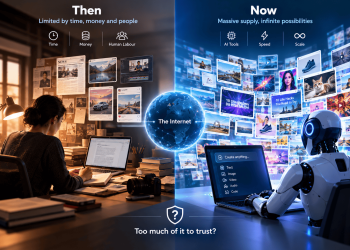
The next disruption from AI may not be about machines replacing workers. It may be about machines replacing the human in the buying decision.
For two years, the AI conversation has largely been about productivity: software that writes code, summarizes documents, answers customer queries and automates repetitive work. But a more consequential shift is now emerging in commerce.
AI systems are beginning to search, compare, select and eventually purchase products and services on behalf of people.
That changes the role of AI from employee to customer.
The distinction matters. An employee works inside a company’s existing processes. A customer determines where money flows. If an AI agent starts making purchasing decisions, the companies that control those agents could influence which retailer gets the order, which hotel gets the booking, which software provider gets the contract and which product disappears from consideration.
The first signs are already visible.
Amazon says its AI shopping assistant Rufus was used by more than 300 million customers in 2025 and helped generate nearly $12 billion in incremental annualized sales. OpenAI launched Instant Checkout in September 2025, initially connecting ChatGPT users with Etsy sellers and saying more than 700 million people were using ChatGPT weekly at the time. Shopify says AI-driven traffic to its stores grew eightfold year over year in Q1 2026, while orders originating from AI-powered searches increased nearly 13 times.
This is no longer simply an AI productivity story.
It is becoming a distribution story.
The Customer Is Moving From The Browser To The Agent
Traditional online commerce was built around a human-controlled journey:
Search → browse → compare → click → checkout → pay.
Google helped people find websites. Amazon helped them compare products. Marketplaces aggregated sellers. Payment companies processed the transaction.
AI agents threaten to compress that entire journey into a conversation.
A consumer may eventually say:
“Find me a laptop under $1,000 with 16GB RAM, good battery life and delivery by Friday.”
The agent does the searching, evaluates specifications, checks prices, considers reviews and potentially completes the transaction.
The consumer does not necessarily visit Google, Amazon or ten individual retailer websites.
That distinction is economically significant because the interface through which demand enters the market is changing.
OpenAI’s shopping infrastructure already illustrates this direction. Its Agentic Commerce Protocol is designed to allow AI agents, consumers and businesses to communicate around a transaction, while merchants retain control over fulfillment, returns and customer support. OpenAI initially enabled Instant Checkout for Etsy sellers and said more than one million Shopify merchants were expected to become eligible.
The implication for businesses is straightforward: having a good website may no longer be enough.
Products must also be understandable to machines.
Amazon Shows What Happens When The Retailer Owns The Agent
Amazon is an unusually important case because it already controls both sides of the equation: the marketplace and the AI shopping assistant.
Amazon reported $716.9 billion of net sales in 2025, up 12% from $638.0 billion in 2024. AWS contributed $128.7 billion, while operating income reached $80.0 billion.
But the more interesting number for this story is not Amazon’s overall revenue.
It is the company’s claim that Rufus helped deliver nearly $12 billion in incremental annualized sales last year after being used by more than 300 million customers. Amazon says the system can research products, compare options and, through its agentic capabilities, purchase products from other online stores on customers’ behalf.
Amazon subsequently renamed Rufus Alexa for Shopping in May 2026, combining shopping capabilities with Alexa’s broader personalized context.
This reveals the strategic prize.
Amazon does not merely want AI to help people navigate Amazon. It wants the AI assistant to become the starting point for the purchasing decision.
That gives Amazon another layer of control over commerce: not simply inventory and fulfillment, but potentially the decision about what gets bought in the first place.
There is, however, a major contradiction emerging.
Amazon recently blocked Meta’s Muse AI shopping agent from accessing its platform, demonstrating that retailers may not willingly hand their customer relationships and transaction data to external AI agents.
The coming battle may therefore be less about whether AI agents shop and more about whose agent gets to shop.
Shopify Is Betting That AI Agents Become A New Distribution Channel
Amazon wants to own the customer interface.
Shopify has a different incentive: make millions of merchants available wherever customers choose to interact with AI.
Shopify reported 34% year-over-year revenue growth in Q2 2026, alongside an 18% free-cash-flow margin. The company has increasingly positioned its infrastructure as the plumbing behind AI-driven commerce.
In March 2026, Shopify said millions of merchants could sell through AI channels including ChatGPT, Microsoft Copilot, Google Search’s AI Mode and the Gemini app. It also introduced Agentic Storefronts and supported the development of the Universal Commerce Protocol with Google.
The traffic numbers suggest why Shopify is investing here.
According to Shopify’s Q1 2026 commerce data, AI-driven traffic to Shopify stores increased eightfold year over year, while orders from AI-powered searches increased nearly 13-fold. Shopify also reported that new buyers arriving through AI channels placed orders at nearly twice the rate of other channels.
Even more revealing, AI-referred visitors who landed directly on product pages converted at rates nearly 50% higher than organic-search visitors, while orders attributed to AI-powered search carried 14% higher average order values.
These are still early-stage numbers, and Shopify’s data describes traffic to its own merchant ecosystem rather than the entire global retail market.
But the direction is important.
If AI agents send fewer casual browsers and more highly qualified buyers, the economics of customer acquisition could change dramatically.
Advertising Has A Problem: AI Does Not Shop Like A Human
For decades, companies have spent enormous sums trying to influence human attention.
A consumer sees an advertisement, remembers a brand, searches for it, reads reviews and eventually buys.
AI agents could remove several of those steps.
An agent does not necessarily care that a product has a famous celebrity ambassador. It can compare specifications, price, delivery time, reviews, return policies and availability almost instantly.
That does not mean branding becomes worthless. Trust, reputation and product quality can still influence the information an agent uses.
But the mechanism of persuasion changes.
A company may increasingly need to make its product information machine-readable, accurate and continuously updated.
A retailer whose inventory says “in stock” when it is actually unavailable could be ranked below a competitor. A supplier with poor structured data may be invisible to an agent even if its physical product is excellent.
The new version of search-engine optimization may therefore become something closer to agent optimization.
The question will not simply be:
“How do we rank on Google?”
It may become:
“How does an AI agent decide that our product is the right answer?”
Payments Are Building The Infrastructure For Machine Buyers
A purchasing agent cannot become a real economic customer until it can actually transact.
That is why payment networks are moving early.
Visa has launched Visa Intelligent Commerce, designed to enable AI agents to conduct transactions using payment credentials, controls and authentication mechanisms.
Mastercard has taken a similar route.
In 2025, it launched Agent Pay, built around agentic tokens and controls designed to allow AI systems to make purchases while preserving authorization and security. In June 2026, Mastercard expanded the concept toward machine-to-machine payments, describing a future in which AI agents could transact with one another at high speed, including transactions worth fractions of a cent.
That is a much bigger idea than AI shopping.
Imagine a software agent purchasing cloud computing capacity from another agent, paying for an API call, buying advertising inventory or acquiring a data service automatically.
The customer is no longer necessarily a person.
It could be software purchasing from software.
For payment networks, this potentially creates another transaction layer. For businesses, it means commerce could become increasingly automated, continuous and machine-readable.
But the risks are substantial.
Banks and other financial institutions have recently warned about fraud, privacy, security and consumer-protection issues surrounding AI shopping agents. Reuters reported that some major banks are concerned that autonomous systems could mishandle financial information, use insecure payment methods or make purchases without sufficiently clear consumer recourse.
The technology therefore needs more than faster checkout.
It needs identity, authorization, spending limits, audit trails and liability rules.
The New Middleman Could Be The AI Interface
This creates one of the most important business questions in the entire AI economy:
Who owns the customer relationship when an AI makes the purchase?
Consider a simple hotel booking.
Today, a traveler might search Google, visit Booking.com or Expedia, compare hotels and make a reservation.
Tomorrow, the traveler could tell an AI agent:
“Book me a four-star hotel in New York, close to Midtown, under $300 a night, with free cancellation.”
The agent makes the comparison.
The hotel still provides the room.
The payment network processes the transaction.
But the AI interface controls the decision.
That creates a potential redistribution of economics.
The hotel may have less direct access to the customer. The marketplace may lose some traffic. The AI platform may gain influence over which hotels are selected.
Recent market reactions show that investors are already considering this possibility. Following Meta’s launch of its Muse AI assistant, travel stocks including Expedia, Booking Holdings, TripAdvisor and Airbnb came under pressure, with Bloomberg Intelligence analysts cited by Barron’s estimating that a 5%-010% shift of business toward AI agents could represent more than $5 billion of revenue exposure across travel, ride-sharing and delivery sectors. That is an analyst scenario, not an established forecast of actual losses.
The larger point is not the exact number.
It is where the bargaining power moves.
The Biggest Businesses May Become The Ones Behind The Agent
The economic opportunity extends beyond retailers.
AI agents require infrastructure at almost every stage:
- AI models to reason and make decisions
- Cloud infrastructure to run them
- Data platforms to provide context
- Commerce systems to expose products and inventory
- Payment networks to settle transactions
- Fraud systems to authenticate them
- APIs to connect agents with businesses
- Logistics networks to fulfill purchases
This is why companies such as Salesforce are pursuing agentic enterprise software.
Salesforce reported $41.5 billion of revenue in fiscal 2026, while its Agentforce platform continued to grow rapidly. By Q1 fiscal 2027, Agentforce ARR had reached approximately $1.2 billion, according to Salesforce’s reported figures cited in June 2026.
Salesforce’s opportunity is different from Amazon’s.
Amazon is attempting to put an AI layer over commerce.
Salesforce is attempting to put agents inside companies.
That distinction matters because the ultimate AI economy may contain two types of machine customers: consumer agents purchasing products and enterprise agents purchasing software, services, data and computing resources.
What Happens To The Economics Of Customer Acquisition?
This is where the story becomes particularly important for investors.
Companies currently spend heavily to acquire customers through advertising, search marketing, affiliates, marketplaces and sales teams.
If AI agents increasingly make purchasing decisions, some of those economics could change.
A company might need fewer expensive clicks because an AI agent can directly identify a suitable product.
But there is another possibility.
The AI platform itself becomes the new gatekeeper.
Instead of paying Google to appear prominently in search results, businesses may eventually compete to become the product an AI agent selects.
That could produce a new form of platform dependence.
Today’s digital economy has already demonstrated what happens when a small number of platforms control distribution. AI agents could concentrate even more power because they do not merely provide a list of choices, they can potentially make the choice.
That could increase the value of the platform controlling the agent while reducing the visibility of companies operating behind it.
For investors, this means revenue growth alone may not tell the whole story.
The more important questions could become:
Who owns demand? Who owns the customer data? Who controls the recommendation layer? Who processes the transaction? And who receives the economic take rate?
The First Battle May Be Between AI Agents Themselves
There is another possibility that is even more disruptive.
Today’s internet largely assumes that humans are the buyers and businesses are the sellers.
Agentic commerce could create a market where both sides are software.
A company’s procurement agent could automatically request quotes from suppliers.
Supplier agents could respond with pricing and availability.
- A negotiation agent could compare contracts.
- A purchasing agent could select a vendor.
- A payment agent could settle the invoice.
- A logistics agent could arrange delivery.
Humans could move increasingly far away from the individual transaction.
Mastercard’s 2026 Agent Pay announcement explicitly describes this possibility: businesses could create services for AI agents to purchase and use, with machines potentially transacting continuously and at high velocity.
That would create a new category of economic activity where machine-to-machine transactions become the unit of commerce.
The scale is impossible to know today.
But the infrastructure is already being built.
The Risks Are As Large As The Opportunity
There is an obvious temptation to assume that autonomous shopping will automatically make commerce more efficient.
It may.
But several problems remain unresolved.
- Trust: Why should consumers trust an AI agent to make a $2,000 purchase?
- Liability: If an agent buys the wrong product, who pays- the consumer, AI company, retailer or payment provider?
- Manipulation: If an AI controls the buying decision, what prevents companies from paying to influence the agent?
- Data: An agent that knows a person’s budget, location, preferences, purchase history and financial credentials possesses an extraordinary amount of commercial information.
- Platform concentration: If a handful of companies control the dominant AI assistants, they could become powerful intermediaries between millions of businesses and their customers.
These concerns are not theoretical. Financial institutions are already calling for greater transparency around AI-initiated transactions, stronger data safeguards and clearer responsibility when something goes wrong.
The Investor Question Is Not “Who Will Replace Workers?”
That question dominated the first phase of the AI boom.
The more important question for the next phase may be:
“Who will control the economic decisions made by machines?”
The companies positioned around that decision layer have potentially different economics from traditional AI software.
Amazon has enormous transaction volume and increasingly sophisticated shopping AI.
Shopify is attempting to make millions of merchants accessible through AI interfaces.
OpenAI is building protocols that allow AI systems and merchants to transact.
Visa and Mastercard are developing the payment infrastructure.
Salesforce is putting agents inside enterprise workflows.
And companies across cloud computing, cybersecurity, data infrastructure and logistics are preparing for a world where automated software initiates more activity.
None of this guarantees that agentic commerce will replace conventional shopping.
Consumers may continue to want human-controlled browsing, physical retail and direct relationships with brands. Regulators may impose restrictions. Retailers may block third-party agents, as Amazon has done with Meta’s Muse.
But the direction of investment is clear: the infrastructure required for machines to participate directly in commerce is being built now.
Conclusion
The internet was designed around humans.
We search. We click. We read. We compare. We enter card numbers. We press “Buy.”
AI agents can potentially compress much of that into a few instructions.
That creates a fundamental change in the economics of the internet.
The next generation of businesses may not compete only for human attention. They may compete to become the answer selected by an AI.
That makes product data, APIs, payments, trust, distribution and agent access strategically important. And it creates a new hierarchy of economic power.
The company selling the product may still make the money. The logistics company may still deliver it. The payment network may still process it.
But increasingly, the company controlling the machine that decides what gets bought could sit between all of them and the customer.
The AI revolution therefore may not end with machines becoming employees.
It may end with machines becoming customers and with businesses discovering that the hardest customer to win is one that can compare every option in milliseconds.