Corporate America is sitting in an unusual position where cash generation is strong, but the use of that cash is increasingly narrow in focus. Instead of aggressively expanding physical capacity or hiring at scale, companies are directing a growing share of free cash flow toward share repurchases.
What was once a tactical tool for opportunistic capital return has gradually evolved into a structural feature of modern equity markets. Buybacks are no longer just about signaling undervaluation, they are increasingly becoming the default mechanism through which corporate cash flows are translated into shareholder returns.
The real question is whether this represents a cyclical phase or a deeper regime shift in capital allocation behavior.
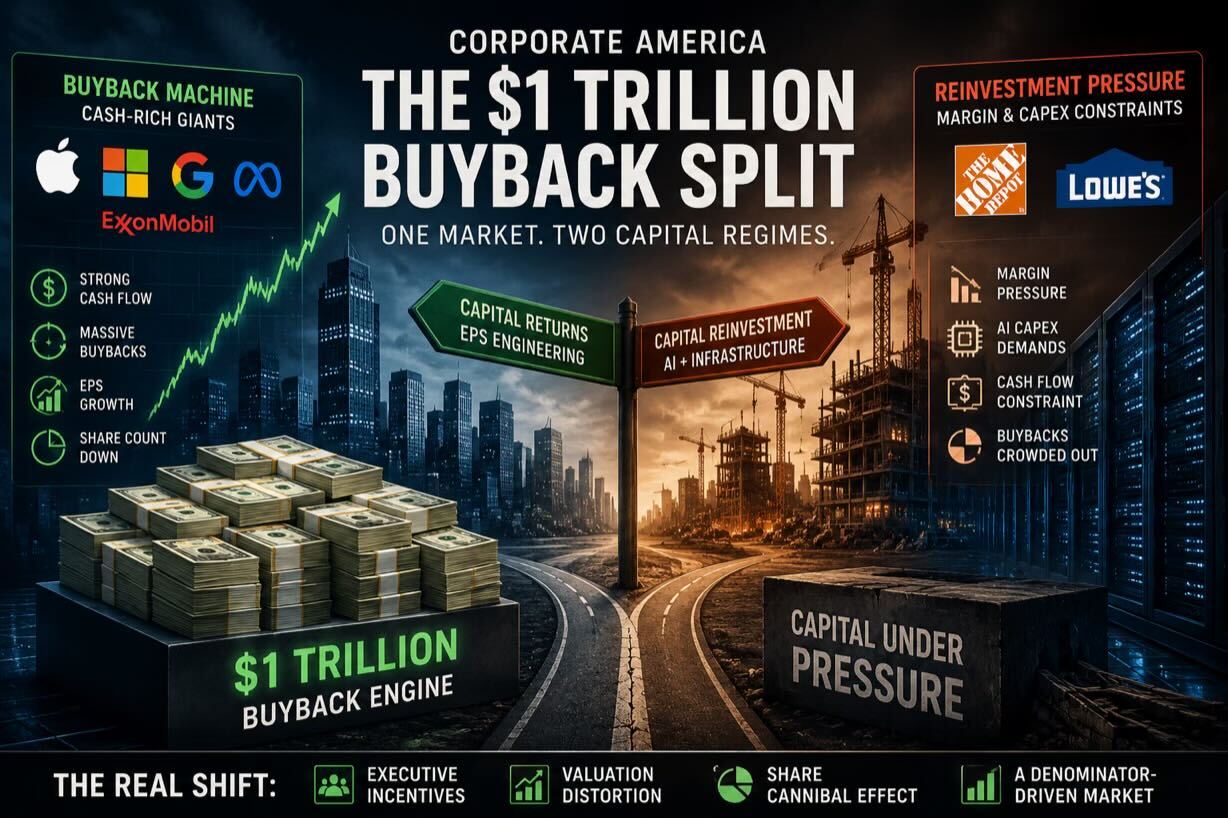
The Core Thesis: This is No Longer a Uniform Cycle
Corporate America is not entering a simple buyback supercycle. It is entering a bifurcated capital regime.
One part of the market is accelerating buybacks into a structurally elevated $1.2 trillion system, led by mega-cap cash machines with limited reinvestment needs. The other part is already hitting a ceiling, where margin pressure and rising capital intensity are forcing a slowdown in repurchases.
The divergence is the real story. The S&P 500 is no longer moving as one capital allocation block. It is split into two regimes: cash-rich compounding machines and reinvestment-constrained industrial and mid-cap operators.
The Math: $1 Trillion Buybacks are Now a Structural Feature
Buybacks are no longer cyclical noise. They are a structural output of Corporate America’s cash generation engine.
- S&P 500 buybacks are running at an annualized ~$1 trillion pace
- The top tier of companies is responsible for an estimated ~40–45% of total repurchases
- In Q4, the “Magnificent 7” alone accounted for an outsized share of index-level buyback activity, with Apple, Alphabet, Meta, Microsoft, and ExxonMobil leading flows
Apple alone authorized and executed over $100 billion in buybacks in recent cycles, reinforcing its role as the single largest structural buyer of U.S. equities.
This concentration matters more than the aggregate number. Buybacks are no longer broad-based corporate behavior. They are now a mega-cap balance sheet mechanism.
The EPS Illusion vs AI Crunch
The real transformation becomes visible when you compare company behavior rather than averages.
The EPS Engine: Apple and the Perpetual Buyback Model
Apple represents the purest version of the buyback machine. With limited capital intensity relative to its cash generation, Apple has consistently returned excess cash through aggressive repurchases.
Over time, this has created a structural EPS effect. Even in periods where revenue growth slows into the low single digits, earnings per share continue to expand due to sustained share count reduction. Apple is effectively a capital return compounding machine, not just a product company.
The Reinvestment Tradeoff: Microsoft and the AI Capex Pivot
Microsoft represents the opposite end of the spectrum. While still a major buyer of its own stock, its capital allocation profile is increasingly dominated by AI infrastructure spending.
Azure data center expansion, AI compute clusters, and long-duration infrastructure investments are absorbing incremental cash flows. The result is visible friction: higher capex intensity is directly competing with the buyback envelope.
In other words, Microsoft is shifting from a capital return identity toward a platform reinvestment identity, even if it temporarily compresses buyback capacity.
The Flat Growth, High EPS Construct: Home Depot and Lowe’s
Retail names such as Home Depot and Lowe’s illustrate a different distortion.
Over the past cycle, revenue growth has been relatively muted, yet EPS expansion has remained structurally positive. The primary driver is not demand strength, but aggressive share count reduction.
This is the clearest expression of what buybacks have become: a mechanism that can manufacture per-share growth in environments where top-line growth is structurally capped.
The Human Layer: Buybacks are Now an Executive Compensation Tool
The clean financial narrative hides a more uncomfortable incentive structure.
In most large U.S. corporations, executive compensation is directly tied to EPS growth, often through bonus thresholds and equity-linked performance metrics.
This creates a structural behavioral bias. When management is faced with excess cash, the decision is not neutral. Allocating capital toward buybacks can immediately improve EPS and therefore move compensation closer to trigger thresholds.
This does not mean buybacks are purely opportunistic. It means they are embedded in a system where capital allocation and personal incentives are tightly coupled through EPS mechanics.
In that sense, buybacks are not just a financial strategy. They are also an incentive optimization tool at the executive level.
The Market Impact: What Investors are Missing?
Valuation Distortion
The rise of buybacks has created a structural distortion in how markets read valuation.
Because EPS is mechanically inflated by share count reduction, the standard price-to-earnings multiple can understate the true expensiveness of the underlying business.
In effect, part of what appears as “earnings growth” is actually balance sheet contraction. This creates a subtle illusion of cheaper valuation multiples than what underlying revenue growth would justify.
The Share Cannibal Effect
A small group of companies has now crossed into what can be described as “share cannibal” territory.
Firms like Apple, Microsoft, and others have reduced their share count meaningfully over the past decade, in some cases by 30 percent or more over long horizons. This does not just improve EPS. It structurally alters liquidity dynamics.
Lower float increases sensitivity to flows, amplifies price reactions, and changes volatility behavior during market stress cycles. Buybacks are therefore not just an earnings mechanism, they are a market microstructure force.
The Real Regime Shift: A Split Corporate America
The buyback story is no longer about whether repurchases are rising. It is about who can still afford to keep doing them at scale.
On one side sits a group of cash-generating giants that can simultaneously fund AI-scale capex and maintain historically high buyback programs. On the other side is a broader corporate base where margin pressure and reinvestment needs are beginning to crowd out repurchases.
This is the true bifurcation:
- One regime is compounding through capital returns and EPS engineering
- The other is reinvesting under constraint, with declining flexibility for buybacks
The Investor Implication: This is a Denominator-Driven Market
For investors, the implication is structural rather than cyclical.
Equity returns in the U.S. are increasingly driven not just by earnings growth, but by share count dynamics. This makes index-level performance more sensitive to capital allocation decisions than at any point in modern market history.
It also means that traditional valuation frameworks, which assume earnings are purely operational, are increasingly incomplete.
The market is no longer just pricing growth. It is pricing capital structure efficiency at scale.
Conclusion
Corporate America is not entering a uniform buyback supercycle. It is already inside one, but it is structurally uneven.
Mega-cap firms are anchoring a $1 trillion buyback system while simultaneously funding the next industrial revolution in AI infrastructure. At the same time, the broader market is approaching a constraint phase where capital intensity limits further expansion of repurchases.
The defining tension of the next decade is not whether buybacks continue. It is whether the U.S. corporate system can sustain both capital return maximization and capital reinvestment acceleration at the same time.
Because ultimately, one of them will have to give.